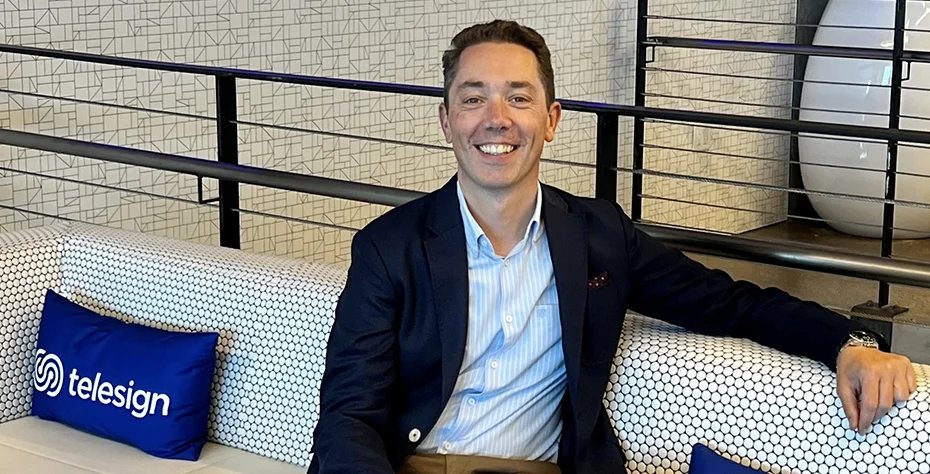
When Christophe Van de Weyer moved to Los Angeles to run Telesign, he found one improvement that required no management consultant: the sky. After years in Belgium, California’s blue was an agreeable change from grey. He mentioned it while recounting a career spent inside the machinery of telecommunications. For a moment, the machinery could wait. A new job had also brought better weather.
He was describing the move in January 2024. By August 2026, he had become chief executive of Vonage and head of Ericsson’s Global Communications Platform business. The Belgian executive had moved from advising telephone companies to operating businesses whose products help decide whether a digital interaction can be trusted. His career now sits at a familiar, awkward moment: the instant someone asks a customer to believe the voice, message or identity on the other end.
A long apprenticeship in other people’s businesses
Van de Weyer studied commercial engineering at KU Leuven and later completed the Stanford Executive Program. The combination suits a career spent moving between the economics of technology and the people expected to make it work. A network can be technically impressive and commercially disappointing. A sensible strategy can encounter an organization perfectly capable of resisting it.
Before taking an operating role, he spent almost two decades at Bain & Company, including nine years as a partner. Telecom and technology were his territory. It was an extended education in how established companies change, with all the competing interests that sentence politely conceals. Consulting offers a particular vantage point: close enough to inspect a problem, with a different relationship to the consequences than the executive who owns it.
The distinction matters in his story because he eventually crossed it. In July 2020 he joined Proximus, the Belgian telecommunications group. The adviser became an operator. Recommendations now had to survive contact with customers, commercial teams, delivery schedules and the rest of the working week.
- 2020Proximus
Enterprise COO - 2023Telesign
Chief executive - 2025Vonage
API business head - 2026Vonage CEO
Ericsson executive team
Seven businesses, three countries, one operating problem
At Proximus, Van de Weyer became chief operating officer of the Enterprise Business Unit. In 2021, he added responsibility for the group’s IT affiliates across Belgium, Luxembourg and the Netherlands. He later described managing seven ICT subsidiaries, working in cloud, security and smart networking. Those are related businesses, but related businesses do not automatically behave like a single company.
The task included increasing commercial traction and finding ways for the affiliates to work together. Proximus also recorded his involvement in its sovereign cloud strategy and partnerships with hyperscalers. Here was a different scale of coordination: a European telecom group working with the much larger technology companies that supply the infrastructure on which other businesses increasingly depend.
It is tempting to read every later appointment backward, as though the destination had always been booked. The more useful observation is how the operating problem developed. Each job brought another boundary to cross: between advice and execution, between subsidiaries, between a telecom operator and its technology partners. The work increasingly concerned making separate capabilities useful together.
The phone number becomes a question of trust
On September 15, 2023, he became CEO of Telesign, succeeding Joe Burton. The Los Angeles business, owned by Proximus, worked in customer identity and engagement. His brief included leading digital identity activities across the group. It brought him closer to the everyday consequences of communications technology: an account opened, a customer authenticated, a message accepted as legitimate.
In a February 2024 essay, Van de Weyer described how generative AI was making fraud more convincing. Bad grammar had once been a useful warning in a suspicious message. Software could now remove that warning at scale. A polished sentence was becoming a very poor character reference.
His argument was practical. Businesses should use machine learning to examine behavior and assess risk, adapting authentication to the circumstances. A device or number behaving unexpectedly can warrant more scrutiny. A routine interaction should not have to negotiate an obstacle course merely because an organization has installed one.
That tension gives his work a human dimension. Customers want access to be easy and accounts to remain protected. They tend to notice the first failure immediately and the second rather painfully. The commercial challenge is to make protection work without making ordinary customers feel permanently under suspicion.
He also discussed artificially inflated SMS traffic in an April 2024 interview. Even the apparently mundane act of sending a verification message can become a revenue opportunity for someone manipulating the system. The communications business has an unusually tiresome feature: success attracts people hoping to misuse the product.
“What brings a team together is a common vision.”Christophe Van de Weyer
What the boss rewards
His account of leadership is less interested in the commanding entrance than in what happens after it. At Telesign, he emphasized collaboration, daily coaching and learning on the job. People who help other teams should see that behavior reflected in promotions and incentives. Otherwise the company is teaching one lesson in its speeches and another in its decisions.
He has also spoken candidly about a regret: waiting too long to act when strong individual performers damaged a collaborative culture. It is an inconvenient admission for anyone hoping that hiring talented people will settle the matter. Talent still has to live in the same room as everyone else.
For Van de Weyer, managers should teach people how to improve, and senior leaders should remain open to coaching themselves. That gives apprenticeship a continuing role, even after the apprentice acquires a much larger office. Authority may change the seating plan; it need not end the education.

There is a pleasingly specific example in his account of taking his son to a Lakers game against the Spurs. Van de Weyer watched Greg Popovich coaching Victor Wembanyama and saw an investment in a young player’s future. Most spectators have paid to watch the basketball. A chief executive can apparently find a management seminar included in the ticket.
His Belgian upbringing also enters his thinking about working with differences. He has described the value of navigating ambiguity and building agreement across perspectives. In an international organization, agreement is work. Declaring it desirable is the easy portion.
Vonage, and a larger set of connections
On April 29, 2025, Vonage appointed him president and head of its API business unit. He initially reported to Niklas Heuveldop. His remit centered on profitable growth and bringing network capabilities together with communications tools for developers and enterprise customers.
The initials deserve a moment of translation. An application programming interface lets one piece of software request a function from another. A developer can incorporate a communications capability into a product instead of building every component. Network APIs extend that idea to capabilities available through telecom networks. Much of the ambition is to make complicated infrastructure accessible through something a software team can actually use.
Conceptual illustration of the network API model. Not a performance comparison.
Ericsson had completed its acquisition of Vonage in July 2022. The rationale included connecting its network expertise with Vonage’s developer community and communications products. Van de Weyer arrived inside an existing strategic commitment, with an assignment to make the pieces produce commercial results.
His earlier experience gives that appointment a recognizable logic. Proximus had put him among telecom operations, cloud businesses and technology partnerships. Telesign had put identity and customer trust at the center of his brief. Vonage brought those subjects into a broader platform business.
A promotion with unfinished business attached
Ericsson announced his promotion on July 21, 2026, with the change taking effect on August 15. Alongside the Vonage CEO role came leadership of the Global Communications Platform business area and membership of Ericsson’s executive team. Heuveldop would remain available through the end of the year to support the transition.
At the announcement, then Ericsson CEO Börje Ekholm credited Van de Weyer with helping return the API business unit to growth. That is a specific endorsement of his work. It also leaves a larger task ahead. Running the API operation and taking responsibility for the whole business are different assignments.
Vonage’s history under Ericsson makes the distinction consequential. In July 2024, before Van de Weyer joined, Ericsson announced a non-cash impairment charge of SEK 11.4 billion, mainly associated with Vonage. Lower anticipated market growth had forced a reassessment. An acquisition strategy can make sense on paper and still require difficult revisions when the market refuses to follow the forecast.
The new chief executive therefore inherits both a technology proposition and expectations that have already been tested. His stated ambition is to combine AI, data and APIs to improve enterprise workflows and customer engagement. The useful questions are concrete: what can a customer do more easily, what can a developer build, and what will a business pay for?
In March 2026, his MWC Barcelona speaker listing placed him in a session about scams and the erosion of trust. The subject followed him from Telesign into Vonage. Faster connections and more capable software still depend on someone being willing to engage.
California supplied the blue sky. The rest is an operating job: helping people build services that other people can use with confidence. For an executive who has spent years connecting organizations, technology and teams, the next chapter will be measured in how well those connections hold.
Continue the conversation
Explore Vonage, Van de Weyer on LinkedIn and his Ericsson executive biography.
Watch his Futurum conversation on digital identity, trust and AI. Read his leadership interview, essay on AI and fraud and the 2026 appointment announcement.