Alan Masarek came out of retirement in 2022 to run a company whose customers had little use for dramatic interruptions. Avaya supplied the communications systems that let large organizations answer calls, connect colleagues and keep conversations moving. Seven months after his appointment was announced, the company was in Chapter 11. A chief executive selling continuity now had to deliver it through bankruptcy.
There is an awkward comedy in the assignment. Technology companies celebrate the new, preferably at a conference with a large screen. Their customers often want something more modest: for the thing they bought to work on Monday. Masarek’s Avaya strategy took that preference seriously. He wanted customers to adopt newer capabilities while keeping useful parts of their existing systems.
He had spent years working around versions of that problem. At Quickoffice, it was the document that needed to survive the journey from a desktop computer to a phone. At Vonage, it was a communications company finding a different future in business software. At Avaya, the practical question came with a formidable balance sheet attached.
A spreadsheet small enough for a pocket
Masarek earned his undergraduate business degree at the University of Georgia and an MBA at Harvard Business School, collecting academic distinctions at both. Before the familiar communications jobs, he co-founded AdOutlet, a marketplace for the media industry, where he served as chief executive and chairman from 1999 to 2001. His route to mobile software ran through business building as well as technology.
He became Quickoffice’s CEO in 2007. The company addressed a problem that anyone who has opened a mangled attachment can appreciate. Microsoft Office documents traveled widely; the devices receiving them did not all run Microsoft software. Quickoffice let people work with those files on mobile devices. Compatibility was a product people would pay for.
In September 2009, Microsoft and Nokia’s partnership presented an obvious threat. Nokia was an important source of Quickoffice revenue. If official Office applications arrived on its handsets, what would happen to the independent supplier? At Nokia World in Stuttgart, Masarek acknowledged that the announcement had initially troubled him.
“Three weeks ago, I was worried.”
“I’m not worried now.”
Alan Masarek, Nokia World, 2009
His explanation involved the delivery schedule. A full suite would take years, he argued, and schedules could slip. It was a useful glimpse of an executive looking past the imposing names on an announcement to the work still required. Competition had a calendar. Quickoffice still had time to serve customers.
Google acquired Quickoffice in June 2012. Its announcement singled out the company’s ability to work with popular file formats and said the technology would be brought into Google Apps. The appeal was concrete: help people use their documents across devices and software environments. Masarek joined Google as director of Chrome & Apps, remaining until October 2014.
Registered Quickoffice users at the time of Google’s purchase in 2012. Registered users are a different measure from devices with the software installed.
That distinction matters in a career full of large numbers. Quickoffice’s audience represented individual people trying to get work done away from a desk. The business depended on making a complicated technical translation feel ordinary. A successful result might be a spreadsheet that looked exactly as its sender intended. Few people applaud a correctly aligned column. They notice the alternative.
The phone company changes the conversation
Vonage appointed Masarek chief executive effective November 6, 2014. He arrived from Google at a business with an established identity in residential internet calling. Its next phase would require customers and investors to think about it differently. A company associated with the home phone began putting more of its effort into business communications.
The shift involved eight acquisitions during his tenure. These were additions to the company’s capabilities as well as its size. Business communications could mean software for employees to call and collaborate. It could also mean tools that developers placed inside another company’s application, making messaging or a voice connection part of an existing task.
Nexmo, acquired in 2016, made that second possibility tangible. Its application programming interfaces let businesses incorporate communications into apps, websites and workflows. Vonage brought a voice network; Nexmo brought programmable communications. The combination created a way to sell the machinery of a conversation to a business building its own customer experience.
By September that year, Vonage had launched a next-generation Nexmo voice API with capabilities including conferencing, recording and call control. The detail is useful because an acquisition is easy to describe as strategic. A working product gives the adjective something to stand on. The purchased capabilities had to connect with the existing network.
Vonage reported consolidated revenue of $956 million for 2016, up seven percent, and seventy-two percent growth in Vonage Business revenue. Those figures belonged to a company deliberately redirecting investment toward a different market. By the end of Masarek’s tenure in June 2020, the former residential specialist had become an enterprise cloud communications business.
Seventy-five percent, and the rest of the job
Avaya appointed him CEO effective August 1, 2022. He returned from retirement to a company with an extensive customer base, a partner ecosystem and communications technology embedded in large organizations. Those were reasons to take the job. They also made the consequences of getting it wrong considerably less abstract.
The financial restructuring reached court confirmation in March 2023. The plan cut total debt by more than seventy-five percent. On May 1, Avaya emerged from Chapter 11 as a private company with approximately $650 million in liquidity. Lenders and institutional investors were central to the new ownership and capital structure.
A reduction of roughly 75%. September figures are a dated snapshot, not a current balance sheet.
There was a cost to that reset. Existing equity was cancelled under the restructuring plan. Shareholders raised objections, including concerns about executive compensation. Masarek received a $6 million retention payment in December 2022 in place of the long-term equity awards historically granted at the start of the fiscal year. Court documents described repayment conditions attached to it. The financial rescue looked different depending on where a person stood.
Masarek distinguished the financial restructuring from the business restructuring. It was an essential distinction. A smaller debt burden could provide room to invest; it could not decide which products customers wanted or persuade them to remain. There was still an operating company to run after the lawyers and financial advisers completed their work.
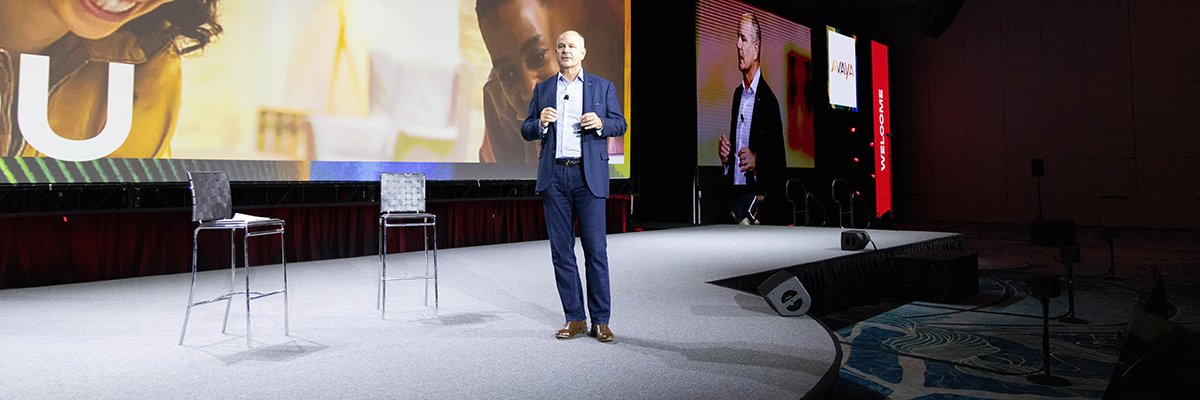
His proposition to customers was captured in the phrase “innovation without disruption.” Large organizations could retain on-premises systems while adding cloud capabilities at a pace that suited them. The offer recognized that an existing communications installation was an operating dependency. Replacing it involved more than agreeing that newer technology sounded attractive.
“Our customers are at different stages of their cloud journey.”
Alan Masarek, May 2023
Avaya Enterprise Cloud offered a dedicated instance of its contact center, collaboration and unified communications software. The approach gave hybrid deployments a deliberate place in the strategy. In public conversations after emergence, Masarek kept returning to customer experience and the value of adding functionality without forcing a wholesale replacement of working infrastructure.
There is a family resemblance to Quickoffice here. A new environment creates demand, but the customer's existing work still matters. One business helped documents cross between software worlds. The other sought to help organizations cross between infrastructure models. The resemblance is a way of reading his career, rather than a claim that a mobile app and an enterprise restructuring require the same skills.
A different kind of continuity
In July 2024, Avaya announced another transition. Board chair Patrick Dennis would become CEO on September 1, and Masarek would retire at year-end. Dennis had worked with him on the strategy after the recapitalization. Masarek’s public year-end farewell marked his final day at Avaya. The return from retirement had acquired an ending.
His subsequent public presence includes board work and reflection on the earlier chapters. SalesIntel lists him among its directors. The University of New Haven’s 2025-2026 Board of Governors roster identifies him as Avaya’s former president and CEO. The titles have changed; the corporate biography needs its dates kept in order.
At New Haven, his involvement also reaches beyond governance. He established and funds an emergency scholarship for students needing tuition assistance, mentors students and speaks with the business college. He and his wife Patti, who live in Milford, Connecticut, also co-chaired the EmpowerHouse project in Bridgeport. These commitments give his working life a local dimension alongside its global businesses.
Reflecting publicly on an eCoffee with Experts interview, Masarek encouraged younger entrepreneurs to build experience across product, finance and dealmaking. He described the importance of human interaction even in a business world shaped by technology and data. It is practical advice from someone whose jobs have repeatedly required several kinds of expertise in the same room.
The lasting interest of his career lies in those negotiations between ambition and dependence. A buyer wants new technology. A customer wants the old file to open. A board wants a new direction. Someone still needs to answer the phone. Masarek’s assignments have put him where those demands meet, with rather less opportunity to unplug than retirement originally promised.