The customers were coming. That was the awkward part. In a CallCorp case study, an unnamed communications service provider had added a leading call-center product to defend a business squeezed by competition and thinning margins. Early sales looked encouraging. Then the reseller relationship became burdensome. The provider had found demand. The arrangement for serving it had become the problem.
- CallCorp supplies the technology; qualified partners can supply the brand.
- Referral pays a stated 30% technology revenue share. Qualified white-label offers 35%-70%, tied to volume and responsibility.
- The practical decision is how much implementation, hosting and support your team can own.
CallCorp’s account describes a switch to its templates, modules and revenue-sharing model. The provider built packages for smaller financial-services businesses, set its own pricing and reassigned some onboarding staff to other service work. Those are vendor-reported results from an anonymous customer. Still, the sequence is revealing: selling the software was only the beginning of making the business work.
01 Whose name is on the promise?
CALL, operating here as CallCorp, makes cloud contact-center software. It helps organizations route conversations, equip agents and review customer interactions. Its chosen place in the market is behind service providers: resellers, carriers, managed service providers, outsourcing businesses and customer-experience consultancies that already have relationships worth protecting.
White-label software can sound like an exercise in changing the badge. CallCorp treats it as a question about running a business. A qualified partner controls its market-facing brand, pricing, packaging and customer relationship. Deployment, implementation and escalation are worked out together. The platform underneath supplies routing, customer environments, reporting, quality tools and APIs.
Picture a service provider that already manages a customer’s technology. Adding a contact center creates another reason for that customer to stay. Selling it under the provider’s own name can make the relationship more coherent. But the same name also sits on the promise when an integration misbehaves. Ownership has a service desk attached.
“We make powerful contact center technology accessible and adaptable”
CallCorp’s stated mission
02 Two percentages. Two different jobs.
CallCorp offers a lighter route through Refer CCPro. The partner identifies a qualified opportunity, makes the introduction and supplies account context. CallCorp handles the CCPro product conversation, delivery and ongoing service. The published reward is a flat 30% technology revenue share on qualified business, with payment and attribution governed by the agreement.
Qualified white-label moves the partner further into operating the offer. Its published revenue-share range is 35% to 70%, depending on licensed-agent volume and responsibilities such as hosting and support. The upper number deserves a pencil beside it. Revenue share becomes useful business income only after the costs of doing the agreed work.
More operating responsibility →
Agreement-specific revenue share. These figures are not profit margins.
Pricing is scoped to the model, agent volume, deployment and customer requirements. For a prospective partner, the useful calculation starts with staffing and infrastructure: who configures the queues, who maintains the connection to customer records, and who handles an urgent incident? Comparing percentages without those answers would be an expensive shortcut.
03 The machinery behind the badge
For an agent, the work is more immediate. A customer calls, sends a text or starts a chat. The software needs to route that interaction and preserve enough context for someone to help. CallCorp’s product materials describe voice, email, chat, SMS, WhatsApp and Microsoft Teams among its supported channels. Quality workflows and historical reporting let managers examine what happened afterward.
A few controls.
A whole service behind it.Official CallCorp mobile interface
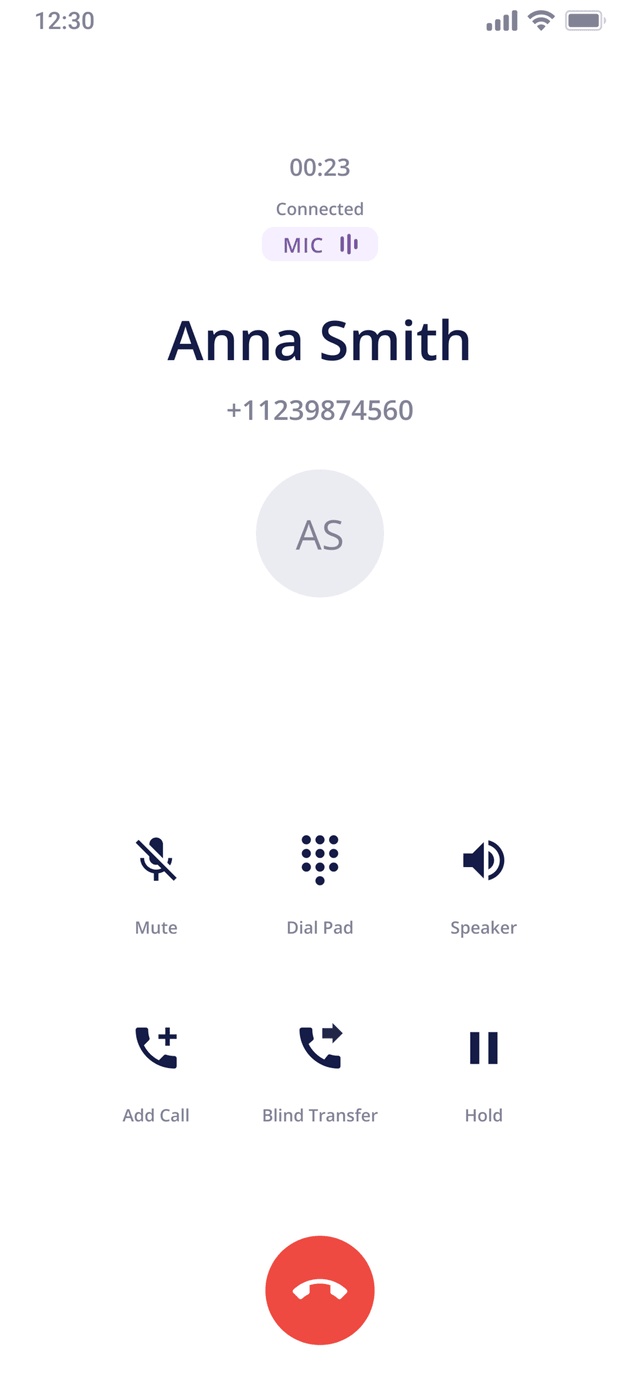
The architecture matters especially to the partner managing several customers. Separate environments can have different configurations, modules and integrations. CallCorp also describes partner reporting for usage and invoice support. That is the less photogenic half of the product: the ability to understand what each account is consuming without rebuilding the operation for every account.
There is flexibility below the application, too. Qualified deployments can use CallCorp hosting or customer-owned AWS or Azure environments. Database, storage, carrier and AI-provider choices sit within approved architecture requirements. For buyers with particular data or infrastructure needs, those choices create room to negotiate a workable design. They also create decisions somebody must document.
04 Experience, with a different seat at the table
The founders’ background helps explain the emphasis. CallCorp identifies co-founders Drew Judkins, its CTO, and Kevin Childs, its CEO, as contact-center veterans. Its team includes people from the inContact lineage, later acquired by NICE. The Cloud Communications Alliance also names David Peterson and Shane Kelly among the founders.
That history places CallCorp in a crowded software category. NICE CXone, Genesys, Talkdesk and Amazon Connect are alternatives buyers may consider. CallCorp’s useful comparison point is the scope of partner control: brand, commercial relationship, deployment and ongoing work. A feature checklist alone will miss much of what it is asking a service provider to buy.
Its recent public activity follows that argument. A CCA webinar pairs Judkins with IP Integration’s Steve Murray to discuss partner economics and data sovereignty. An October 2026 announcement names CallCorp and Zoom as sponsors of an upcoming Singapore industry dinner. The audience is the network of businesses that can carry the technology to customers.
05 Start with one conversation
The transferable idea is straightforward: before packaging software, map one customer interaction from arrival to follow-up. Identify the routing, agent context, reporting and escalation it needs. Assign an owner to each handoff. Then test the workflow and calculate what delivering it costs.
A provider with trusted accounts but little delivery capacity has a reason to consider referral. A provider equipped to implement and support a branded service has a reason to investigate white-label. The dividing line is capacity to keep the promise. CallCorp’s interesting proposition is that the software company can step into the background while somebody else builds the relationship in front.