Christina Kosmowski got better at soccer and discovered that getting better was insufficient. Northwestern’s new women’s team had endured a first season of three wins, thirteen losses and a draw. She went away and worked on her game. When she returned, her own improvement had outpaced the group’s. All that effort had produced a better player inside a team that still had work to do.
Years later, she would describe the error with unusual economy: “I did not bring my team with me.” It is an awkward discovery for an ambitious person. Practising harder sounds like the responsible answer to almost any problem. The catch arrives when the result depends on ten other people, each with a separate summer and a separate idea of what needs fixing.
The team reached the NCAA tournament in her junior year. She became a captain. The lesson survived the uniform: an individual can prepare thoroughly and still leave the larger enterprise behind. Her subsequent career would give her plenty of opportunities to test that proposition, with considerably more expensive equipment than a soccer ball.
An engineer follows the customer
Kosmowski came to Northwestern from Kansas City, attracted by a combination that was unusually well suited to her interests: demanding academics and the chance to play Division I soccer. The university was starting its women’s team. She could join something while it was still being built. Initially a chemistry major, she switched to industrial engineering and graduated in 1998.
Her early work was at Tenneco Packaging, now Pactiv, improving the manufacture and distribution of familiar household products, including Ziploc and Hefty bags. The beginning has a pleasing lack of Silicon Valley glamour. Before the enterprise platforms and international conferences came the practical business of getting everyday objects made and moved efficiently.
Technology drew her toward a different setting for the same broad interest in how work gets done. In 2002, she joined Salesforce as a consultant. She stayed fifteen years. Her responsibilities grew to include consulting, support, renewals and customer success, eventually reaching senior vice president of revenue lifecycle management and customer success.
Customer success is an unromantic name for a revealing vantage point. A product has been bought. Now someone has to help make it useful. The customer must introduce it into existing work, persuade colleagues to use it and decide whether the result justifies continuing to pay. A polished demonstration can skip those complications. The people working after the sale encounter them.
At Salesforce, Kosmowski helped establish that practice while subscription software was becoming a familiar way for businesses to buy technology. Her work crossed the boundary between the technical product and the commercial relationship. Moody’s later described her Salesforce responsibilities as leadership of a $4 billion revenue organization. The figure helps explain the scale of responsibility behind a title that might otherwise sound chiefly diplomatic.
She moved to Slack in 2017, building and leading customer success and enterprise go-to-market teams. Slack put her near another change in workplace habits: colleagues moving conversations and collaboration into a shared software environment. Once again, buying access was only the opening move. A company also had to figure out how people would work together inside it.
“My career has always been about bridging technology and business outcomes”
Christina Kosmowski, November 2024
Her four years at Slack preceded the next broadening of her job. In January 2021, LogicMonitor appointed her president, giving her responsibility across go-to-market strategy, research and development, and customer success. The customer specialist now had a brief that reached across the business. A year later, she became CEO.
- 1998Northwestern
Industrial engineering - 2002Salesforce
Consultant to SVP - 2017Slack
Customer success - 2021LogicMonitor
President - 2022LogicMonitor
Chief executive - 2026Moody’s Analytics
Chief executive
When she spoke with Northwestern engineering management students in 2023, she urged them to think about the company and industry they wanted to join rather than fixating on a particular role. Roles evolve. Her own passage from customer success into company leadership gave that advice some substance. The person closest to a customer’s difficulties can accumulate a broad understanding of a business, provided the organization makes room for that knowledge to travel.
A wider field at LogicMonitor
LogicMonitor brought her into the machinery beneath the digital workplace. Its software helps organizations observe complex IT infrastructure, including systems running in their own facilities and in the cloud. The everyday promise is straightforward enough: help people understand what is happening before a technical problem consumes the working day.
When the company announced her appointment as CEO in January 2022, it reported more than $150 million in annual recurring revenue and growth above 50 percent for 2021. Those numbers describe the business she was taking over, rather than an achievement to assign retrospectively to her tenure as chief executive. Kevin McGibben, the outgoing CEO, became executive chairman in the planned succession.
By November 2024, the scale of the financing had changed. LogicMonitor announced $800 million in new equity and strategic financing, involving investors including PSG and Golub Capital. Vista Equity Partners remained the controlling shareholder. The transaction valued the company at approximately $2.4 billion, including debt.
New equity and strategic financing.
Transaction valuation: approximately $2.4 billion, including debt.
In her own account of the investment, Kosmowski connected the next phase to a familiar concern: customers needed systems they could trust. Generative AI would depend on the infrastructure beneath it. She set out plans for platform expansion, acquisitions and entry into additional markets. The ambition had a practical foundation. More intelligence at the surface makes the reliability of the underlying systems more consequential.
That is a useful way to understand the continuity in her career without pretending the jobs were interchangeable. Slack’s workplace conversations, Salesforce’s customer relationships and LogicMonitor’s infrastructure involve different products and different technical demands. In each setting, she worked on the passage from a software capability to something an organization could depend upon.
A board that includes her daughters
For advice, Kosmowski has described a personal board of directors with a membership more varied than the phrase might suggest. Her father and daughters belong alongside former bosses, peers and people who have reported to her. The arrangement makes room for people whose authority comes from knowing her, rather than occupying a higher rung in an organization.
One influential mentor is Maria Martinez, whom she credits with developing her management skills at Salesforce, particularly the use of data in decisions and the translation of products into business value. The two ideas belong together. Listening gives a leader information; examining it carefully helps distinguish a persuasive account from a useful basis for action.
She has continued her formal education too, completing an Executive Education program at Stanford Law School. In discussing it, she connected the decision to the need to keep learning as technology changes. For an executive whose experience stretches across several generations of enterprise software, returning to a classroom offers another way to encounter unfamiliar questions. Experience supplies a useful starting point; she has made a habit of seeking additional perspectives alongside it.
Her account of leadership also leaves room for pressure. She has described herself as someone who pushes people toward their potential and expects accountability in more than one direction. In a 2022 interview, she explained that LogicMonitor had a Slack channel through which employees could follow her day-to-day activity and get in touch. Approachability had a specific mechanism.
“I think accountability is very important”
Christina Kosmowski, December 2022
She has argued for making technology careers more accessible through intentional hiring, flexibility and mentorship. In her telling, the work extends into job descriptions, hiring practices and the conditions under which people can contribute. Her interest is in building teams where women can belong and progress, with the ordinary processes of employment doing some of the work.
There are also occasions when she chooses a less orderly environment. Kosmowski has said she has swum from Alcatraz Island to San Francisco several times. A few kilometres of open water is a distinctive addition to an executive biography. She describes the experience as both frightening and exhilarating. The swimmer and the engineer appear comfortable sharing a life.
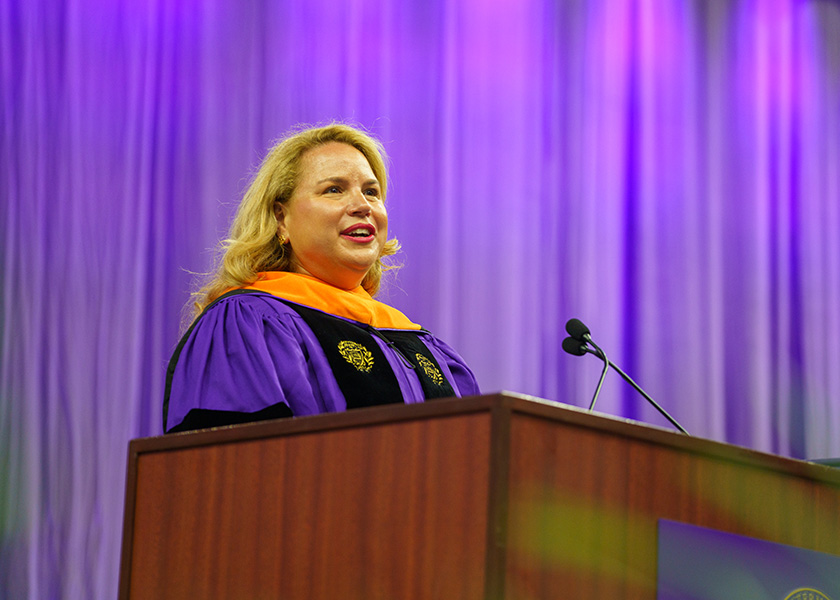
In June 2023, she returned to Northwestern to address graduating engineers. Her theme was saying yes: to opportunities, to unfamiliar responsibilities and to the people who might help along the way. The soccer story was part of the address. So was her experience helping build customer success at Salesforce. The invitation to take a chance came with an accompanying obligation to collaborate.
The next decision at Moody’s
Moody’s announced her appointment in April 2026, with the move to CEO of Moody’s Analytics taking effect in June. At the announcement, it described Analytics as a $3.6 billion division serving financial institutions and enterprises. Her current remit brings together data, risk intelligence and AI. The setting changes again, from observing technical infrastructure to helping customers make decisions in complex operating environments.
Her stated focus is helping those customers act on intelligence with confidence and precision, while building on Moody’s reputation for rigor and trust. That gives the new role a recognizable connection to the older ones. Information must reach the people who need it, in a form they can use. The achievement will depend on what customers can do with it.
It is tempting to give a long career the tidy appearance of a plan. Kosmowski’s route is more interesting with its turns intact: household packaging, cloud software, workplace collaboration, IT monitoring, financial intelligence. What persists is her attention to the people expected to make technology productive. The young player who improved alone learned to ask a larger question: how does everyone else come along?