A hello is cheap. Keeping track of everything that follows can become an expensive occupation. A customer asks a question in Slack; someone answers; someone else needs to act. Multiply that exchange across hundreds of channels and the friendly little message acquires a supporting cast. There are handoffs, promises, deadlines and, somewhere, a person wondering whether anybody remembered to reply.
Ankit Saxena built a company around that awkward interval between conversation and responsibility. As co-founder and CEO of Thena, he works on software that helps businesses manage customer requests in the messaging tools their customers already use. The premise sounds modest. Its complications were familiar to him long before he had a startup name to attach to them.
At Branch, where he led enterprise post-sales teams, customer communication spread across Slack, Microsoft Teams and email. Managing it involved manual work that became harder as the operation grew. Thena emerged from that experience. Saxena had spent years helping technology businesses grow; now he was building for the people left to make that growth function every day.
Before the customer channels, the internship portal
His route to the problem ran through software engineering. Saxena attended Visvesvaraya Technological University from 2004 to 2008, with an entrepreneurship cell among his listed activities. Years before Thena, his name appeared in the management team of LetsIntern, an Indian platform connecting students, colleges and employers. An early recruitment notice listed him as its technology lead.
He went on to serve as CTO. LetsIntern was working on an immediate, practical mismatch: students wanted opportunities and employers wanted young talent, but connecting them required a platform. That put Saxena on the building side of a business whose usefulness depended on other people being able to find each other.
The company was acquired by Aspiring Minds in 2015. His connection to its founders lasted longer than the job. Rish Gupta, a LetsIntern co-founder, later recalled Saxena joining the company as CTO in 2012. He also described introducing Saxena to Mike Molinet as LetsIntern was sold. That introduction would connect two chapters of Saxena’s career.
When Gupta celebrated Thena’s seed round, Saxena replied: “All the dots connect!” It is an unusually tidy description of a career assembled through working relationships. The introduction led to years at Branch; years at Branch eventually supplied both collaborators and the operational problem behind Thena. A professional acquaintance had turned into quite a productive piece of infrastructure.
Learning to speak both engineering and business
At Branch, Saxena’s job crossed the boundary between explaining software and helping customers use it. In April 2017, he was the technical evangelist leading the company’s work in India. A webinar paired him with MakeMyTrip product manager Ramit Goyal to discuss mobile experiences, personalization, app growth and retaining users.
Two months later, a Bengaluru developer meetup listed him alongside speakers from Ola, Urban Ladder, HeadSpin and Ampiri. His session occupied the same programme as product, engineering and sales discussions. Technical evangelism required him to make software intelligible outside the team that wrote it. A product can be clever in private; customers require it to be useful in public.
His responsibilities expanded. He became general manager of Branch’s APAC business, helping grow it from zero to more than $20 million, as described in his professional biography. He also led global post-sales teams, with work spanning Asia Pacific, Europe, the Middle East, Africa and North America. Engineering knowledge was now accompanied by the work of managing teams and commercial relationships.
Ramsey Pryor, who worked closely with him at Branch for nearly five years, described Saxena building a developer community in India before overseeing technical and business teams in the region. Pryor’s recollection ends with “patience, poise, grace, and a smile.” It offers a colleague’s view of the person behind the expanding job titles.
By May 2020, Saxena was discussing his entrepreneurial journey on The V Show with Vaibhav Raj. The episode covered college startup ideas, failed ventures, jobs and company building. His public career already contained more than one kind of work. The next company would draw on that mixture: someone had to understand the engineering, the customer and the business waiting behind the message.
“Patience, poise, grace, and a smile.”
Ramsey Pryor, on working with Saxena at Branch
The office moved into the conversation
Thena was founded in April 2022. Saxena began building with Govind Kavaturi, another Branch colleague; Molinet, Branch’s co-founder, later joined the venture. Unmukt Raizada was also part of the founding team described at the seed announcement. The group brought experience across customer operations, company building and data architecture.
For Saxena, the product started close to work he had already done. Businesses were carrying customer relationships into shared messaging channels. Those channels made it easier to speak directly, but did not automatically provide the tracking and coordination a growing customer operation needed. The conversation had moved. Much of the administrative furniture was still in the old office.
At the August 2022 launch, Thena announced $2.16 million from Pear VC and Tenacity VC. Its early proposition connected Slack conversations to internal tools and offered information about customer behaviour. The aim was to make ongoing relationships easier to understand and manage as conversations accumulated.
By May 2023, Saxena was describing enterprise clients with 200 to 400 Slack channels for customers. At that size, remembering who asked for what becomes a job in itself. A request can be perfectly visible to the people in one channel and effectively invisible to everybody responsible for the wider account.
Thena’s approach was to detect, track and measure requests, provide insight into interactions, and connect conversations with tools such as Zendesk, HubSpot and Salesforce. The engineering problem and the management problem met in the same place. Teams needed the ease of a conversation along with enough structure to carry its obligations through to completion.
The bugs get a paragraph, too
Saxena’s account of Thena’s first year contains an appealing interruption to the usual startup progress report. He acknowledged embarrassing bugs and described a rhythm of “shipping - and unshipping - every single day.” A release could be progress. Taking it back could be progress, too, though presumably a less festive variety.
The initial product reached production with a pilot customer in under three months. It had limited functionality. Toward the end of 2022, the team was working on outreach, proof-of-concept projects, content and search, and had a few paying customers. By Q1 2023, 50 customers were using Thena. These were early milestones in a business still being assembled.
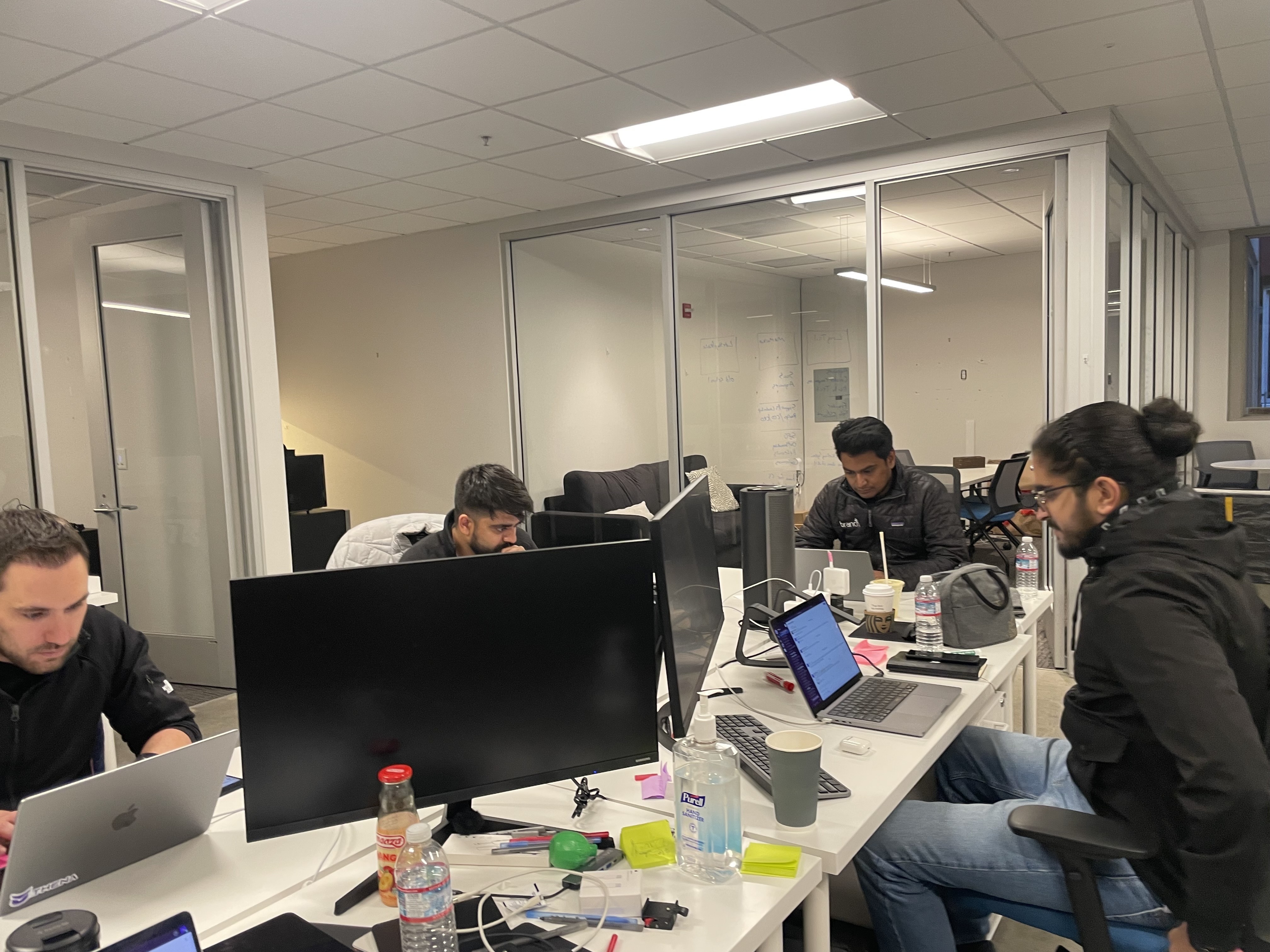
The team photograph from Palo Alto in 2023 gives that period a suitably practical setting: monitors, laptops, cables and takeaway cups crowd a shared table. There is little ceremony in the scene. A customer communication company still had the familiar physical requirements of getting people together and giving them somewhere to plug things in.
In May 2023, Thena announced a $5 million seed round co-led by Lightspeed and First Round Capital. Including the earlier financing, the company reported approximately $7.2 million raised. The planned uses included product development and hiring. Among its customers at the time were Branch, Embrace, Mixpanel, WorkRamp and Spotdraft.
Lightspeed’s account of the investment placed Saxena at the meeting point of product, engineering and global team management. It described him and Kavaturi splitting time between India and San Francisco while the team grew. That geographical spread echoed his Branch experience: building software and supporting customers required people to coordinate across more than one office or market.
Q1 2023
May 2023
An AI founder makes room for an off switch
Saxena’s ambition for Thena extends beyond organising requests. He has described using AI to draw useful information from communication across channels, helping companies make decisions about customers. In his telling, the move toward messaging and advances in generative AI belong to the same product opportunity.
His writing about data governance adds a revealing qualification. In an article dated January 14, 2025, he set out principles for transparency, customer control and limiting data collection. He described customers being able to turn off the AI models that trigger workflows while retaining the underlying request and collaboration functions.
That is a concrete product choice. It gives customers a way to use the workflow without accepting every layer of automation. He also argued that additional data requests should face scrutiny and described export and deletion controls, distinguishing existing manual processes from tools the team planned to put directly into customers’ hands.
The principle is relevant to the job he has chosen. A business may welcome faster answers while still wanting authority over what its software can access. Saxena’s stated approach makes that authority part of the experience. Convenience has to earn its permissions, even when it arrives carrying an impressive demonstration.
“Give controls in the hand of our customers. Ask Twice!”
Ankit Saxena, writing on data governance
Still close enough to discuss the frontend
The technical work remains visible in his public role. The May 24, 2025 agenda of the Next.js India Developer Association listed Saxena for a session called “Next.js at Thena: Framework for Scalable Frontends.” The advertised subject was architecture and the decisions behind scaling applications. It was a technical topic for a company CEO to take to a developer audience.
It also fits the career that preceded the title. LetsIntern put him in charge of building. Branch required him to explain, sell, support and lead. Thena brings those responsibilities into one business, where his stated focus remains product and engineering. The customer conversation supplies the problem; technical decisions determine how convincingly the software can answer it.
There is an ordinary human appeal to this particular ambition. People would like to ask a question in a place they already know. The people answering would like a reliable way to remember, organise and finish the work. Saxena has spent enough of his career on the business side of software to recognise the distance between those wishes. Thena is his attempt to shorten it, one customer conversation at a time.