Christian Frahm tried having nothing urgent to build. He did not take to it. After selling the remaining stake in his trading-technology business in 2019, he considered the familiar possibilities: retirement, a boat, a little distance from the daily demands of a company. Within two weeks, he recalled, he was bored. The boat had encountered a fairly fundamental customer-satisfaction problem.
He travelled with his children for three months. Then came a different sort of trip, visiting people at banks who had helped his earlier business grow. These conversations became part of the preparation for United Fintech, the company he founded in 2020. He had spent years persuading financial institutions to trust a small supplier. Now he wanted to make that encounter easier for other founders.
The interesting thing about Frahm is where he places himself in the fintech argument. Banks are his prospective customers, collaborators and, increasingly, shareholders. He wants them to survive and modernise. His career has taught him that an institution can have money, customers and an urgent need for software while still finding it extraordinarily difficult to buy any.
A family business, then a blank page
Entrepreneurship appeared early in his life, along with a warning about its uncertainties. His father belonged to the third generation of a large coffee business. The family sold it, invested heavily in property and, Frahm later recalled, lost everything within a few years. He has described wanting to create something of his own even at that low point. A family exit had provided no permanent ending.
He studied at Boston College’s Carroll School of Management from 1995 to 1999. Returning to Europe, he went to London during the internet boom and started BizzAdvice.com, connecting people who had knowledge with people seeking it. Long before United Fintech, there was already a business about bringing two sides together. The technology and the customers would change; the attraction of the meeting place would endure.
Bloomberg and Saxo Bank supplied his education in financial technology as a working business. At Saxo, he served on the senior leadership team, with global responsibility for sales and business development. Those are useful seats from which to discover that software does not arrive at a bank simply because its inventor has finished writing it. Someone must understand the buyer, win confidence and make the relationship work.
- 1995-1999Boston College, Carroll School of Management
- 2008Founds CFH Group after Bloomberg and Saxo Bank
- 2016-2019CFH sale to Playtech takes place in stages
- 2020Launches United Fintech with NetDania acquisition
The first bank is the difficult one
CFH Group, founded in 2008, supplied trading technology and access to liquidity. Its customers included regional banks and retail brokers. The business needed relationships with larger banks to make that proposition possible. Frahm’s recollection of securing early support is refreshingly short on inevitability: he asked someone at Barclays to give him a chance, promising that his small company would become a substantial customer.
Once Barclays had agreed, he could approach Goldman Sachs and UBS with something better than a forecast. Another bank had already taken the first step. Trust could travel. In his telling, these institutions became important partners throughout CFH’s development. The episode helps explain why his next company would treat access and distribution as serious business assets. A useful introduction can be a piece of infrastructure, too.
Playtech’s 2016 acquisition terms were precise: $43.4 million for an initial 70% stake, with arrangements to acquire the remaining 30% in 2019. The announced maximum aggregate consideration was $120 million. Frahm subsequently described selling in those two stages. The headline number belongs to the transaction; the more revealing detail for his next chapter is that the work of leaving took time.
After the final stage, his visits to former banking contacts offered a view beyond CFH’s own products. Financial institutions needed specialist technology, while smaller providers faced lengthy assessments and difficult routes to market. Frahm had experience of both sides of that conversation. United Fintech would make a business out of helping them get further along it.
Arriving with something to sell
United Fintech launched in November 2020 with a majority stake in NetDania already acquired. The Danish company supplied market data, charting, APIs and trading interfaces. This gave Frahm’s new venture an existing product business from the start. Rather than wait for a grand platform to be invented, he began with technology that financial institutions were already using.
Tom Robinson joined as partner and head of sales. His background included senior electronic foreign-exchange sales roles at Goldman Sachs and Jefferies. He and Frahm had known each other for about two decades. The appointment made the early emphasis clear: a group acquiring software businesses would also need people who understood how to get those products into institutions.
Frahm’s launch position was explicit. “We believe banks serve as a core part of our society,” he said. His proposed help extended into technical onboarding, vendor assessment and due diligence. These subjects seldom enliven a dinner party. They do, however, decide whether a promising product ever becomes a working part of a bank.
“We believe banks serve as a core part of our society.”
Christian Frahm, November 2020
His preference for established specialist businesses became clearer as the portfolio grew. In 2023, he described looking for proven products, positive cash flow and room to expand. United Fintech could contribute sales reach and support in areas such as finance and legal work. Founders brought the detailed understanding of problems they had already spent years solving. The attraction was the combination.
When the customers buy a seat
In February 2024, BNP Paribas and Citi became United Fintech’s first institutional investors, in a round led by Citi. The group’s customers were beginning to become its owners. An investment committee and a software procurement team ask different questions, but here their interests were meeting inside the same company. Frahm’s argument about working with banks had acquired a place on the shareholder register.
Danske Bank and Standard Chartered joined during 2024. Barclays followed in December 2025, becoming the fifth global bank investor and joining the board. United Fintech says no single bank controls the platform. That condition matters to a founder selling across the industry: a bank considering a supplier will want confidence that the supplier can serve competitors without becoming an extension of one of them.
The ownership model makes an intriguing demand of Frahm. He must keep banks sufficiently involved to help shape useful technology, while maintaining the independence that makes the group attractive across competing institutions. The company’s stated neutrality is therefore a working promise. Its value depends on the decisions made after the investment announcements and the photograph.
The products also widened his brief. In 2025, United Fintech acquired Commercial Banking Applications and Trade Ledger, adding payments, trade finance and lending capabilities to its existing businesses. Trade Ledger’s founders exchanged their shares for equity in the group. For Frahm, the deal extended the idea that joining a larger organisation could give entrepreneurs another way to continue owning the work.
Six partners and a longer clock
In August 2026, United Fintech formalised a six-person partnership. Guy Hopkins, Rasmus Bagger and Darren Coote joined Frahm, Marc Levin and Tom Robinson. The announcement linked long-term ownership to the people who had built the business. Hopkins had built FairXchange; Coote had helped build Cobalt; Bagger had developed the group’s commercial organisation. Acquisitions had brought people as well as products.
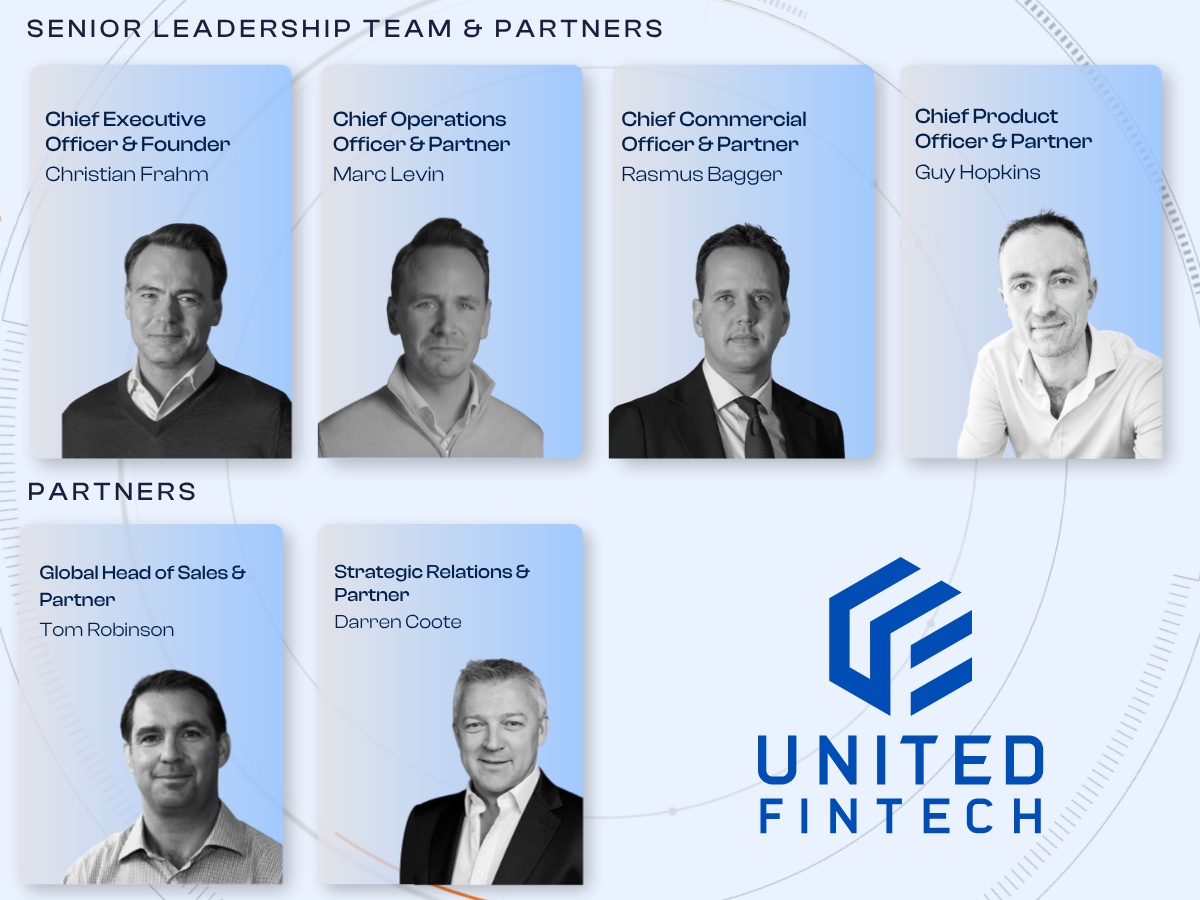
Frahm remained founder and chief executive, also leading the partnership. The senior leadership team put Bagger in charge of commercial work, Levin in operations and Hopkins in product. This is a consequential stage in a founder’s career: the organisation needs a clear distribution of responsibility as much as it needs the original idea. Building a company also involves deciding who gets to build it with you.
September brought a larger Singapore office, Stuart Billingham’s appointment as head of Asia-Pacific and additional local payments expertise. United Fintech reported serving more than 250 financial institutions. The geographical expansion gives Frahm’s proposition a practical test. Banks operate through different currencies, market structures and regulatory settings; a common platform still needs people who understand the place where a customer works.
The small victories department
There is a revealing modesty in the business lesson Frahm chooses to emphasise. He recommends James Clear’s Atomic Habits, which he read after his 2019 exit. Its account of incremental improvement reminded him of how his team had worked already. He talks about repeated failures, corrections and small victories accumulating over time. The entrepreneur who gets bored quickly has developed an appreciation for slow compounding.
His advice to new founders similarly starts close to the customer. Make early customers collaborators in shaping a product. Solve one customer’s problem well enough to earn a reference. Expect the first relationships to take time. The advice fits the Barclays story and the company he subsequently built: confidence grows through evidence, and evidence begins with someone allowing you to do the work.
Asked in 2022 to imagine his dream job with no limits on time, resources or location, Frahm chose United Fintech. The answer makes sense of his brief experiment with retirement. He appears to enjoy assembling the people, customers and capabilities that turn an idea into a functioning business. Six years after the launch, that assembly has become more complicated. It has also become the job he wanted.