In 2019, Chris Power checked into a hotel room in Texas and began calling factories. There were hundreds of calls, most of them cold, all of them part of a private reconnaissance mission. Power had arrived from Melbourne with six thousand dollars, one American relative and a theory large enough to make both resources look inadequate: the United States had allowed the machinery beneath its power to decay. He believed the decline of manufacturing was not an economic curiosity. It was the sort of plot point that historians notice shortly before an empire gets an unflattering final chapter.
He was not a machinist. He had studied commerce at Monash University, left without graduating and learned business in the less metallic precincts of Australian e-commerce. At Retail Splash and CatchOfTheDay, he worked on products, pricing, inventory and partnerships. At workforce-software company Ento, where he joined as an early employee, he became head of growth and chief revenue officer. Software had taught him that systems could scale. The factory owners on his telephone taught him that expertise often could not.
Again and again, Power encountered the same fragile arrangement: a critical aerospace part depended upon a veteran called Bob or Jeff, someone who had made it for decades and carried the process in his head. The machines were only part of the bottleneck. The real constraint was knowledge, accumulated slowly and approaching retirement. A rocket may be a magnificent object, but it can still spend months sulking on the ground for want of one small, correctly inspected piece of metal.
The first answer was too sensible
Power initially chose the orthodox remedy. He formed ADSC, a fund meant to acquire strategic aerospace and defense suppliers. Buy capable shops, improve them with technology, assemble a stronger group. It was the kind of plan that could be explained without drawing breath or alarming a banker.
Then he decided it was too slow. Existing shops had been built around existing processes, and Power concluded that incremental software could not produce the speed or scale he wanted. He shut the fund, returned the capital and, in 2020, started Hadrian. The new premise was less comfortable: do not merely improve the factory. Make the factory the product.
The name contained the argument. The Roman emperor Hadrian inherited a realm accustomed to expansion and became associated instead with consolidation, fortification and infrastructure. Power, who reads the history of empires for clues to their decline, chose the reference for a company concerned with what happens inside the boundary. The allusion is rather grand for a machine shop. That is precisely why it fits. Hadrian has never advertised its problem as a shortage of brackets. It talks about the endurance of countries.
The distinction matters. Hadrian would own and operate highly automated factories, combining computer numerical control machines, robots, inspection equipment and proprietary software called Opus. The software translates designs into production steps, schedules jobs, tracks work and turns the factory into a visible system rather than an archipelago of clipboards and private memory. Humans remain in the picture. In Hadrian’s Torrance facility, one person could supervise four to six machines instead of one expert attending one machine.
Power is careful about where the machine stops. He has said the aim is to automate roughly 80 to 90 percent of the work and allow human judgment to handle the difficult remainder, perhaps indefinitely. “You don’t want everything to be a science project,” he observed. It is a bracing sentence from a founder selling the future: even the future needs someone willing to leave a stubborn problem alone until Tuesday.
A factory that behaves like computing
The production puzzle is awkward. Aerospace and defense require exquisite precision, but not the endless repetition of an automobile line. A shop might make hundreds of different components in low volumes, each with its own geometry, material, programming and inspection ritual. Automation loves sameness. Hadrian is asking it to tolerate variety.
Power’s answer is a standardized cell that can be reconfigured, managed more like shared computing capacity than a rigid line. He calls it GPU-like manufacturing. The metaphor does useful financial work. If most machines and workers can move from a drone program to a missile program, building capacity before either contract is signed becomes less reckless. The equipment is not married to one forecast.
USD, not cumulative
There is another obstacle. A customer will not award critical production to a factory that exists only in a presentation. Power’s solution is to build first. Capacity must be visible before trust becomes a purchase order. He compares the predicament with cloud computing: a customer rents infrastructure because the infrastructure is already humming somewhere. American contract manufacturing, in his telling, lacks that credible reserve.
This is the factory-before-the-order wager. It converts sales risk into concrete, cables and burn rate. It also explains Hadrian’s appetite for capital. The company’s first Hawthorne research facility occupied 20,000 square feet. Torrance was five times larger. By August 2026, Hadrian had nearly three million square feet across four sites, with more planned. Real estate is a formidable way to express an opinion.
The scale arrives, and brings company
Hadrian began commercially with precision parts. Its machines continued cutting after the day crew went home, and Power claimed parts could move through the system ten times faster and with more than 40 percent greater efficiency than at traditional suppliers. The company grew from aluminum into steel and titanium, then widened its ambitions beyond components. A 2024 acquisition of Datum Source helped it serve startups that needed prototypes and rapidly changing designs, work that did not fit neatly into a scaled production line.
By 2025, Hadrian was offering “factories as a service,” including production cells installed within a customer’s operation. It announced a 270,000-square-foot site in Mesa, Arizona, a maritime division and plans for a much larger headquarters. In December, Lockheed Martin agreed to place a Hadrian machining and inspection cell at a Missiles and Fire Control site. The cell was intended to raise output across programs including PAC-3 MSE, THAAD, PrSM and GMLRS.
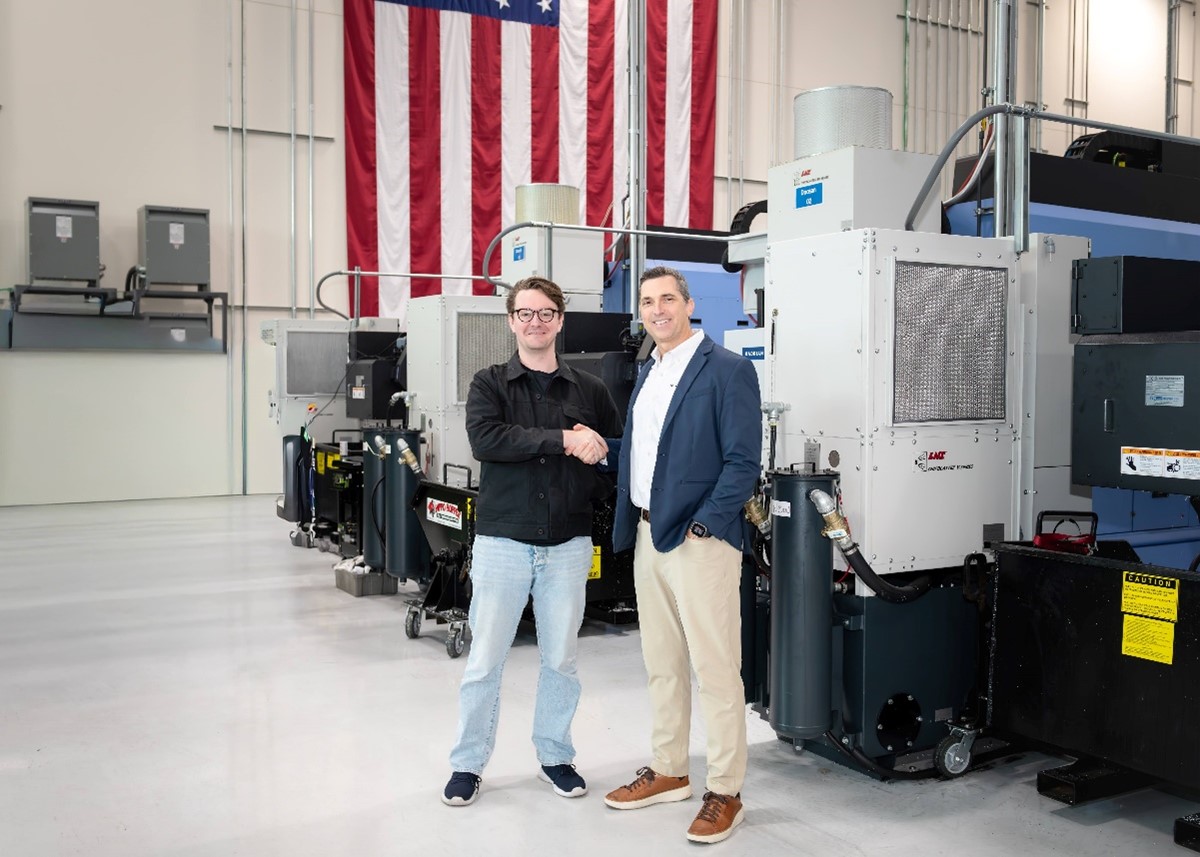
The company’s financing rose just as quickly. A $90 million round in 2022 became a $117 million Series B in 2024, then a $260 million Series C in July 2025. In August 2026, Hadrian raised $1.37 billion at a $7.87 billion post-money valuation. Power’s reaction contained more fatigue than confetti. “We were early,” he said, calling the preceding five years a slog that only recently collided with a broad political and commercial realization that manufacturing mattered.
Urgency, with a micrometer
Power is a student of imperial decline with a salesman’s tempo. His public language is blunt: industrial power, deterrence, China, production. His X biography describes him as a techno-industrialist and believer in hard power. In 2024, he confessed, “I get bored of things going too slowly.” Manufacturing, with its permits, long-lead equipment, material qualifications and tolerances measured in microns, is almost exquisitely designed to annoy him.
That friction is the interesting part of the character. Power is not merely trying to make objects quickly. He is trying to make speed repeatable, inspected and trusted. A rushed aerospace part is junk. A fast system that reliably produces the same documented quality is capacity. Urgency must become process or it remains theatre.
His workforce argument follows the same logic. Hadrian recruits people without years in machine shops and teaches them to operate within a software-mediated system. The veteran’s judgment is not dismissed; it is translated where possible into programming, inspection and workflow so a new operator can become productive in weeks rather than a decade. Power frames automation as multiplication, not an empty building. The worker gets leverage, the country gets throughput, and the machine still has a human nearby when physics objects.
This is also where Power’s career stops looking like a sequence of unrelated industries. Retail taught him inventory and pricing. Growth work taught him to measure a funnel. Workforce software taught him to turn complicated organizational behavior into a product. The acquisition fund taught him how fragmented suppliers were financed and valued. None made him a master machinist. Together, they made him unusually attentive to the factory around the machine: the queue, the handoff, the inspection record, the idle hour and the reason a promised date quietly becomes next month.
The wager remains exposed. Factories absorb cash before they produce trust, and defense demand arrives through long cycles. Hadrian has expanded from machining parts to making assemblies and systems while building sites ahead of contracts. Every additional capability is both an opportunity and another way to be late. Power knows this. His recent conversations dwell openly on burn rate, execution risk and the possibility of failure.
Still, the hotel-room thesis has become difficult to dismiss as merely a thesis. It now occupies millions of square feet. The former e-commerce operator who once cold-called factory owners has become a factory owner whose customers include some of the largest names in defense. His task has changed accordingly. He no longer needs to prove that industrial capacity is scarce. He must prove that it can be manufactured.