In the first 30 days of a new executive job, there are two tempting poses. One is the conquering hero, arriving with a deck and a diagnosis. The other is the tasteful ghost, observing so discreetly that nobody can tell whether any observing is taking place. Chris Byrne chose motion. Sales Kickoff. Earnings. Agency meetings. Customer workshops. Team roundtables. One-to-one conversations. In his own account of joining Corpay as chief marketing officer in February 2026, the itinerary reads less like an onboarding plan than the arrivals board at a busy station.
This is fitting. Corpay helps companies move money, manage expenses and control payments. Byrne's public vocabulary keeps circling movement too: growth, transformation, momentum, what comes next. Yet the more revealing word in his career may be translation. For three decades he has moved between the rooms that large companies often struggle to connect: strategy and sales, analytics and brand, operating detail and public promise.
His route to Corpay was not the usual ascent through a single marketing department. It began in management consulting at PwC and Deloitte, where the work involved global clients, business transformation and the difficult art of turning a grand intention into changed behavior. Then came Xerox in 2002. Byrne stayed for 16 years, crossing strategy, sales and marketing roles before becoming senior vice president of Sales Excellence and Revenue Enablement. He was learning not merely how to tell a corporate story, but how the corporate machine produces one.
The education of an outsider
Byrne has offered a neat description of the outsider's advantage. A newcomer, he said, can ask, “Why do we do it that way or do we have to do it at all?” It sounds almost comically basic. It is also the sort of question that can make a conference room go silent. Corporate customs have excellent camouflage. After enough repetition, a workaround becomes a process, the process becomes tradition, and tradition eventually acquires a budget code.
His second point is subtler. Outsiders also face a learning curve and the invisible nuances of an organization. Fresh eyes are not x-ray vision. The trick is to retain the question while earning the context required to answer it. Byrne's first-month tour at Corpay suggests his method: move widely, listen closely, and refuse to confuse a title with understanding.
“Why do we do it that way or do we have to do it at all?”Chris Byrne on the advantage of fresh eyes
Xerox was a long apprenticeship in that balance. The company had already become a noun and a verb, a linguistic achievement that can double as a strategic headache. Familiarity makes a brand easy to recognize and harder to reconsider. Byrne's responsibilities grew broader as the business worked through its own growth transformation. Sales excellence and revenue enablement are not glamorous phrases, but they reveal his recurring instinct: before changing what the market hears, understand how the company sells, serves and learns.
Brown can carry bright ideas
In 2018 Byrne moved to UPS. The jump from document technology to parcel logistics was less strange than it looked. Both were enormous, familiar businesses being redrawn by digital behavior. At UPS, his remit eventually touched digital marketing, brand management, marketing operations, advanced analytics, product management and customer experience. This was marketing with the bonnet open.
The public-facing work became more colorful. The Be Unstoppable platform put small-business owners and aspiring entrepreneurs at the center. One collaboration brought J Balvin into a song and video featuring Latino-owned businesses. Another featured tennis star Coco Gauff in an anime-inspired story alongside Gen Z founders. Byrne described the latter as support for dreamers making their marks in championships and small-business wins.
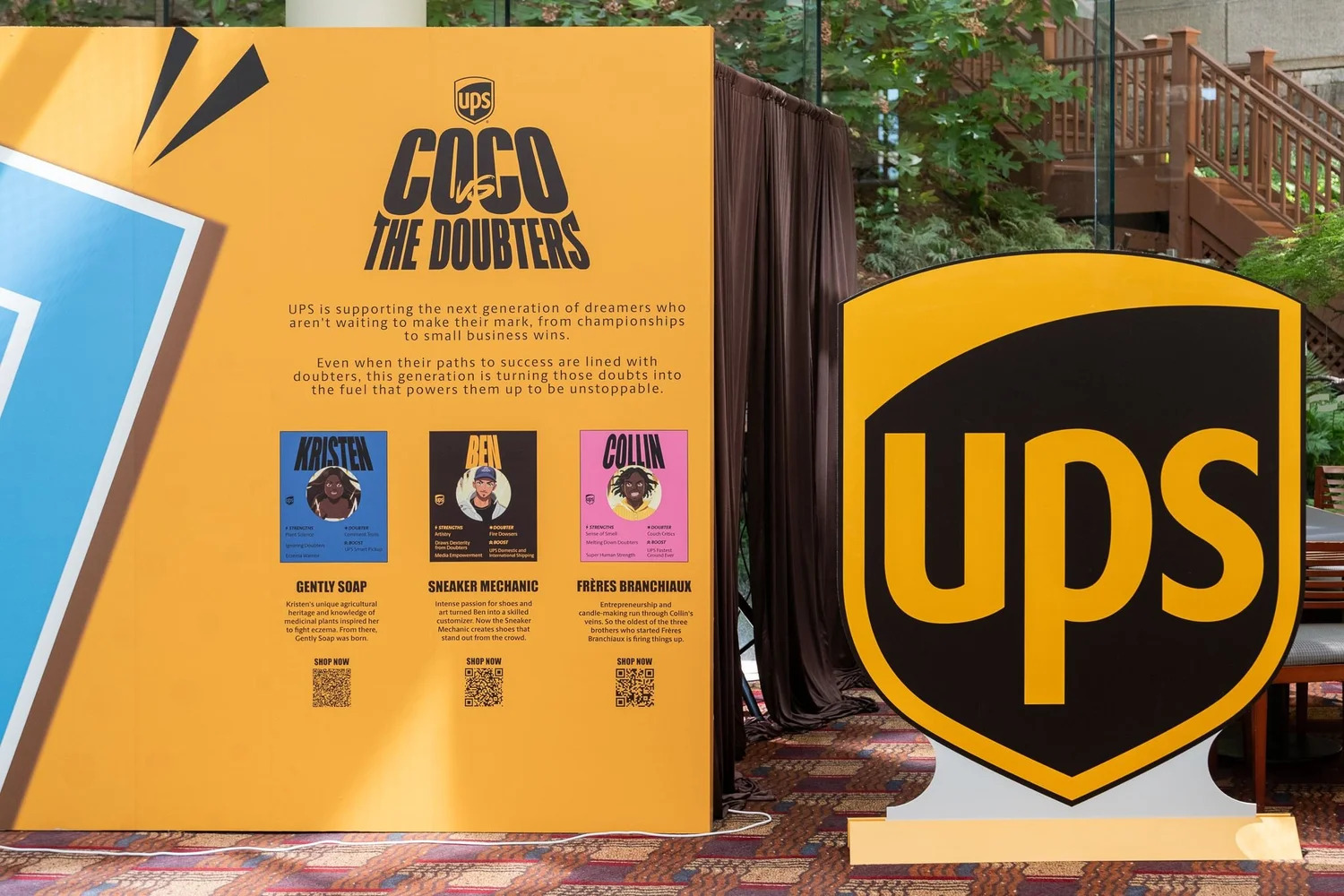
There is a useful tension in that work. UPS is represented by a shield, a brown truck and a century of dependability. Anime is kinetic, exaggerated and young. Put them together badly and it feels like an adult wearing a teenager's trainers. Put them together with a reason, in this case Gauff's genuine affection for anime and the ambitions of young founders, and an established brand earns permission to behave differently.
Byrne also interviewed lacrosse player and Premier Lacrosse League co-founder Paul Rabil for a Be Unstoppable conversation about turning passion into a career. That assignment carried a small personal rhyme: Byrne's volunteer record includes coaching youth lacrosse. The marketer asking an athlete about the business of sport was not entirely visiting from another planet.
Start with the operation. Find the human ambition inside it. Let the campaign dramatize a truth the company can actually deliver.
From story to system, and back
Byrne left UPS for NCR Voyix, where his work became overtly operational again. As a corporate vice president, he led business-unit strategy, go-to-market growth and sales operations. One of his roles focused on Restaurants Strategy and Operations. The category had changed from boxes on doorsteps to software at counters and kitchens, but the connective problem remained: how does an established business organize itself around the next customer decision?
When he closed that chapter, Byrne did not publish a victory lap. He remembered ringing the closing bell to mark NCR's 100 years on the New York Stock Exchange. What stayed with him, he wrote, was the culture's ownership, pride in the work and care for getting it right. The remark is revealing because it places transformation beside stewardship. Reinvention is not a license to treat the past as clutter. A company old enough to celebrate a century has accumulated habits, yes, but also loyalties, craft and institutional memory. The operator's job is to know the difference.
That sensitivity matters at Corpay. The Atlanta company sits behind activity most people prefer not to think about: fuel cards, vendor invoices, hotel bookings, foreign exchange and cross-border payments. Money should move, but not recklessly. Controls, fraud mitigation and visibility are part of the promise. The marketing challenge is to make invisible financial plumbing legible without pretending it is a fireworks display.
Byrne now leads marketing strategy, brand and digital execution. His background suggests those will not be three tidy columns. Brand affects how a customer interprets the product. Digital execution determines whether the interpretation survives contact with a screen. Strategy decides which promise deserves investment. The work is joined whether the org chart admits it or not.
Trust is an operating metric
Years ago, while discussing a leader he had followed from Xerox to UPS, Byrne explained why people get behind someone: belief, support and the extension of trust. He admired a leader who built trust and then gave it away. It is a less theatrical philosophy than the heroic CEO myths found in airport bookshops. It also scales better. Transformation requires many people to alter small decisions when no executive is in the room.
His own career has depended on followership of another kind. He crossed industries without discarding the people-side lesson of consulting, the commercial discipline of Xerox, the brand canvas of UPS or the operational intensity of NCR Voyix. Each chapter added a lens. By Corpay, the unusual breadth had become the qualification.
Fresh eyes are valuable. Fresh eyes that respect the machinery are rarer.
There is no evidence that Byrne intends to make corporate payments glamorous. That would be the wrong ambition anyway. The more interesting opportunity is clarity: show how a sprawling set of products helps a finance team keep control while business crosses borders, employees travel and vendors expect to be paid. “Keep business moving” is a modest line with a large backstage. It asks marketing to compress complexity without lying about it.
In his first public reflection from Corpay, Byrne said he was humbled to join a team that knows how to win and saw real opportunity ahead. The sentence is conventional. The itinerary around it is not. Workshops, roundtables, earnings, agencies, customers, conversations. He was mapping the system before drawing the poster.
That may be the practical lesson in his story. A career does not always advance by narrowing into a specialty until the title becomes inevitable. Sometimes it advances by collecting adjacent fluencies: how strategy becomes a sales motion, how data becomes a choice, how a choice becomes an experience, how an experience becomes a reputation. Byrne has spent roughly 30 years moving along that chain. Corpay is simply the current place where he gets to ask the old question, listen for a better answer, and help a large company feel new without pretending it was born yesterday.