Chris Ashenden has a useful answer to the entrepreneur who is busy celebrating a first sale: think about the second. A stranger can be persuaded to try something once. Getting that person to return is a different examination, conducted without the founder in the room. The customer has opened the parcel, lived with the purchase, and formed an opinion. The advertising has had its turn. Now the business has to earn another.
That distinction sits near the centre of Ashenden’s account of building Athletic Greens, the company now known as AG1. Founded in 2010, it took its first outside equity investment in 2021. In January 2022, it announced another $115 million in funding. The long interval matters. For much of the journey, customers were supplying the money that allowed the company to keep going.
It is an appealing entrepreneurial story. It is also an incomplete portrait of its founder. Before AG1, Ashenden ran New Zealand property schemes that led to convictions under the Fair Trading Act. In 2024, he wrote publicly about responsibility for that business. That July, Kat Cole succeeded him as AG1’s chief executive. His career contains the patient building and the earlier damage. Both belong in the frame.
A small businessman, briefly licensed by Dad
In an interview with former New York Yankees strength coach Dana Cavalea, Ashenden places an early commercial adventure in Abel Tasman National Park. He was nine. A visitor wanted a beer. Ashenden knew his father had cold ones nearby, recognised a gap in the local market, and began negotiating.
His father initially allowed the transaction. More followed. Eventually, parental judgment caught up with customer demand and the venture was closed. The anecdote is funny partly because it contains so much familiar business behaviour in miniature: notice the wish, locate the inventory, establish a price, discover that someone else controls the licence.
Ashenden is a New Zealander, often introducing himself as Chris “Kiwi” Ashenden. His childhood included living in Japan and travelling with his family. In conversation, he credits his parents with encouraging independent thought. There is movement throughout his account of his life: countries, jobs, businesses, fresh attempts. Staying in one professional lane was evidently going to require a compelling reason.
He studied at the University of Auckland and has said he left with two classes remaining to start a business. That first company failed. Later came work selling cars, a period in the New Zealand police, and property. It is a less tidy route than the familiar campus-to-startup biography. Each occupation also places a person close to other people’s decisions about money, persuasion, and trust.
The decade before the cheque
AG1’s funding announcement arrived more than eleven years after the company’s founding. The business had already achieved a reported $150 million revenue run-rate when its first strategic outside investors came aboard in 2021. A run-rate is an annualised snapshot of sales at a particular pace. It should be read with that qualification, rather than silently promoted into an audited full-year result.
The chronology changes how one reads the financing. Investors were joining a business with an established commercial engine. The task was to expand something customers were already buying. That is a different set of problems from finding out whether anyone wants the thing at all.
The January 2022 round was led by Alpha Wave Ventures. E-commerce entrepreneur Mark Vadon joined the investor group; SC.Holdings and Bolt Ventures were among the returning backers. The money was earmarked for expansion, distribution, production capacity, and product development. Behind the announcement was the thoroughly unromantic work of having enough stock in the right places.
A recurring order can make a revenue forecast look reassuring. It also creates a recurring obligation. Every month, the company must deliver again. A subscription business gets to repeat its sales; it also gets to repeat its mistakes if the operation cannot keep up. Ashenden’s long bootstrap period makes that operational side of his story especially interesting.
The voice between the episodes
For many people, AG1 first arrived through their headphones. Its advertising appeared across podcasts with very different audiences, from comedy to current affairs. The brand became a familiar interruption in programmes whose listeners had already chosen to spend time with a particular voice. An advertisement travels differently when the person reading it is already part of someone’s week.
That route suited a company interested in recurring relationships. A podcast listener returns to a host; a subscriber returns to a product. The parallel helps explain the commercial attraction of the medium, although familiarity alone cannot establish whether an individual purchase deserves to be renewed.
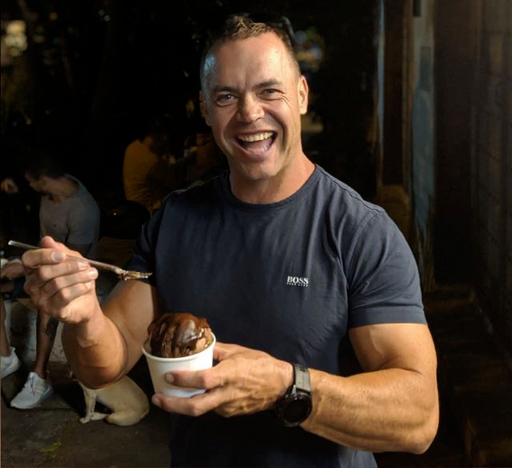
Ashenden’s own public presence is looser than a conventional corporate biography. There is the “Kiwi” nickname, the easy interview manner, and an older social-media description of himself as “Chief Vision Dude.” A title like that does at least make an introduction harder to deliver with a solemn face.
His personal website chooses an equally unceremonious photograph: Ashenden grinning over a cup of ice cream. It is a useful detail in a career so often discussed through funding announcements. He presents an approachable version of himself, comfortable with a joke and ready to talk at length. The image tells us how he chooses to appear; the business record requires its own examination.
The operator he heard before he hired
Podcasts also helped introduce Ashenden to a future colleague. He has written that he heard Kat Cole speaking in 2020 and was impressed. A mutual connection introduced them in early 2021. She became a mentor and adviser before he asked her to help lead AG1.
Cole joined as president and chief operating officer in 2021. Her background included leading Cinnabon and serving as president and COO at Focus Brands. She brought experience running consumer businesses with employees, systems, and customers spread across an operation much larger than a founder’s immediate circle.
In July 2024, she became CEO. Ashenden described their working relationship as having already approached shared leadership. “She has effectively operated as co-CEO in everything but name,” he said. At the time of the transition, both were reported to remain on AG1’s board.
Founder biographies often give hiring a supporting role: an impressive name arrives, the organisation grows, the story moves on. Here, the recruitment becomes a turning point. Ashenden had spent years identifying the company with his own ambition. Bringing in Cole created a practical route for the business to be led by somebody else. The eventual change in title made that distinction public.
The word ownership has a history
In May 2024, Ashenden published an essay titled “Leadership Lessons: Radical Ownership.” He acknowledged that customers of his earlier rent-to-buy property business had lost money or been evicted. He said it had taken him years to accept responsibility. In his telling, that experience changed the way he approached building AG1.
The underlying record is more severe than the phrase “failed business” suggests. In 2011, an Auckland court ordered Ashenden and two companies to pay fines, costs, and reparations for Fair Trading Act breaches. Customers had been misled about acquiring ownership of homes. The properties remained legally registered to investor companies while occupiers paid under long-term agreements.
For the families involved, the difference between occupying a house and owning it was the substance of the transaction. It determined what their payments were buying. Entrepreneurial language about experiments and lessons cannot carry that distinction on its own. A founder’s later success does not change the earlier customers’ experience.
“I was terribly naive, and I should have done better on many fronts.”
Chris Ashenden, writing in May 2024
His decision to address the episode publicly is part of the story. So is the need to read his explanation alongside what happened. “Ownership” is an unusually loaded word for this particular founder: it describes a leadership principle he advocates and the thing property customers believed they were obtaining.
There is a reasonable standard for assessing such a principle. Look at the precision of the promises. Look at who carries the risk. Look at what happens when an agreement disappoints the person with less power. Those questions apply to a small property venture and a global consumer company alike. Their usefulness survives any change in branding.
Another order, another obligation
Ashenden’s activities extend beyond AG1. The company dates his founding of Fundación Da Alegría in Colombia to 2016. The foundation supports children through local partner organisations, including assistance with schooling. His personal website links to it alongside the company. It is another part of his public identity, with a purpose distinct from selling subscriptions.
His writing returns often to action and purpose. In one 2024 post, he described a desire to live with joy and meaning and to help others do the same. In another, he urged readers to begin whatever they had been putting off. The language is expansive; the recurring instruction is practical. Start something. Continue working. Accept responsibility for the result.
The end of his CEO tenure leaves a useful separation in view. AG1 is the business he founded; it now has another chief executive. His own biography continues to carry the decisions that preceded it. Neither the funding milestone nor a change of management can finish that account for him.
Return, then, to the second sale. Ashenden’s attention to repeat customers offers a way to understand the business he built and a demanding measure for the promises surrounding it. The customer comes back with experience. They know more than they did the first time. The founder, if he is listening, should too.