Before Chirag Dhull became a chief marketing officer, he was a software engineer. This is more than an agreeable opening detail, the sort that lends a technical executive a little workshop dust. It explains the route. For nearly two decades, Dhull has kept turning up where technology is clever, consequential, and not yet easy to describe. Windows mobile apps. Machine learning. Cloud databases. The Internet of Things. Managed blockchain. Decentralized oracles. Now, enterprise AI governance. The nouns change. His assignment barely does.
In April 2026, Dhull joined Collibra as Chief Marketing Officer. The company describes his remit as connecting the platform's capabilities to outcomes that matter to customers. It is polished corporate language for an awkward practical problem: how do you explain infrastructure that often becomes visible only when it fails? Data governance is rarely the star of a demo. Yet every confident AI answer rests on definitions, ownership, quality, permissions, and traceability. Dhull arrived with a succinct warning that AI would reward an enterprise's strengths and expose every weakness in its data foundation.
That argument sounds current because it is. It also sounds like Dhull because he has spent his career one floor below the spectacle, talking about the systems that let the spectacle work.
The education of a translator
Dhull studied computer science engineering at Visvesvaraya Technological University, graduating in 2007, and began at Accenture. His first role was in software engineering; he later moved into information-technology strategy consulting. Graduate study followed at Carnegie Mellon University, where he earned a master's degree in information systems management in 2011. By 2012, at Microsoft, he had crossed into developer growth marketing for the Windows mobile ecosystem.
This was not a departure from technical work so much as a change in where he stood. Rather than make the thing, he would help a market understand why and how to make with it. He moved into product marketing for machine learning and artificial intelligence, including Azure Machine Learning. A former Microsoft colleague later recalled that Dhull took a new product with no blueprint and built a worldwide ecosystem of hackathons and learning opportunities around it.
One scene from 2016 makes the approach vivid. More than 130 students from universities across Melbourne spent a night working with Australian government data. Microsoft supplied workshops in Azure Machine Learning and Power BI; Dhull delivered a keynote at the opening. The point was not merely to describe data science. It was to put the tools into students' hands and give them a public problem worth staying awake for.
A taste for the unfinished category
At AWS, beginning in late 2016, the territory widened. Dhull worked on developer-platform marketing, then AWS IoT, then analytics, business intelligence, managed blockchain, and ledger databases. These were not products a marketer could reduce to a pleasant adjective and a photograph of someone looking productive near a window. They demanded diagrams, workshops, architectural distinctions, and patience.
His 2019 AWS work offers a glimpse of the necessary range. An online office-hours session on Amazon Managed Blockchain put Dhull alongside a product manager, a business-development lead, and a solutions architect. The audience included developers, database administrators, architects, and senior technology decision-makers. At re:Invent that year, his written guide mapped 22 sessions devoted to managed blockchain and Amazon's ledger database: seven breakouts, five chalk talks, six builder sessions, and four workshops. The numbers are less important than the choreography. A new platform does not acquire a market through one grand announcement. It needs several doors, each cut for a different level of fluency. Some customers want the architecture. Some want a use case. Some need to place their hands on the controls. Product marketing, in this form, is the design of those entrances.
Dhull appears to like that difficulty. In a 2020 interview, he called himself “a developer at heart” and said the pleasure of his job came from helping customers build new products, unlock new business models, and see their businesses differently. His stated role model was Steve Jobs, especially the original iPhone launch. The comparison is revealing, not because an enterprise ledger database resembles an iPhone, but because both need a story that makes unfamiliar machinery feel graspable.
I have always been a developer at heart.Chirag Dhull, 2020
His operating habits are charmingly less theatrical. Dhull says he is a devoted user of Kanban boards. His favorite book is Stephen Covey's The 7 Habits of Highly Effective People. Asked what advice he would give his younger self, he first joked that he should have bought Bitcoin, then offered the actual answer: read more. Steve Jobs on stage, sticky notes on the wall, Covey on the shelf. One can do worse for a marketing department.
The doodle and the oracle
In 2021, Dhull moved from AWS to Chainlink Labs. Former colleagues began asking what the blockchain company actually did. His response was wonderfully on brand: he drew a doodle. The sketch explained the “oracle problem,” or how decentralized applications can connect securely to information beyond a blockchain. It was a small piece of public pedagogy and a useful clue about his instincts. When a category has too many abstract nouns, give people a picture.
Over nearly five years, his remit grew from product marketing and developer-platform growth to leading marketing. Chainlink sat at the junction of blockchains, outside data, developers, and increasingly traditional finance. Dhull's own summary of the period named work spanning Swift, JPMorgan, Mastercard, DTCC, ANZ, Fidelity, and the Hong Kong Monetary Authority. The audience was no longer merely crypto-native. The story had to travel between technologists and institutions that measure novelty by its operational risk.
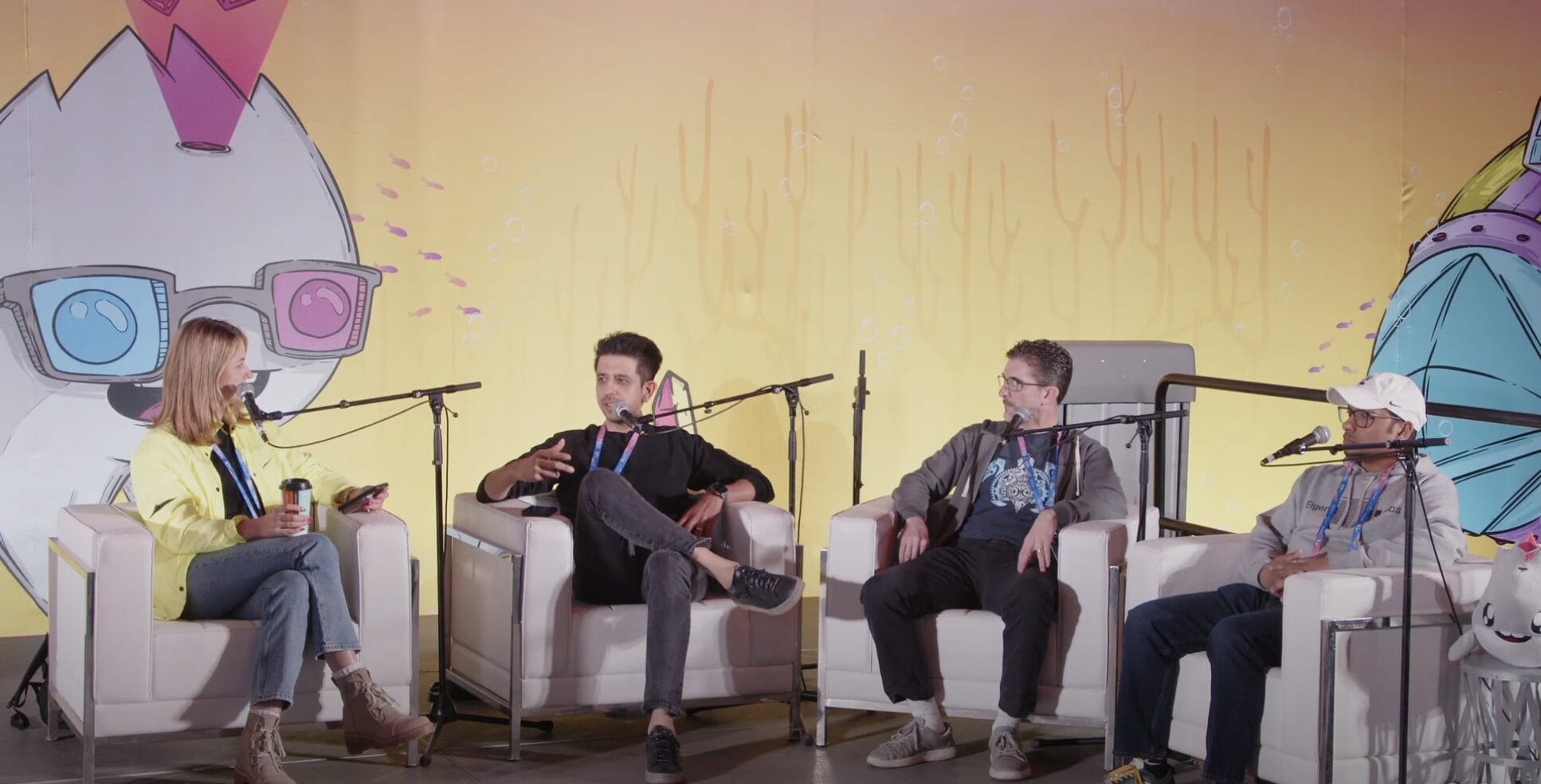
On a 2024 ETHDenver panel, Dhull framed security with an airplane metaphor. Developers should not build the plane while flying it; the aircraft ought to be ready when it leaves the hangar. He argued that teams could use reliable oracle infrastructure and spend their attention on the business logic and creative idea instead of rebuilding the connective tissue. It is product marketing at its most useful: locate the labor customers should not have to repeat.
Can the explanation show a builder what to stop rebuilding, an executive what to trust, and a customer what becomes possible?
The most telling compliment Dhull remembers receiving was not an award, though Microsoft gave him several. After an event, a customer remarked that he was so passionate about the work that it seemed like his own startup. Dhull said the comment felt more rewarding than appreciation or promotions. For a career spent representing other people's products, founder-like ownership is a revealing standard.
Now the product is confidence
Collibra brings Dhull back to data and AI, but with the intervening lessons of distributed systems and institutional adoption. His arrival post set out the problem in unusually concrete terms: enterprises need discovery and quality, shared definitions, trust scores, policy alignment, protection for sensitive data, and access controls across business units. A model can be impressive in isolation. A company has to know what it is connected to, who owns it, and whether its answers can be defended on Monday morning.
In his first months, Dhull leaned into “context governance,” the emerging task of governing the semantics, ontologies, and knowledge structures that AI agents use. He promoted Collibra's AI Command Center as a way to see and control systems and agents across their lifecycle. His phrasing sharpened the managerial stakes: if leaders do not know who is running which agents, visibility is not merely a governance concern. It is a leadership concern.
This is an unsurprising destination for someone who has moved between engineering, product management, and go-to-market work. Governance is where the technical and organizational systems meet. Definitions matter. So do incentives, ownership, and language. The platform may catalog assets and enforce policies; the marketer has to make an enterprise recognize itself in the problem.
AI will reward every strength and expose every weakness in your enterprise's data foundation.Chirag Dhull, announcing his move to Collibra
There is a temptation, in profiles of technology executives, to mistake proximity to several booms for clairvoyance. Dhull's record suggests something more practical. He has chosen fields in which adoption depends on explanation, then stayed close enough to builders to make the explanation credible. At Microsoft, that could mean an overnight hackathon. At AWS, a complete map of blockchain workshops. At Chainlink, a doodle or a security metaphor. At Collibra, it is a vocabulary for confidence in production AI.
The aspiration is not to make the complicated sound simple. That trick usually breaks the moment a customer tries to use the product. It is to make the complicated clear enough that someone can decide, build, or govern. Dhull's career has been a long argument that technical depth and good storytelling are not rival disciplines. At their best, they are colleagues who share a Kanban board.