In 1995, Chip Mahan helped put a bank on the internet. Customers could reach it without visiting a branch, which was an interesting proposition at a time when the web itself still required explanation. Yet one of the consequential things inside Security First Network Bank was something its depositors were unlikely to think about: the software making the whole arrangement work.
The banking operation eventually went to Royal Bank of Canada. The technology business became S1. Years later, in Wilmington, North Carolina, Mahan helped build another bank, Live Oak. When that bank needed better software for handling loans, its people built a system that became nCino. A bank had contained another business. Then it happened again.
There is a pleasing untidiness to this career. The institution on the sign is only part of the story. Behind it sit programmers, document trails, lending specialists and colleagues who turn up in the next venture. Mahan’s contribution has often been to see that an answer built for one organization might be useful to others. The bank is both a business and a place where another business can be discovered.
Before the browser
James S. Mahan III began at Wachovia in Winston-Salem in 1973, after earning an economics degree at Washington and Lee University. The career started in conventional banking, with all its balance sheets and customer calls. He has recalled buying a book to understand a bank’s assets, liabilities and income statement. Even the people who eventually run banks have to begin somewhere.
By 1984, he was chairman and chief executive of Citizens Union National Bank & Trust Co. He subsequently launched Cardinal Bancshares in Lexington, Kentucky, in 1987 and took it public in 1992. These were years of learning how to organize capital, recruit people and run institutions before an internet venture entered the picture. The browser arrived after the banker.
The opening to that next chapter came through his brother-in-law, software entrepreneur Michael McChesney. Over dinner, they discussed the internet and what it could mean for financial services. Mahan’s early questions were those of a banker looking at a new distribution channel. McChesney brought the technical knowledge. Their discussions eventually took them to Netscape and its leadership.
That division of labor matters. Mahan’s own retellings give the technical people considerable room. He was willing to ask questions about an unfamiliar technology, then work with people equipped to build with it. A family dinner is an agreeable origin story; a banker finding a capable software partner is the business underneath it.
Internet banking operations → software for financial institutions
Internal lending workflow → banking software business
Security First opened in 1995. Its banking operations were sold in 1998, while S1 developed into a supplier to other financial institutions. The distinction between running a bank and supplying banks had become commercially significant. The software could travel into institutions Mahan did not own, carrying a piece of the original experiment with it.
A lending territory without county lines
Mahan moved to Wilmington in 2006 after leaving S1. Live Oak began banking operations on May 12, 2008. A new bank could hardly have selected a more awkward moment to introduce itself. The financial crisis soon made confidence, capital and the durability of a business plan much more than subjects for an opening presentation.
Live Oak’s approach changed the familiar boundary around a community bank. Instead of learning every industry within a limited territory, it developed deep knowledge of particular industries and lent nationally. Veterinarians were an early focus. A lender could become familiar with a customer’s business economics even when the customer lived a long way from Wilmington.
That is an organizational choice with practical consequences. Specialization affects whom a bank hires, which questions it asks and what it understands about a borrower’s cash flow. Technology makes the distance manageable, but a fast connection cannot supply industry judgment by itself. The lending specialists and the systems have different jobs to do.
The bank also had to defend its existence. At Elon University in 2024, Mahan recalled a March 2009 meeting in Atlanta at which a regulator urged Live Oak to sell or liquidate. His account centered on the bank’s commitments to customers. His response gives a sense of how personally he understood the obligations of the new institution.
“small business America had been orphaned”Chip Mahan, speaking at Elon University, 2024
The early model gave Live Oak a way to expand without assembling a nationwide chain of conventional branches. It also created an operating problem: people in different roles needed to move a loan through the same institution without losing information along the way. A national lending strategy still has to survive the journey from somebody’s desk to somebody else’s.
The paperwork gets a company of its own
The quantities could be sobering. In 2015, Live Oak described a typical SBA 7(a) loan as potentially requiring as many as 150 separate documents. Each document has to arrive, be identified and be available to the right person. A missing form has a remarkable ability to make a sophisticated financial institution behave like a search party.
Live Oak developed software to organize the process. The aim was to give people a usable view of the loan across its life, rather than leave them passing disconnected pieces of it around. Customers could also follow progress through an online portal. The useful invention was tied to a job the bank already had to perform.
A typical SBA 7(a) loan could require up to this many documents in Live Oak’s 2015 account of its lending process. An operating problem with plenty of paper evidence.
By 2012, nCino was operating separately, with Pierre Naudé as chief executive and Neil Underwood among the people connecting the banking and software efforts. The name came from encino, Spanish for oak. Even the new company’s name kept a small botanical record of where it had started.
Mahan was a co-founder. His role should be understood alongside the people who developed and ran the software business. Today, Sean Desmond is nCino’s president and chief executive. Mahan leads Live Oak. Their connected origins are useful context, but the companies have their own leadership and responsibilities.
The earlier S1 experience makes the nCino story particularly revealing. In both cases, software grew out of operating needs inside a banking venture. That origin offers a demanding first customer: colleagues who must use the thing while doing their daily work. It can expose weaknesses quickly. It also leaves an obvious question once the system works: how many other banks have the same difficulty?
The people who keep coming back
The recurring names are as important as the recurring business pattern. Mahan and Lee Williams met at Wachovia in 1973. They later helped establish Live Oak, and in March 2024 they received Elon’s Medal for Entrepreneurial Leadership together. More than half a century separated the beginning of that working relationship from the ceremony.
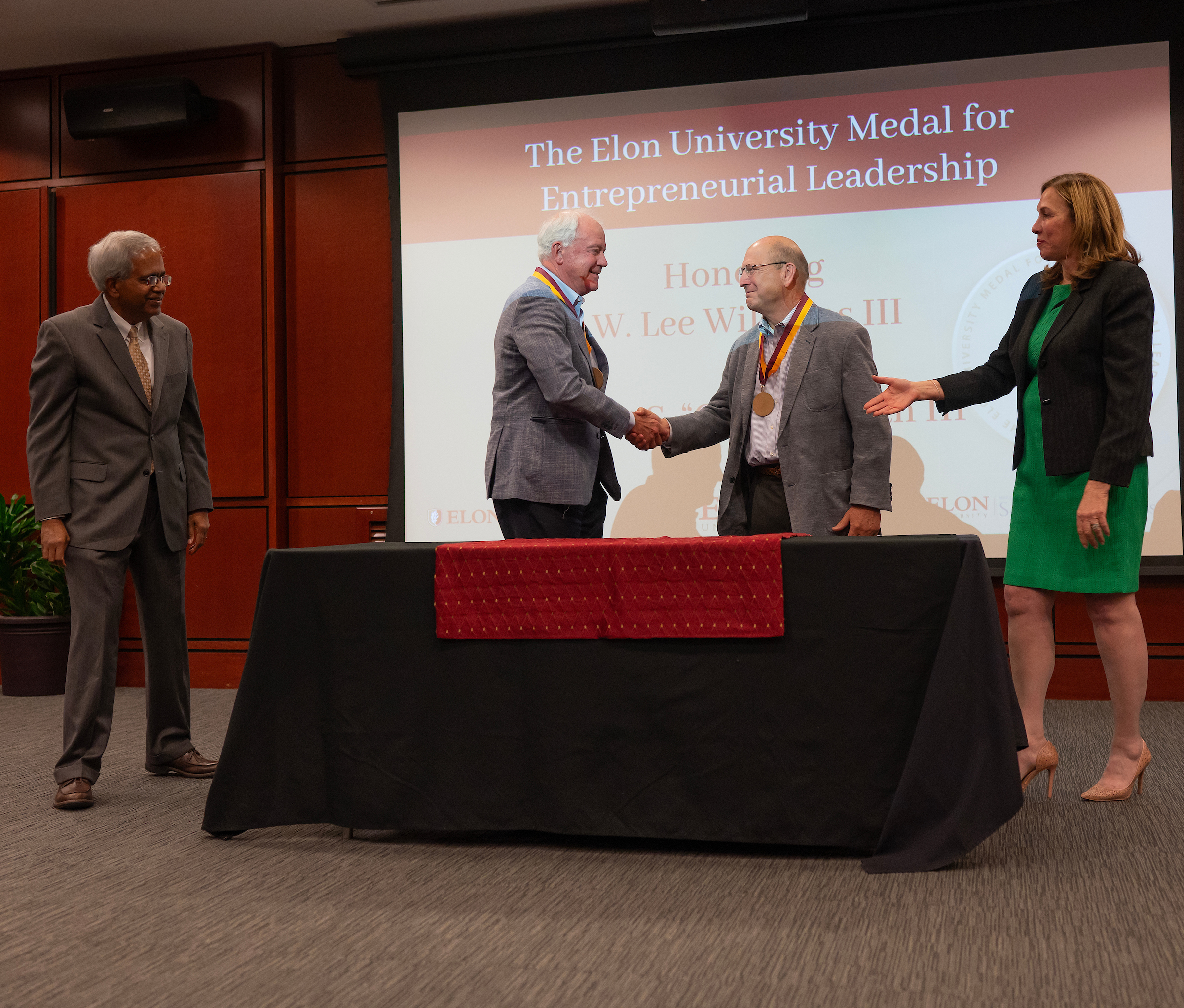
Underwood had worked at S1 before joining Live Oak. Naudé also came from S1. The story is easier to understand when those relationships remain visible. A fresh company can draw on people who have already learned how one another works. Experience travels through a team, including lessons that are harder to put into a presentation.
Mahan’s explanation of management tends to begin with employees. “It’s your folks,” he told interviewer Jon Evans in 2018. His shareholder writing returns to the idea that looking after employees helps them look after customers, with shareholders benefiting from the result. It is a chain of responsibility that gives the employee a prominent position.
Place is part of that thinking too. Live Oak’s Wilmington campus developed from cramped leased space into buildings with cedar exteriors and large windows. In 2016, Mahan publicly described an ambition to build a technology community in Wilmington. The city became a setting for several related ventures, rather than simply an address on bank stationery.
His work also expanded into investing. Canapi Ventures, which he co-founded with Gene Ludwig in 2018, focuses on financial technology. The investor role fits beside his operating history: he has spent years seeing the distance between a bank’s need and the product offered to meet it. That experience provides questions to ask a founder, even when it cannot guarantee the answer.
Still working on the handoffs
The recent numbers belong to a continuing business, rather than a completed founder legend. Live Oak reported $1.37 billion in loan production for the first quarter of 2026. In the second quarter, originations reached $1.5 billion. Mahan highlighted small-dollar lending and checking balance growth alongside the broader lending total.
Growth carries obligations. The second-quarter release also reported $25.8 million in provision expense for credit losses. An account of a lender needs room for that figure beside production. Lending volume describes activity; the costs and performance of the loans help determine what that activity eventually means for the institution.
Live Oak’s annual report set out priorities for 2026: deepen customer relationships, grow lending with discipline around pricing and structure, and strengthen operating leverage. These are the less theatrical parts of running a bank. They involve repeating useful decisions, watching costs and keeping the quality of the operation in view.
Mahan’s career offers plenty of beginnings: new banks, a new channel, software businesses and an investment firm. The thread connecting them is close attention to what happens inside an institution once the idea meets the working day. Somewhere between a borrower’s request and a lender’s answer, a team encounters another awkward handoff. For Mahan, that has often been a promising place to start.
Follow the conversation
Explore Live Oak’s leadership, Mahan at Canapi, his LinkedIn profile and nCino.
- Banking on his customers’ success - conversation with Jon Evans
- Merging Traditional Banking with Tomorrow’s Technology - LendKey interview
- Watch the interview: The Art of SBA Lending, episode 190 - YouTube
- A conversation about Wilmington and the blue economy
- Mahan and Williams at Elon’s 2024 medal ceremony
- Live Oak’s latest company updates