Before Bill Sarris offered investors a way into private companies, he offered banks a way into the app store. At FinovateSpring in 2016, his product was an App Store for Banks: select software, put the institution’s name on it, and get it onto a customer’s phone. It was an unglamorous problem with an immediately useful answer. Banks had customers. Developers had applications. Someone needed to make the introductions less exhausting.
That earlier Sarris is essential to understanding the later one. The founder of Linqto came to private investing through software, carrying a builder’s interest in removing steps. His eventual pitch could fit in four words: “private investing made simple.” It served as his founding principle. It had the pleasing economy of a well-designed button.
By October 2026, Sarris’s career had acquired a much more difficult set of words. Federal prosecutors had charged him with securities fraud and other offenses. The SEC had filed a separate civil complaint. The cases challenge what investors were told about pricing and availability. Sarris denies the criminal charges through his lawyer and is presumed innocent. The distance between a useful interface and a trustworthy transaction runs through his story.
The bank needed an app
Sarris’s professional background was in the machinery behind financial services. He delivered enterprise applications for Microsoft, Intuit, Digital Insight, NCR, and Stanford. At Intuit, his work included applications for QuickBooks, Mint, and QuickBooks Online. For Digital Insight, he managed Linqto’s engagement on its Promotion Suite and Business Banking systems. These were products used to make other people’s financial routines work.
The distinction matters. Sarris had experience building software for established institutions before he became the public face of an investment platform. His software work received the Forrester Groundswell Award and the Monarch Innovation Award for Banking. His authority in the later business rested partly on a documented career of getting financial technology to function.
In 2016, Linqto’s Otter platform offered banks and credit unions an automated route from choosing an application to submitting a branded version to app stores. Sarris presented with Wallaby’s Kim Fraser. The company listed 15 employees and $1.2 million in revenue in its conference materials. Here was a modest business with a concrete customer problem, well before private-company shares became its calling card.
The company’s announcement described a partnership with LEVERAGE and a pilot involving nine credit unions. Sarris argued that fintech businesses could become suppliers to financial institutions. The proposal gave smaller institutions another way to deliver new tools to their members. Software could spare them the expense and delay of building every application themselves. It was the sort of convenience a bank could explain without needing a mythology department.
A different kind of access
The change in business was substantial. By February 2020, Linqto was introducing a private-securities investment platform. Its launch announcement described electronic signatures, automatically completed forms, and mobile access. The new customers were accredited investors, including people outside Silicon Valley who wanted exposure to companies that had yet to list on a public exchange.
Sarris wanted to “make it easy for average investors” to participate in private equities. The attraction was understandable. A person could know a company’s products, follow its progress, and still have no straightforward way to invest before an IPO. Linqto proposed to reduce the procedural obstacles. Familiar software conveniences would carry customers into an unfamiliar market.
“make it easy for average investors”
Bill Sarris’s stated ambition, 2021
There was continuity with the bank-app business: make an awkward process easier to complete. There was also a new responsibility. Choosing software for a bank and selling an investment to an individual involve different judgments. The second customer needs to understand the security, its price, and the rights attached to it. Removing forms cannot remove those questions.
Sarris also cultivated an audience around the investment business. His LinkedIn activity promoted Linqto’s Global Investor Conference and an event featuring Tim Draper, Greg Kidd, Kelly Rodriques, and Bart Stephens. These posts place him in a network of investor gatherings and technology discussions. They show how the platform’s invitation traveled: through meetings and recognizable names as well as through the application itself.
The company behind the company
A purchase on Linqto involved several layers. A subsidiary, Linqto Liquidshares, acquired private-company securities. Economic interests were allocated to special purpose vehicles, or SPVs. Customers bought units in those vehicles. The private company whose name attracted the customer sat at the far end of that chain.
This structure is central to understanding Sarris’s second act. The customer gained indirect economic exposure rather than a straightforward transfer of the underlying company’s shares into the customer’s own name. The interface could make the purchase brief while the ownership arrangement remained elaborate. A transaction can take a few minutes and still require a diagram.
Conceptual ownership chain, not a measure of investment value.
For Sarris, accessibility was the recurring public theme. For customers, the company name on the screen was only the beginning of the bargain. The intermediate entities determined how that exposure was held. Once Linqto entered bankruptcy, the distinction between the investment a customer recognized and the legal interest the customer purchased became much harder to overlook.
A handover, then a return
On February 23, 2024, Linqto announced Joe Endoso as its next CEO. Sarris would become executive chairman. The announcement presented the change as a continuation of an established partnership. Endoso had joined in 2019 and worked through finance, revenue, operations, and presidential roles. Sarris publicly endorsed his colleague’s ability to lead the next stage.
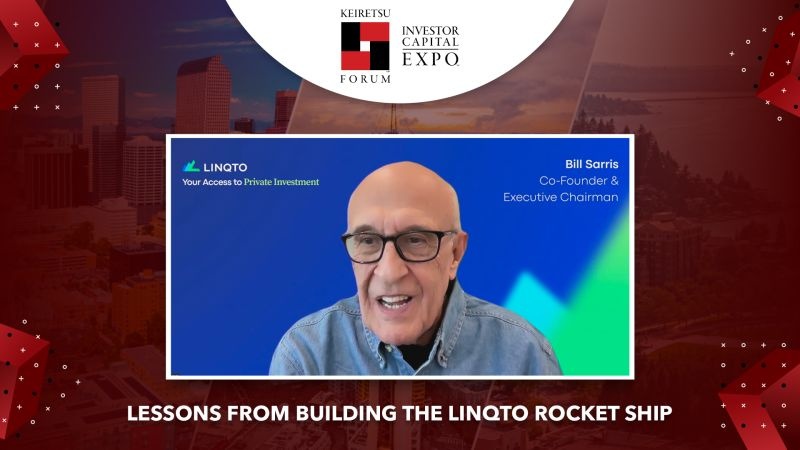
That spring, Keiretsu Forum promoted Sarris’s Investor Capital Expo keynote about building the Linqto rocketship. The image shows him speaking against a branded blue and green background. The language belonged to the expansion chapter: experience accumulated, lessons available, a founder explaining the climb.
The leadership chronology became less tidy than the handover announcement suggested. The SEC’s later complaint states that Endoso served as CEO from February to August 2024 and that Sarris then resumed the role. Sarris’s tenure ended on January 2, 2025. Dan Siciliano took over. A neat succession story had become a return engagement followed by another departure.
The first-day bankruptcy declaration says Linqto terminated Sarris’s employment on March 10, 2025. The investment platform stopped operating that March, and the company entered Chapter 11 in July. Siciliano later told customers that new management had expected to pursue growth but instead encountered misconduct requiring the platform to pause. That was management’s account of why the business stopped.
Who was setting the price?
In September 2026, federal prosecutors announced a six-count indictment against Sarris. They alleged that he misled customers about prices, manufactured scarcity, and imposed undisclosed excessive markups. Their account covered more than $450 million drawn from over 13,000 customers. Those figures describe the prosecutors’ alleged scheme; they do not establish that the entire amount was lost.
Investment volume described by prosecutors.
Over 13,000 customers. Neither figure is a proven loss total.
His lawyer, Tim Treanor, responded that Sarris was innocent and intended to fight the charges. Treanor also attributed customers’ recovery questions to the bankruptcy filed six months after Sarris stopped running Linqto. The defense disputes the government’s account. Endoso, meanwhile, pleaded guilty in August 2026 and agreed to cooperate. His plea concerns his own conduct and does not determine Sarris’s guilt.
On October 9, the SEC brought its separate civil action. It alleged misleading statements about market prices, claims that offerings were exhausted while inventory remained, and representations about automated pricing while people were still setting prices manually. The agency sought financial remedies and officer-and-director bars. These were allegations and requested remedies, rather than a judgment against Sarris.
The pricing question cuts close to his professional identity. Software can perform a calculation faithfully, but someone decides what the calculation is meant to accomplish. Calling a price dynamic does not explain the assumptions behind it. Customers still need to know whose interests the mechanism serves and how the seller describes it. In Sarris’s case, those descriptions are now being tested in court.
What survives the slogan
The aftermath has more than one timetable. In February 2026, Linqto announced court confirmation of its reorganization plan. That approval concerned the company’s bankruptcy process. The criminal prosecution, the SEC action, and disputes over customer recovery ask different questions. A procedural milestone for the company cannot supply a verdict on the founder.
Sarris’s career gives the story its particular shape. He worked on the practical software of banking before turning to the promise of private-market participation. He stood before financial institutions with an app-delivery product, then before investors with an access proposition. Each business asked people to trust that the complicated work behind a short transaction had been done properly.
The original appeal remains easy to understand: fewer obstacles between a person and a financial opportunity. Sarris knew how to describe that appeal, and his software background helped him give it a usable form. The dispute now surrounding him concerns the information that traveled with the opportunity. A customer who can finally reach the counter still needs to understand the bill.
Continue reading & watching
- Linqto website
- Bill Sarris on LinkedIn
- Bill Sarris on Twitter/X (archival handle)
- Watch: the 2016 Finovate demo
- The 2024 Investor Capital Expo appearance
- The banking software demonstration
- The 2020 investment-platform launch
- The 2021 career and ambitions profile
- The February 2024 leadership announcement
- Linqto’s first-day bankruptcy declaration
- The September 2026 report and defense response
- The federal charging announcement
- The October 2026 SEC announcement
- Linqto’s reorganization announcement