A large porcelain vase presents a practical difficulty for Kevin Ching: you cannot reasonably take it to bed. Small jade carvings are better company. They fit in the hand, invite inspection and accommodate a collector who likes to keep his objects close. Long before he was running an auction business across Asia, Ching was making that distinction. Price mattered, too. As a young collector, he could afford jade more readily than the porcelain he admired.
His taste runs to children and animals carved in the round. A tiny figure can carry a joke, an auspicious wish and evidence of the maker’s ingenuity. His advice to beginners is equally intimate: look at actual objects, meet experienced collectors, learn through handling. In his early collecting years, Friday dinners with friends became occasions to compare purchases and debate authenticity. Dinner came with homework, though the homework was rather prettier than usual.
The lawyer had other interests
Ching’s professional education covered an unexpectedly expansive territory. His master’s studies at London University included English and Soviet law, Chinese law, and air and space law. He was educated in Hong Kong and England and qualified to practise across several jurisdictions, including Singapore, England and Wales, and Victoria in Australia. At Johnson Stokes & Master, his work ranged across banking, shipping, commercial matters and investment in China. Negotiating the movement of valuable things would become a recurring theme.
During a two-year posting in Beijing in the 1980s, his weekends belonged to museums, historical sites and antique markets. The city supplied an education beyond the office. He later described finding routine legal research and paperwork increasingly dull. Dickson Poon offered him a move into Dickson Concepts, combining group legal responsibilities with the development of its mainland retail business. Ching accepted. Luxury retail brought him closer to the commercial world of taste, where desire has consequences for the balance sheet.
That combination made sense to auction houses looking towards Asia: legal training, negotiation, familiarity with luxury goods and friendships with collectors. Ching joined Sotheby’s as Asia chief executive in 2006. A personal interest had become useful professional knowledge. The collector and the executive would share a desk.
A saleroom with room for a mammoth
Ching’s curiosity extends well beyond jade. He likes plants and fossils; his friend and colleague Nicolas Chow has interests in medieval and ancient Egyptian sculpture. Their conversations helped produce Sotheby’s Curiosity sales, bringing objects from different periods and categories into the same auction. The organising pleasure lay in discovering connections. A conventional department label could wait outside.
One of Ching’s own purchases makes the point neatly. Travelling in the 1980s, he bought a piece of fossilised mammoth tusk. Its shape suggested a brush rest, so he had a base made for it. An ancient fragment acquired a new domestic purpose. The transformation was modest, funny and thoroughly consistent with his preference for objects that can join everyday life.
There is a business proposition here, too. A sale can give collectors permission to follow an interest across categories. Ching described the pleasure of making money while enjoying the saleroom. In an industry with plenty of solemn catalogue prose, enjoyment deserves its place in the accounts.
The numbers, and the work behind them
Under Ching’s leadership, Sotheby’s Hong Kong spring auctions in 2019 realised HK$3.78 billion, or US$482 million. The combined sell-through rate was 90 percent. Modern, contemporary and Southeast Asian art together accounted for HK$1.82 billion. Those were company results, produced by specialists, consignors and bidders across a programme of sales. They give a sense of the commercial scale of the business he led.
The timing mattered. There had been uncertainty about the Asian market, and the spring season offered an early test of collecting appetite. The total exceeded the presale high estimate. Ching’s response emphasised collectors’ willingness to compete when the material was right. His public optimism came attached to objects offered and prices achieved, rather than a promise that every season would behave.
Sotheby’s Hong Kong spring auctions, 2019
His management explanation is less theatrical than an evening auction. He values continuity, morale and estimates that make sense to customers. “Stability is the key,” he said in 2019. He also identified two decisions he particularly valued: making Hong Kong a saleroom that could attract consignments internationally, and requiring deposits from bidders on premium lots.
The deposit policy drew objections. Ching defended it in terms of the auction house’s obligations to sellers, including those consigning from overseas. The legal background is visible in that explanation: who is represented, whose interests need protection, and what procedure makes the transaction work? The glamorous object still needs a dependable agreement.
“Stability is the key.”
Kevin Ching, 2019
A little mischief travels well
For all that procedural seriousness, Ching has made room for silliness. In a 2019 tour of Sotheby’s Hong Kong spring previews, his choices hopped between a Tang bodhisattva, an enormous diamond and a comparison involving Darth Vader. The captions allowed the executive to behave like an interested visitor with a running commentary.
One caption supplied a more terrestrial confession: he had failed his driving test three times as a young man and still lacked a licence. Presented alongside an object that made him wish he could drive, it punctured the familiar image of the auction executive as someone equipped for every expensive eventuality. The joke works because it comes with a limitation anyone might recognise.
His taste in self-presentation is equally revealing. Artist Fanny Rush painted him grinning, with a sleeve rolled up and a bicep flexed in a pose recalling Rosie the Riveter. The small portrait hung in his sitting room. It is an agreeable departure from the standard corporate portrait, in which a jacket usually does most of the acting. Ching chose a picture that could laugh with him.
Then there are the poems. An introduction for his 2015 talk to the University of Hong Kong Museum Society described his habit of writing poetry during flights and leaving it aboard for someone else to discover. It also recalled comic hotel-room photographs in which he appeared to jump over Taiwan’s tallest building. His audience was being invited to hear an auction executive who could discuss value without treating dignity as a fragile antique.
The airborne poems are a particularly good detail. An auction gives an object a catalogue, a viewing and a buyer. A poem left on a plane takes its chances with the next passenger. Both involve the hope that a stranger might stop and look.
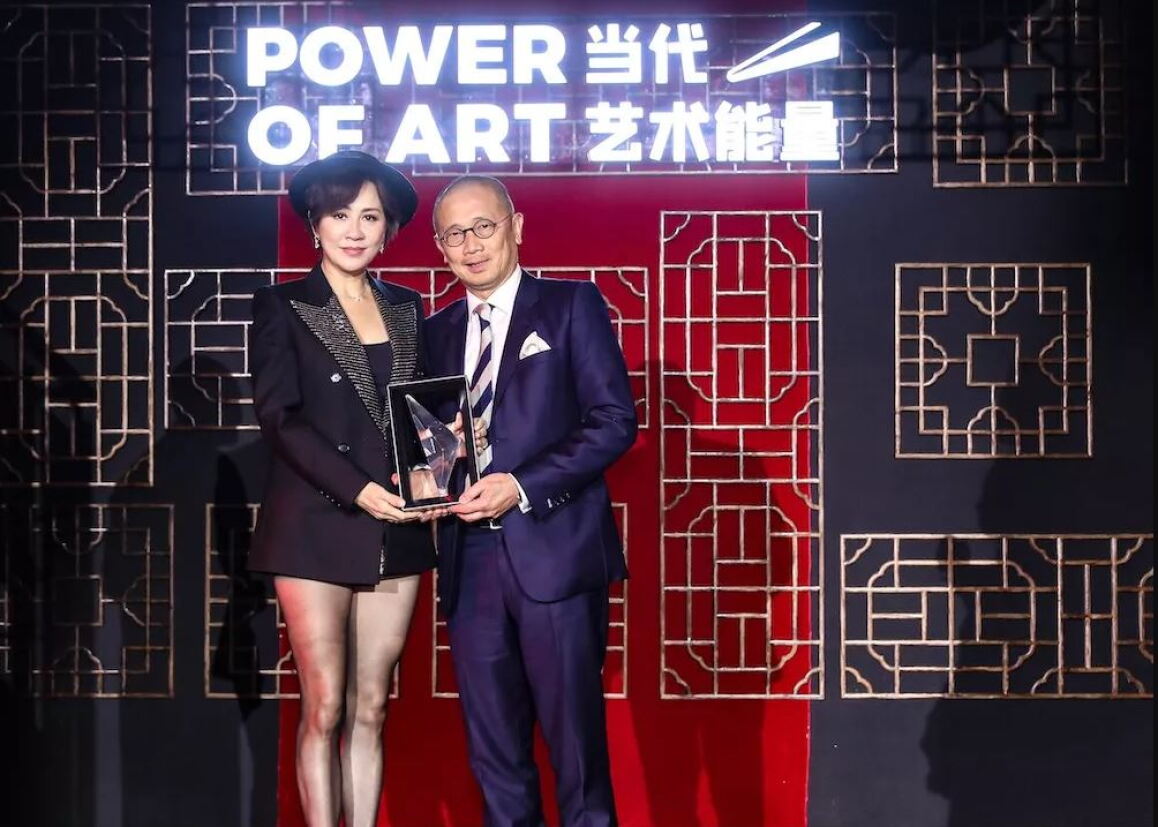
In December 2019, he received an Asia Art Pioneers award, presented by actress Carina Lau. The inaugural awards, founded by Modern Media, recognised contributions to art and contemporary culture. Editors from The Art Newspaper China, ArtReview Asia and LEAP served as jurors. The recognition placed the business of bringing art and audiences together within a broader cultural conversation.
Retirement lasted two years
Ching retired from Sotheby’s in 2021 after 15 years as Asia CEO. On 24 May 2023, he began a new job as Christie’s chairman for Asia, based in Hong Kong. The move brought experience gained at one auction house to its longstanding competitor. His remit included strengthening relationships across the region and helping Asian collectors participate in Christie’s salerooms internationally.
The appointment preceded Christie’s move into The Henderson in Hong Kong. A new building gave the next chapter a visible setting; Ching’s contribution was rooted in relationships accumulated over years. He joined the global Executive Management Group, connecting regional client development to an international business. The title had changed from chief executive to chairman, while collectors remained central to the work.
His 2025 professional biography highlighted the Tianminlou single-owner sale of November 2023 and the Au Bak Ling collection’s place in Christie’s inaugural auction at The Henderson. These collections brought the patient work of individual connoisseurs into public view. Ching’s career had reached a stage where knowing the people behind the objects mattered alongside knowing the objects themselves.
The conversation comes home
By 2026, that work was explicitly celebrating Hong Kong’s collecting community. For Christie’s fortieth anniversary in Asia, Ching and specialist Chi Fan Tsang discussed the city’s traditions around the sale Pearls of the Orient. Ching belongs to the Min Chiu Society, a community whose collecting and scholarship have helped shape appreciation of Chinese art. The sale realised HK$68,440,300 on 30 April.
The emphasis was on the collectors whose decisions preserve objects, develop knowledge and give later generations something to examine. For an executive whose early education included dinners spent comparing jade, the setting feels apt. Connoisseurship grows in company. Someone brings an object; someone else asks a difficult question.
That April, Ching also took part in an art-and-law event co-hosted by Temple Chambers and Christie’s. More than 230 guests attended. After welcome remarks, he joined Laurence Li and Val Chow in a discussion moderated by Theresa Chow, exploring art and law as professions and passions. The evening ended with specialist-led auction previews.
Lawyer, collector, retail executive, auction chairman: the roles had converged in one room. Ching’s career gives those combinations a human scale. The public numbers run into billions. The private pleasure can still begin with a small carving, held close enough to see what somebody else has made.