An auction house has a peculiar sales problem. It can put something extraordinary in the window and still leave a passerby wondering whether they are allowed inside. Charles Stewart, chief executive of Sotheby’s since October 2019, has made that hesitation part of his business. Before anyone raises a paddle, someone has to cross the threshold. The price of admission to an exhibition, meanwhile, is often precisely nothing.
There is a pleasing complication in having a former investment banker explain the pleasures of looking without buying. Stewart’s career includes Morgan Stanley, the international arm of Itaú BBA and the finance office of Altice USA. He knows how to count. At Sotheby’s, he also has to account for the person who wanders in, falls for an object and leaves with an interest they did not have that morning. The transaction may come much later.
His favorite part of a New York working day is walking through the galleries. In a 2025 interview, the objects on his mind included Napoleon’s camp bed, Al Capone’s diamond-initialed pocket watch and Jane Birkin’s original Birkin. It is an excellent antidote to an ordinary office inventory. A stapler has difficulty competing with Napoleon’s sleeping arrangements.
These encounters explain something about the job he actually has. The chief executive manages the business; the objects supply the plot. Each arrives carrying a previous life, and part of Sotheby’s work is finding someone who wants to continue it. Stewart’s own story has involved a similarly indirect route to the right room.
A history major takes the long way round
He graduated from Yale in 1992 with a history degree. The tidy account of a financier marching toward his destiny would have surprised the student. When Stewart returned to campus for a talk in 2007, he described reaching senior year without knowing what he wanted to do. He had interests in squash and singing, rather than a carefully arranged procession of impressive summer internships.
After graduation he taught in Australia and worked on establishing a cooperative in Guatemala. A former classmate’s involvement in investment work connected to Brazil helped him see a possible route into finance. The attraction was a chance to have an impact. His earlier suspicion of the profession makes the eventual career more interesting: this was a choice arrived at through exploration, with some resistance along the way.
The years that followed gave him a practical education in geography and clients. His 19 years at Morgan Stanley included leadership of Latin American investment banking and a deputy leadership role in investment banking across Europe, the Middle East and Africa. He later ran Itaú BBA International in London. These were businesses in which expertise mattered, but so did convincing someone to entrust you with a consequential decision.
At Altice USA, where he was co-president and chief financial officer, he helped deliver the company’s $2.1 billion stock-market flotation in 2017. He also worked on the expansion of its advertising and news businesses. Finance, media and distribution were already meeting in his working life before an auction catalogue entered the picture.
- 1992Yale · History
- 19 yearsMorgan Stanley
- 2017Altice USA IPO
- 2019Sotheby’s CEO
The banker meets the specialists
Patrick Drahi’s acquisition of Sotheby’s in 2019 brought Stewart into another business controlled by an owner he already knew. He succeeded Tad Smith that October. The appointment put a financier in charge of an institution whose authority depends on people who can explain why one painting, watch or ceramic deserves attention and another does not.
The art-world outsider description was convenient, though incomplete. Stewart and his Brazilian wife had been collecting Brazilian contemporary art for years before his appointment. In 2020, he described museum visits and art-history classes as longstanding interests. He was equally clear that a conversation with a Sotheby’s specialist could quickly restore a proper sense of proportion to his own knowledge.
That is a useful admission from the person at the top. The executive can change a platform or approve a new building; he cannot make specialist judgment interchangeable. For a collector considering an unfamiliar object, the institution’s reputation ultimately becomes a conversation with someone who knows it intimately. Making that conversation easier to start is a management problem with a very human answer.
Stewart has described the organization as a combination that includes a Broadway theater and an academic faculty. The analogy earns its keep. There are rehearsals and presentations, but also scholarship, cataloguing and the patient business of establishing what something is. An evening sale compresses all that preparation into a few public minutes.
“Our role is to increase that number.”
Charles Stewart · On the number of collectors, 2020
A saleroom becomes a screen
In June 2020, Sotheby’s staged a live-streamed evening sale linking London, New York and Hong Kong. Stewart discussed the production as something deliberately designed for an audience watching on screens. The event brought $363.2 million. The camera, the timing and the connection between cities had become part of the auction’s machinery.
The subsequent change can be seen in a small pair of numbers. In a conversation recorded in April 2023, Stewart put the share of bids made online in 2019 at about 40 percent. For 2022, he put it at 92 percent. Those figures describe bids, rather than the share of sales value or the number of auctions conducted entirely online. The distinction matters: expensive objects and digital participation were learning to coexist.
Sotheby’s also introduced digital catalogues, hybrid marquee auctions, a Gallery Network and a Buy Now marketplace. Its 2020 reporting recorded a 27 percent increase in first-time buyers over 2019. None of this eliminated the need for confidence in the object. It changed the route by which a prospective buyer could encounter it.
There is a familiar media question beneath the art-market vocabulary. How do you reach people where they already spend their time, then give them a reason to stay? Stewart had been talking about interactive media back in his banking years. At Sotheby’s, the consequence is visible in the distance between a printed catalogue arriving by post and a bidder joining from a phone.
Share of bids placed online, as described by Stewart in April 2023. This is a measure of bids, not sales value.
Concrete, free exhibitions and a new front door
The digital shift makes the investment in physical space especially revealing. Sotheby’s committed in 2023 to acquiring Marcel Breuer’s former Whitney Museum building on Madison Avenue. It opened there in November 2025. After the Whitney, the Met Breuer and Frick Madison, the building acquired an auction-house chapter.
For Stewart there was also a personal return. As a child in New York, he had visited the Whitney to see Calder’s Circus in 1976. Decades later, the museum building became his workplace. His college encounters with art had included architecture lectures by Vincent Scully and photography with Richard Benson. Of the latter, he offers a compact review: “He thought my work was terrible, by the way.”
A familiar museum address gives the company a different introduction to the street. In its first November marquee sales series at the Breuer, Sotheby’s recorded $1.17 billion. Gustav Klimt’s Portrait of Elisabeth Lederer accounted for $236.4 million, including fees. Such a sale makes the building internationally visible. The quieter question is whether people come back between the big evenings.
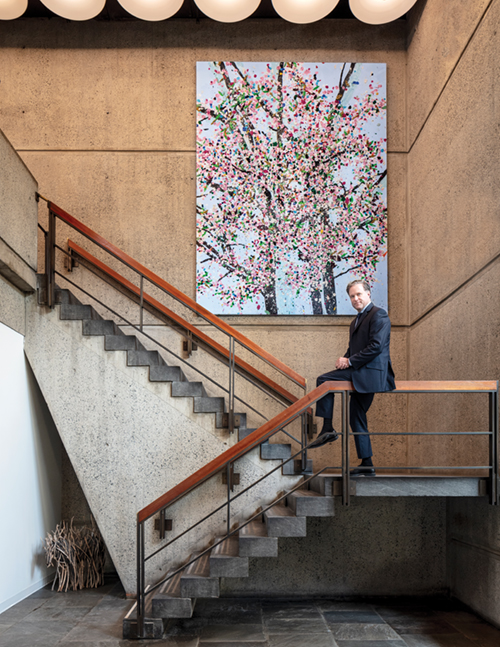
The architecture supplies its own invitation to look. Breuer’s building grows wider as it rises, its galleries extending above a recessed base. A bridge carries visitors over a sunken garden. Inside, the original design’s circular lights turn the ceiling into part of the experience. Even before someone considers a painting, the room has offered them something to notice.
The same attention to an approachable setting appears in Hong Kong. Sotheby’s Maison opened at Landmark Chater in July 2024, with 24,000 square feet over two floors. Its concept store offers objects for immediate purchase. An auction calendar asks a customer to wait for a particular moment; a shop can accommodate the afternoon someone happens to have free.
Expansion comes with a balance sheet
A broader audience still requires a business capable of supporting it. In August 2024, ADQ and Sotheby’s announced a minority investment agreement, with additional capital from Drahi and a combined investment of approximately $1 billion. Drahi would retain majority ownership. The announcement tied that capital to financial strength, innovation and expansion, including Abu Dhabi.
Stewart’s interest in the Gulf has also taken the form of sales and relationships. Ahead of Sotheby’s first Saudi auction in February 2025, he described the region’s growing cultural ambitions and the company’s commitment to it. This is an extension of the international working life that preceded Sotheby’s: understanding where clients are, and where they may be next.
There have been uncomfortable moments along the way. In December 2024, as layoffs affected more than 100 Sotheby’s employees, Stewart’s Instagram photographs from Abu Dhabi drew criticism over their timing. The episode exposed a difficulty in the public-facing executive role. A photograph intended to communicate enthusiasm for expansion can look very different to people facing uncertainty at home.
The recovery in sales should be read with equal care. Sotheby’s finished 2025 with $7.1 billion in consolidated sales, up 18 percent. That figure remained below the $8 billion achieved in 2022. Large collections, the availability of works and collectors’ willingness to sell all influence the total. An auction-house chief can prepare the room; he cannot personally summon every seller into it.
2025 consolidated sales
+18% year on year
First-half 2026 consolidated sales
+58% year on year
What happens after someone walks in?
The latest reported half-year offers Stewart a firmer numerical argument. In July 2026, Sotheby’s announced $4.4 billion in consolidated first-half sales, up 58 percent year on year. It reported $3.4 billion in auction sales, $826 million in private sales and a 90 percent sell-through rate by lot. Visitor numbers at the Breuer were more than double those at the previous York Avenue location in the comparable period.
These are company-reported measures of a busy market and a busy building. Sales totals measure the value of transactions, rather than the company’s revenue or Stewart’s personal wealth. Attendance measures another kind of progress: people have chosen to spend time in the place. Whether their curiosity becomes a lasting collecting habit will take longer to observe.
That leaves a surprisingly modest ambition underneath the billions. Stewart wants more people to feel able to enter, look and learn. The history graduate who found his way into banking now runs a business in which history can arrive as a painting, a pocket watch or a camp bed. He can count the bids afterward. First, he has to get someone interested enough to stop.