The thank-you page is a curious invention. A prospective customer has found your website, considered your product, and asked to see it. You respond with a digital receipt and a promise that somebody will be in touch. The customer has offered you attention. You have offered them an errand to remember.
Chili Piper makes its living inside that exchange. Its software checks whether a prospect qualifies, decides which representative should handle them, and offers a meeting while the person is still there. The proposition is pleasingly impolite: perhaps a company should stop making an interested buyer wait for its internal administration.
- The job: turn buyer interest into a conversation with the right person.
- The distinction: connect booking to qualification, account ownership, and team distribution.
- The evidence: customer stories show improvements after changes to routing and the wider buying process.
- The next bet: AI engagement and follow-up before interest disappears.
The little problem they nearly refused
Alina and Nicolas Vandenberghe started Chili Piper in 2016 with ambitions for enterprise software. Then Stephanie Ouadah at Fivestars asked for help distributing meetings through round robin. In Nicolas’s account, the founders initially thought the task too small. They almost passed.
“We almost declined.”Nicolas Vandenberghe, on the request that helped start Chili Piper
The amusing part is the mismatch of scale. They wanted to change how businesses worked; a customer wanted to know who got the next appointment. That modest question gave the larger ambition somewhere to begin. A meeting sits at the junction of a buyer’s time and a company’s rules. Solve the junction, and the calendar becomes rather more interesting.

By April 2019, Chili Piper reported passing $2 million in annual recurring revenue before announcing a $3 million seed round led by Flashpoint. An $18 million Series A followed in August 2020. In April 2021, Tiger Global led a $33 million round, bringing announced financing to $54 million. Money arrived after the small problem had demonstrated that people would pay to solve it.
The calendar is the last decision
Imagine a prospect at a large company asking for a demo. Someone must establish whether that company already has an account owner. Perhaps territory matters. Perhaps company size determines which team handles it. Perhaps the appropriate representative is away. A booking link alone cannot settle the company’s policy on any of these questions.
Form Concierge handles qualification, routing, and scheduling after a web-form submission. ChiliCal supplies scheduling tools for representatives. Distro works inside the record-assignment problem, routing Salesforce objects and matching leads to accounts. Handoff connects teams, including the sales development representative who needs to book a prospect with an account executive.
Distribution also has a human complication: fairness. Handoff can adjust for cancellations and no-shows and apply weighting rules. Giving every rep an equal number of calendar invitations is not necessarily giving every rep an equal number of conversations. A seemingly dull scheduling decision can become a dispute about opportunity.
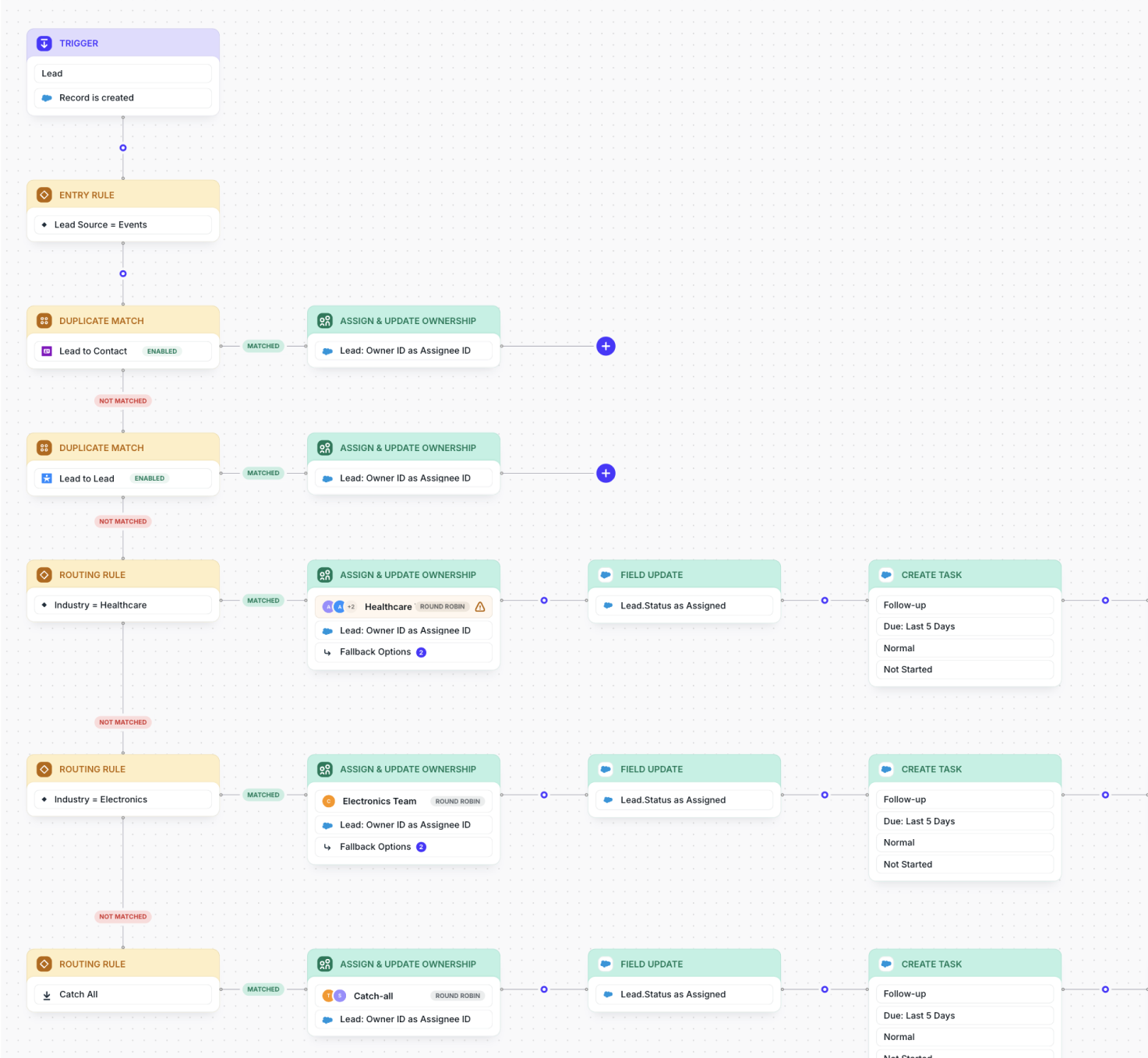
This explains its place among sales tools. Calendly and HubSpot Meetings overlap on booking; LeanData overlaps on distribution; RevenueHero competes in inbound routing and scheduling. Website conversation tools occupy another flank. Chili Piper’s pitch is the connection between these jobs, using shared teams and routing logic. Whether that connection earns its keep depends on how many decisions a business must make before showing someone a time slot.
Three customers, three repairs
At Gong, the old demo request involved a lengthy form, followed by a sales development representative’s outreach and qualification. Marketing automation director Noa Farber’s team first used Clearbit enrichment to reduce the form to an email field. Chili Piper then qualified and routed the enriched submissions, letting suitable prospects book immediately.
The published case study reports a 70% lift in demo-request form conversion and five times as many demo requests. The sequence matters: Gong changed the information-gathering process as well as scheduling. Attributing the entire result to a calendar would miss the work that made the calendar useful.
Workato’s complication was geography. Its routing depended on zip codes. The company’s customer story describes qualified lead-to-meeting conversion moving from roughly 40-55% to 75-80%, with booked demos up 50%. It also describes Slack notifications when someone failed to attend, allowing the team to follow up. Here the repair covered both assignment and attendance.
Directive, a performance marketing agency, changed its invitation from requesting a proposal to immediate scheduling and added account-tier routing. Its website conversion rose from 15% to 23%. The story also credits landing-page optimization. Three companies, then, with three different repairs. The common habit was to examine what happened after interest arrived.
What the machinery costs
As checked on September 30, 2026, Chili Piper’s public Routing & Scheduling plan starts at $1,250 a month, billed annually: $15,000 a year, with up to 15 seats. Additional seats cost $45 a month each. Experiences starts at $3,500 a month, or $42,000 annually, including 30 seats; extra seats cost $50 a month.
Those plans include annual AI credit allowances, and extra credits can be purchased. Standalone enterprise ChiliCal is listed at $12 per user per month with a 200-seat minimum. The relevant buying question is therefore larger than the price of a scheduling link. A team needs to weigh subscriptions, implementation, and ongoing rule maintenance against the value of additional attended, qualified meetings.
A useful calculation begins with your own funnel: how many qualified requests arrive, how many turn into held meetings, and what each extra held meeting is worth. If one person handles a small number of uncomplicated bookings, the value of elaborate routing is limited. Complexity supplies the reason to buy; merely possessing a calendar does not.
The visitor who never submits
Chili Piper’s newer ambition starts earlier. In a public letter, the founders describe realizing that the form was already late in the journey. A person could study a pricing page and leave without submitting anything. Their original system had become good at processing expressed interest while overlooking the interest that remained unexpressed.
Chat AI can answer questions using a company’s supplied knowledge, qualify visitors, and book meetings. Web Experiences adds personalized engagement. Orchestrator responds to events such as an abandoned form or a missed meeting, checks the context, and triggers actions in connected tools. Its email composer can prepare follow-up; low-confidence messages go for review.
The newer developer layer makes the booking process available beyond Chili Piper’s own screens. Its MCP server lets compatible AI tools query and act on company data, while scheduling APIs let an integration submit lead details, obtain available slots, and book. The company updated its MCP connection guidance in September 2026. Scheduling is becoming infrastructure that another interface can call.
Copy the sequence, then measure it
The company's working arrangements carry a related preference for removing unnecessary coordination. Chili Piper has operated remotely since its founding. Its careers material describes autonomy, development coaching, and support for colleagues meeting in person. That is the company’s stated approach to work, rather than proof that every employee experiences it identically.
The practical lesson for a revenue team is straightforward. Start with a genuine request, define who should own it, and offer the next step immediately. Test territory boundaries, existing accounts, absences, and disqualified visitors before publishing the flow. Keep a route for people who should not receive a sales meeting. Measure attended meetings and downstream opportunities alongside bookings.
Chili Piper cannot choose your ideal customer or make an unwanted product desirable. Incorrect CRM data and disputed ownership rules can send automation efficiently in the wrong direction. Its appeal is strongest when a company already has demand and an identifiable coordination problem. The buyer has done the difficult social thing: raised a hand. The company can at least refrain from handing back a waiting ticket.
Follow the next conversation
Explore Chili Piper, its current plans, customer stories, and company writing.
Watch the Form Concierge product demo or Nicolas Vandenberghe’s sales-and-marketing fireside chat. Find the company on LinkedIn, X, Instagram, Facebook, GitHub, and YouTube.