The charming lie of a chatbot is that the screen is empty. It is not. On Character.AI, the blank chat box sits atop a crowded theater: millions of user-made personas, a language model improvising the dialogue, safety systems waiting in the wings and a meter quietly charging for every line. The user types; a medieval knight, anxious classmate or homemade space pirate replies. The exchange feels private. The business behind it is industrial.
Character.AI was founded in 2021 by Noam Shazeer and Daniel De Freitas, two Google researchers with unusually relevant résumés. Shazeer co-authored the transformer paper that underpins modern large language models. De Freitas initiated the work that became Google's Meena and helped lead LaMDA. Their insight was less technical than theatrical: the public might want an AI that could stay in character, not merely retrieve a fact.
The beta opened in September 2022. Two months later, it was generating a billion words a day and users had made more than 350,000 Characters. By March 2023, the library had grown to 2.7 million. People used it for roleplay, fandom, tutoring, brainstorming, comedy and companionship. The creator writes a name, greeting, personality and backstory; the model performs it; other users discover the result. Character.AI did not have to invent every hit. It built the stage and let the audience cast the show.
What it actually built
Calling Character.AI an “AI companion” is accurate but incomplete. Replika centers the relationship with one companion. General assistants such as ChatGPT and Gemini organize themselves around usefulness. Character.AI organizes around a cast. Its competitive advantage is the combination of conversational models, a giant supply of creator-made Characters and a discovery loop that sends an audience back toward creators.
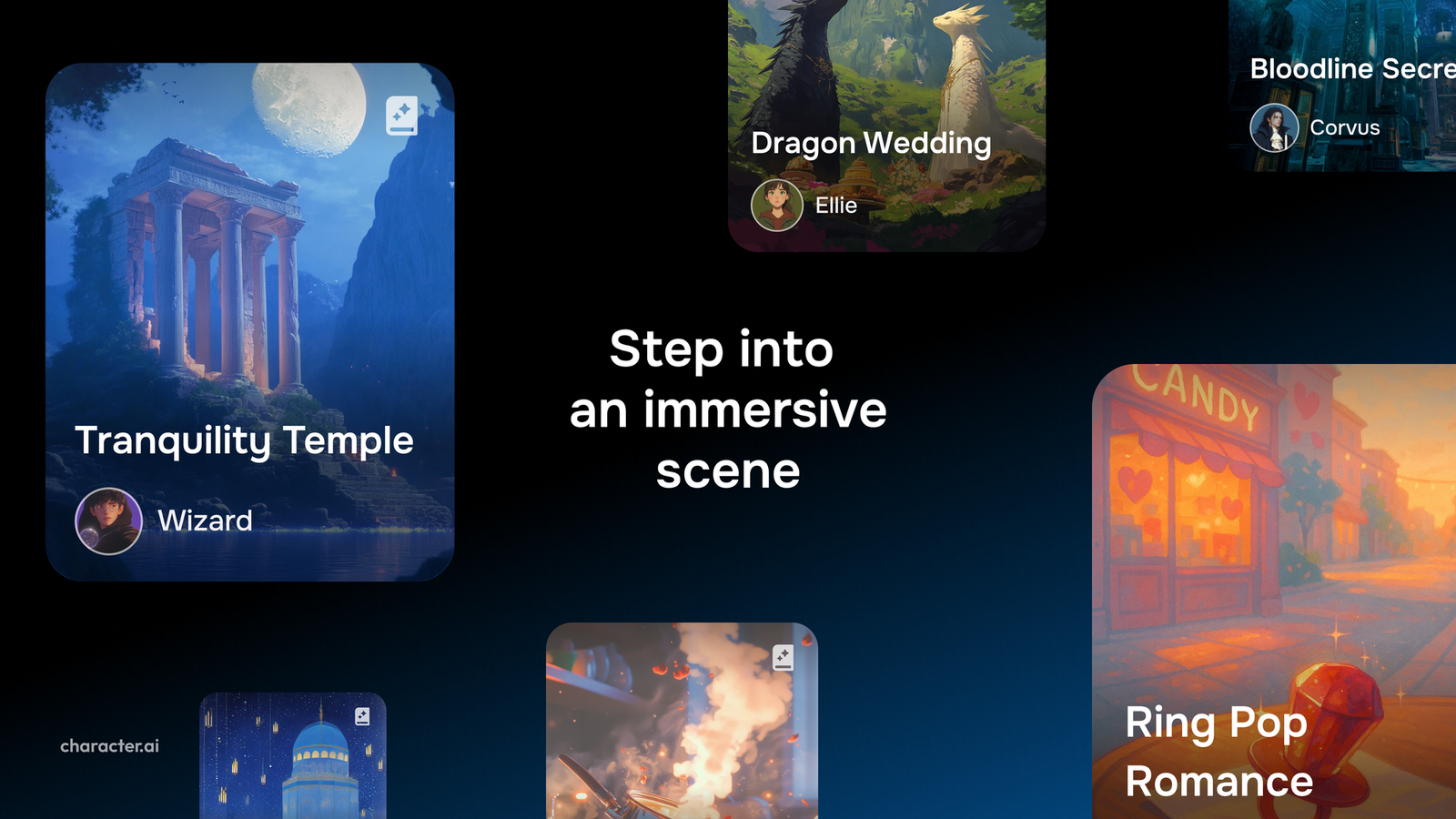
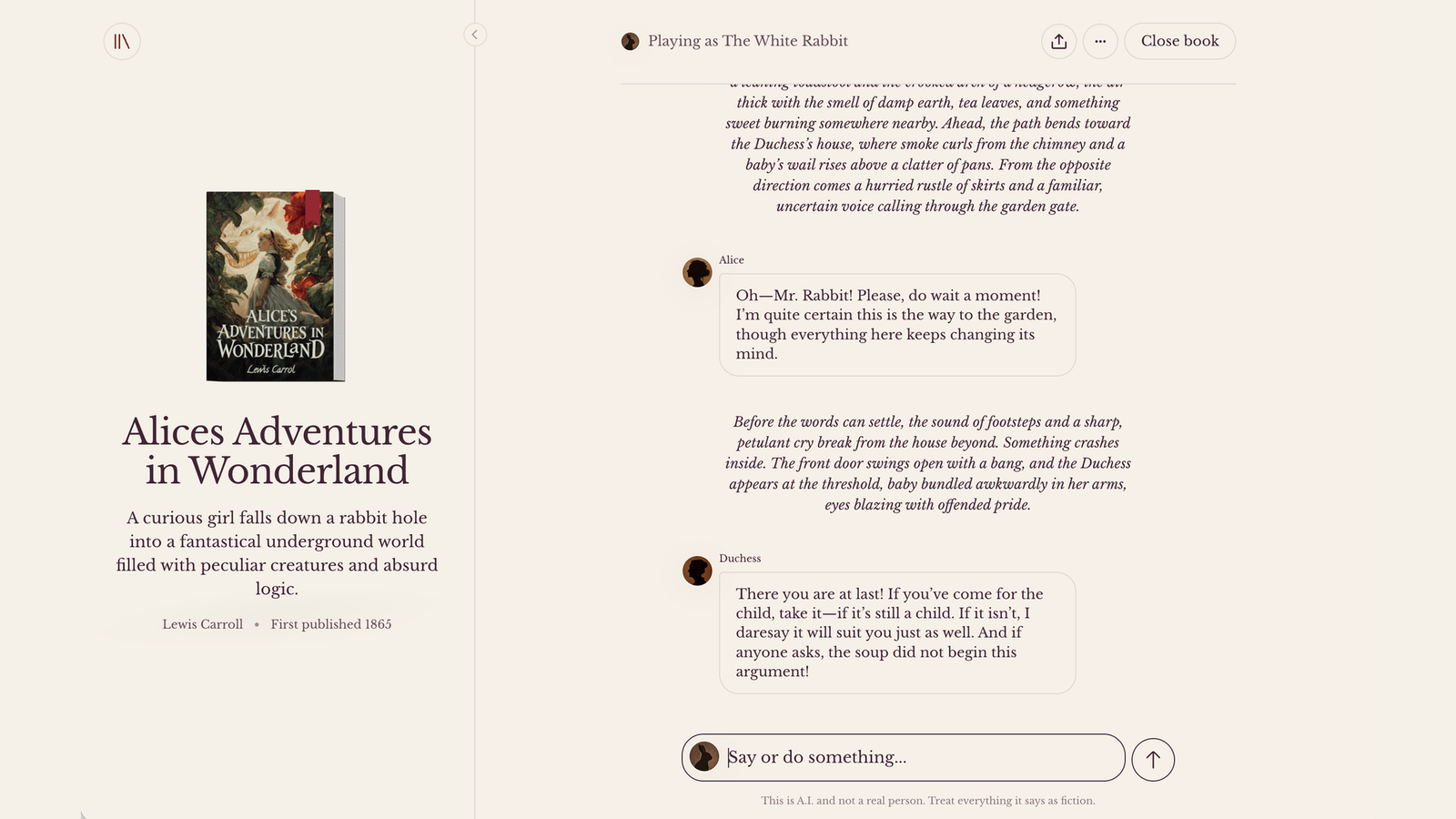
That loop now stretches beyond text. Users can call Characters, place them inside prebuilt Scenes, watch two of them spar in Streams, animate an image with AvatarFX, publish the result to Feed and build branching adventures in Stories. c.ai Books drops a user into public-domain novels. Lorebook lets creators define places, objects, factions and rules once, then attach the same canon to several Characters. The latter solves a deeply unglamorous problem: fictional people who forget their own fiction.
Its customers are mostly consumers, especially young adults who already understand fandom, roleplay and remix culture. In 2025, the company said it had about 20 million active users and more than 6 million daily active users, spending an average of 70 to 80 minutes a day. Creators are the supply side: they make the personalities and worlds that give everyone else a reason to return. Media owners are the emerging third side, because an official character can turn intellectual property from something watched into something answered.
“The boundary between creator and consumer is disappearing.”Karandeep Anand, CEO, on the launch of Feed
The $2.7 billion hinge
The original company described itself as full-stack. It trained proprietary frontier models, served them at consumer scale and owned the interface. That sounded like control. It also sounded like a utility bill with ambitions. Character.AI raised $150 million in a 2023 Series A led by Andreessen Horowitz at a $1 billion post-money valuation, after roughly $40 million of earlier financing. Even that much capital was small beside the escalating price of frontier training and the daily cost of long, high-volume conversations.
In August 2024, Google signed a non-exclusive license for Character.AI's model technology and hired Shazeer, De Freitas and more than two dozen researchers. The agreement was widely reported at about $2.7 billion. It was not a normal acquisition: Character.AI remained independent, its app remained online and Google gained talent and rights without buying the whole company. Investors received liquidity; the remaining business received runway.
Train frontier models, serve the app and own the stack end to end.
Use third-party and refined open-source models; invest in product, creators and entertainment formats.
The deal changed the company's center of gravity. Dominic Perella became interim CEO. In June 2025, former Brex president and Meta product executive Karandeep Anand took the job. His roadmap spoke less about general intelligence and more about memory, model quality, discovery, creator controls and multimedia. The company had learned an expensive distinction: users can love the experience without caring whether every underlying parameter was trained in Menlo Park.

What failed first
Before strategy broke, the website did. In December 2022, the team publicly documented traffic spikes, latency, instability and maintenance windows. It also admitted to pre-generating four alternative replies for every message even when a user saw only the first - a generous interaction design with a savage compute habit. The team changed the swipe system and worked on serving efficiency. This is the first reusable lesson: in generative products, a delightful button can conceal four invoices.
The subtler failure was memory. A Character could produce a dazzling paragraph and later forget a name, relationship or rule established minutes earlier. That is tolerable in a search answer and ruinous in a story. Character.AI kept shipping pins, chat memories, model upgrades and, in 2026, a visible memory meter plus Lorebook. Intelligence attracts a trial; continuity earns the next hour.
A better sentence is nice. Remembering the locket, the rival kingdom and who betrayed whom is the product.
The safety reversal
Character.AI's engagement is also its most serious liability. A persona can feel attentive, persistent and emotionally specific. Lawsuits alleged that interactions harmed minors, including a case filed by the mother of a 14-year-old who died by suicide. Character.AI has disputed liability while steadily changing the product: clearer reminders that Characters are not real people, self-harm interventions, session notices, teen-specific models, parental activity reports and stronger moderation.
Then it changed its mind about the core experience. In October 2025, after feedback from regulators, parents and safety experts, Character.AI announced it would remove open-ended chat for under-18 users. The rollout began in November. Age assurance, including tools from Persona, would separate experiences. Teens could still use guided formats such as Stories, video and Streams, but not disappear into unrestricted one-to-one dialogue.
That reversal matters because the company had already spent a year trying narrower guardrails. It concluded that filters alone did not answer the larger question: should a minor form an open-ended relationship with a machine designed to keep replying? The new boundary sacrifices a source of engagement to reduce a category of risk. It is a product decision, a legal decision and an admission that conversational entertainment is not governed like a normal game.
From chatbot to studio
Character.AI now makes money through several experiments. c.ai+ has standard pricing of $9.99 a month or $94.99 a year in published 2026 terms. The free product carries ads and some usage limits. Charms can be earned through quests and spent on premium actions, with purchases planned. Studio microdramas sell episode continuation. None is as simple as charging per seat, because the company wants mass consumer reach while every enthusiastic user creates inference expense.
The most interesting test is (c.ai) series, a slate of vertical shows produced by an in-house studio. Six episodes of the romance anime Last Summer were free. Of viewers who reached episode seven, more than 10 percent paid to continue. Among adult viewers who finished, more than 40 percent opened a cast profile or Character chat; a quarter of those chatters returned for multiple sessions. The sample is qualified and company-reported, not a platform-wide conversion rate. Still, it reveals the thesis: credits need not end a story when the cast can keep improvising.
Where does that place Character.AI? Somewhere between Replika and Roblox, with a little TikTok and interactive fiction folded in. Replika and Nomi sell companionship. Chai, Talkie and PolyBuzz compete for character chat and roleplay. ChatGPT and Gemini compete for conversational time. Roblox offers the cleaner business analogy: creators make the inventory, a platform distributes it, and audiences become creators when they remix what they find. Character.AI's difference is that every object can speak.
What builders can steal
Make the model disappear
Users choose a knight, tutor or rival - not a parameter count. Package capability as a role with an obvious reason to return.
Turn creation into inventory
A good user-made Character becomes a landing page for the next user. Templates, publishing and discovery turn labor into distribution.
Fix continuity before cleverness
For persistent experiences, memory and canon beat a momentarily brilliant answer. Lorebook externalizes what the model must not forget.
Measure the second action
Character.AI asks whether viewers enter the cast's world after finishing a show. The handoff reveals whether a format forms a loop.
There is another lesson in the Google agreement: decide which layer deserves your capital. Training a frontier model can create differentiation, but it can also consume the company before the consumer product matures. Character.AI traded some technical sovereignty for runway and focus. That move only works when the experience has its own assets - a creator network, brand, behavioral data and distribution - that survive a model swap.
When the playbook does not work
This model fails if creators do not produce enough good Characters, discovery rewards repetitive junk, memory breaks immersion, rights holders reject unofficial personas, moderation costs outgrow revenue or engagement depends on unsafe relationships. It also fails when a general assistant can reproduce the experience with one prompt and import the user's existing social graph. The flywheel needs distinctive supply, repeat visits and rules strong enough to keep both people and intellectual property owners in the room.
Character.AI's story is not a clean ascent. It is a succession of constraints: traffic broke serving, conversation exposed memory, model ambition met capital, and emotional engagement met responsibility. Each constraint pushed the company one layer upward - from model to product, from product to platform, from platform to media format.
The company once promised everyone a personal AI. Its more credible ambition now is narrower and stranger: entertainment that talks back, remembers the props and lets the audience write tomorrow's episode. The result may be a new medium or an unusually elaborate feature set searching for a business. Either way, Character.AI has already shown the behavior is real. People do not merely ask these machines questions. They enter, linger and bring costumes.