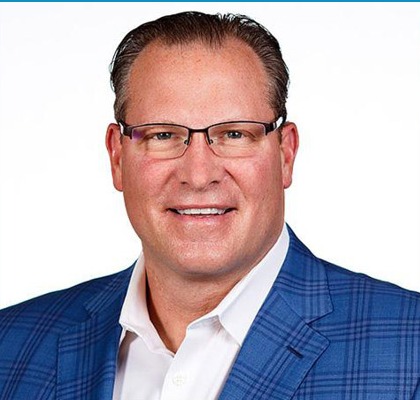
Walk into a gas station in Texas and you can buy CBD next to the beef jerky. Walk into the right doctor's office and you can buy Chad Collins's version - and only there. That single distinction is the whole company. Corganics, the Dallas firm he co-founded in January 2020, sells broad-spectrum CBD you cannot pick up retail. You need a code from a healthcare provider who has decided to put their name next to the bottle.
The CBD you can only get from your doctor
Most founders chase the biggest possible market. Collins did the opposite. He took a product millions of Americans already buy on impulse and made it harder to get - on purpose. The reasoning is almost stubbornly simple. One in five Americans is using some sort of CBD. Three in five, by his telling, see it as valid medical therapy. And yet the people with the medical degrees were nowhere in the conversation, while the shelf down the street was a swamp of inconsistent labels and wildly variable quality.
So Corganics built for the doctor, not the doom-scroller. The products are formulated and advised by physicians, third-party tested, IRB-backed, and held to a manufacturing standard Collins likes to compare to pharma rather than to the corner store. They are broad-spectrum and THC-free - at or below the 0.3% federal line - built on what the company brands Advanced Lipid Technology. They are not prescriptions. They are something stranger: a consumer product that refuses to act like one.
The distribution model follows from the philosophy. You cannot fill a cart with Corganics on a whim. The products are sold at partnered provider offices, or online only when a clinician hands a patient a code. That deliberate friction would be marketing suicide for most consumer brands. Collins treats it as the point. If a healthcare professional is willing to put a product in front of their patient, the product had better be able to survive the scrutiny that comes with it - the certificate of analysis, the testing, the question of what is actually in the bottle.
Teaching the body's own switchboard
Corganics describes its mission in terms most CBD brands never bother with: bridging the gap between healthcare professionals and their patients when it comes to understanding and treating the endocannabinoid system - the network of receptors that helps regulate things like mood, sleep, and pain. The company's pitch is not "buy our gummies." It is closer to "let your doctor explain the biology first." Collins has pointed to research suggesting a healthcare professional's recommendation is the single biggest catalyst that moves a curious patient into an actual user - the moment skepticism turns into a decision.
That insight reframes the whole business. The product is almost the easy part. The hard part is education - giving providers the marketing resources, the data, and the language to have a conversation their patients are already trying to start. Collins keeps returning to the same two failures he is trying to fix: healthcare professionals were left out of the CBD discussion entirely, and the retail market was so inconsistent that quality became a coin flip. Solve for both and you have a category that behaves less like a fad and more like a therapy.
Twenty years of pharma, pointed at a hemp plant
Collins did not wander into healthcare. He spent two decades inside it - biopharmaceuticals, payor systems, medical devices, the unglamorous machinery of how treatments actually reach patients. He served as a Vice President at Galderma, the global dermatology company, and as President and CEO of Boston Select Asset Group. The throughline is brand-building inside regulated, science-first markets - the exact muscle the CBD aisle was missing.
His paper trail is just as deliberate: a BBA in Marketing from Texas Tech University, an MBA in General Management from Cornell University, and an Executive Education stint at Harvard Business School. Three schools, three very different campuses, one consistent instinct - put rigor where rigor is absent. He co-founded the company with Reggie Gatewood, a fellow pharmaceutical-industry executive, and the two rebranded the original entity, MD Farma, into Corganics around the company's Series A raise.
A Series A that bet on the middleman
In late 2021, Dallas-based Altacrest Capital led Corganics' Series A, capital aimed at expanding the clinical product portfolio, scaling commercial operations, and funding research. The investor's logic mirrored the founder's: hemp-based clinical cannabinoids are only as good as the trust around them, and the fastest way to build that trust is to route it through a healthcare professional who is willing to stake their reputation on the recommendation.
Collins framed it plainly. "Patients are asking healthcare professionals about clean, safe natural products," he said. "We provide healthcare professionals a brand they can trust." It is a strategy that lives or dies on credibility - which may be exactly why a man who spent twenty years in regulated pharma found it intuitive.
the Fire
His father ran into a burning car. On crutches.
Before Corganics, before Cornell, there was a night Collins has never let go of. He was five. Driving with his father, they came upon a car engulfed in flames. Rick Collins - a Vietnam veteran who had lost both legs to a landmine and taken three bullets through the shoulder - got out on crutches and ran into the fire. He pulled an unconscious teenage girl from the wreckage, breaking the steering column with his upper body to free her.
Asked later why he did it, Rick gave the line that became the book's spine: "Somebody in that vehicle was loved by somebody." Chad spent roughly a year writing Run to the Fire after his father passed in December 2020. The foreword comes from NFL Hall of Famer and fellow Vietnam veteran Roger Staubach, who had quietly visited Rick at a VA hospital in the 1970s.
Faith, family, football - the three F's
Ask Collins what runs the household and he answers in monosyllables: faith, family, football. Two of his three children played college football at Texas Tech; his oldest son went on to earn an MBA there. It is the kind of detail that explains a lot about a man who chose to build a company around accountability and trust rather than reach. He describes himself, on his own professional profiles, as a servant leader and an innovator - and the through-line from the burning-car story to the doctor-gated CBD bottle is not subtle once you see it. Both are about being the person somebody can count on when it matters.
There is a quiet contrarianism here too. The easy money in CBD was always retail - bright packaging, big claims, no gatekeepers. Collins looked at that and walked the other way, toward IRB approvals and certificates of analysis and the slow work of convincing clinicians. It is less a marketing strategy than a temperament.
The Staubach connection says something about the world Collins moves in. Roger Staubach - Dallas Cowboys legend, Heisman winner, Vietnam veteran - did not write a foreword for a first-time author by accident. He had known the Collins family's story since the 1970s, when he visited Rick at a VA hospital with no press and no audience, just hours spent encouraging men who were learning to live with what the war had taken. Decades later, when the son sat down to write the father's life, that quiet thread of Texas, faith, and service was still intact. It is the same thread, arguably, that runs through a company built on the premise that someone should be willing to vouch for what they put in front of you.
How he got here
Find Chad Collins
Sources: D Magazine, Dallas Innovates, MarketScale, Heroes & Icons Podcast, Crunchbase, Corganics. Facts drawn from public interviews and reporting.