The first campaign took 39 hours. The next took two. In Celtra’s account of its work with McDonald’s Finland, that difference is the detail to linger over. A burger had not become easier to photograph. Finnish customers had not suddenly agreed to buy whatever appeared on a screen. The team had built something it could use again.
- Celtra turns approved creative into reusable systems for making ads across markets, formats and products.
- Its customers include brands, agencies and media operators with large adaptation workloads.
- The business case depends on repeated work. Production savings and advertising returns need separate measurements.
The campaign after the campaign
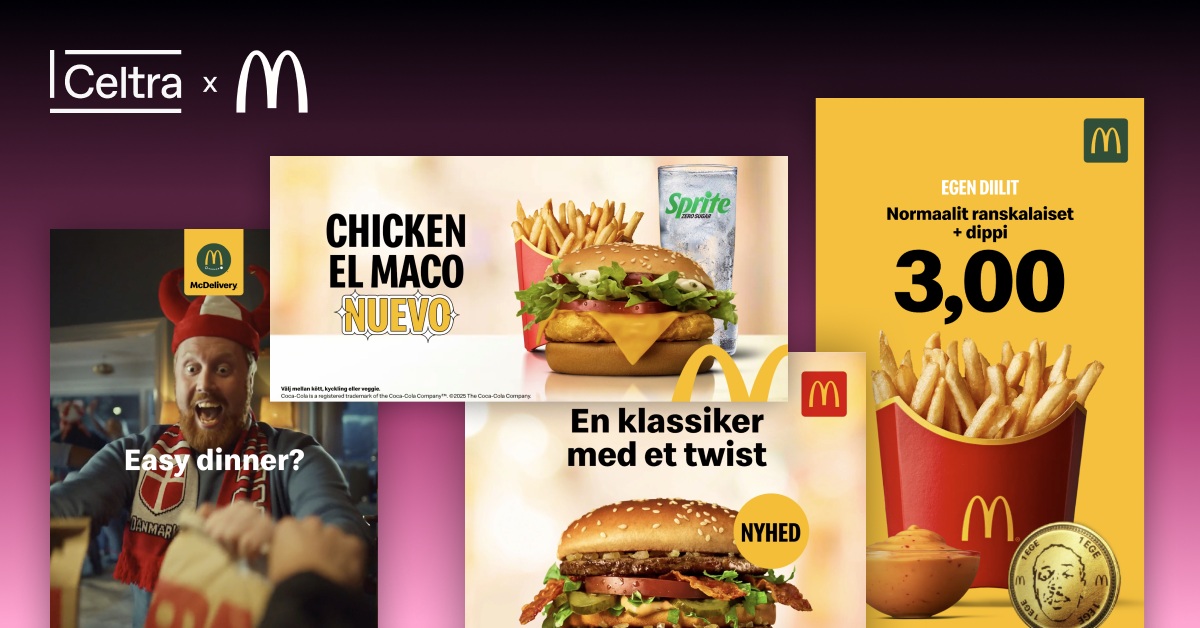
McDonald’s Finland already had a successful video campaign. Its problem was extending that work across more digital touchpoints without commissioning each asset afresh. The team adopted two flexible template structures: one for product offers and local prices, another that brought scenes from national television commercials into the product message.
The published case reports first-launch effort falling from 115 hours to 39, and repeat-launch effort from 27.5 hours to two. The distinction matters. There was still substantial work in establishing the system. Its economy appeared when the next launch could inherit that work. Anyone buying production software should keep those two columns separate.
One shared scale: 115 hours. Vendor-published case results; these measure production effort, not sales.
A separate McDonald’s Nordics case describes a common creative supply system across Denmark, Sweden, Norway and Finland. Toolkits support work from in-store kiosks and app content to paid media. Celtra reports a 12.8-fold production-efficiency gain. The organizational change is at least as interesting: four markets can adapt a shared system instead of repeatedly rebuilding one.
A template is a decision about power
Consider an illustrative campaign with six sizes, four languages and five offers. That is 120 combinations before anyone requests a new photograph. The arithmetic is simple; the approvals are less obliging. A font changes, a price expires, a translated headline breaks onto an extra line. The attractive master design becomes a queue of small jobs.
120 versions of one idea.
Celtra’s Creative Automation offers a way to structure those adaptations. Designers make reusable toolkits; other teams work within the system to create the needed versions. Deciding what remains fixed, what can change and who approves the result becomes part of designing the campaign. The template carries some of the decisions that otherwise travel through messages and meetings.
Nike’s published case makes this concrete. Celtra’s Creative Services helped build a global toolkit containing approved templates and a user manual. Local teams could swap imagery and copy to produce localized work. Celtra reports more than 17,000 creatives in one round and a 19.5-fold production-efficiency gain. That is evidence about production capacity. It does not establish how many extra shoes the campaign sold.
At Cannes in 2025, Unilever executive Ryu Yokoi described a rapid shift to modular production in the company’s North American market. The attraction was the ability to remix content, localize it and respond to changing occasions. Large advertisers have plenty to say. Their difficulty is often getting the appropriate version into the appropriate place while it is still appropriate.
“We went from 0% modular to 100% of our digital programs being run modular in about eight months.”
Ryu Yokoi, Unilever / Cannes conversation, 2025
Following the work nobody wanted to repeat
Celtra began at Babson College in 2006 with Miha and Maja Mikek and Matevž Klanjšek. Its early sequence included FunkyCall in 2007, a mobile marketing platform in 2008 and AdCreator in 2010. The later business grew out of creative technology for mobile rich media, before expanding into the production needs of brands and agencies.
In 2017, Unilever Ventures and WPP led a $15 million investment. That brought a major advertiser and an agency group into the financing story, alongside a partnership to use Celtra’s technology across Unilever’s marketing organization and its surrounding suppliers. Celtra launched Creative Automation in 2020. STG announced a majority investment the following year.
The STG announcement described Celtra as profitable since 2017 and forecast more than $50 million in revenue for 2021. Those are historical statements, including a forecast. They explain why this company belongs in a conversation about established enterprise software rather than being understood only through its latest AI features.
Two doors into the same advertising mess
For brand teams, Creative Automation handles the supply of creative across campaigns and markets. Dynamic Product Ads brings catalog information into product advertising. Creative Services supplies help with execution and technical requests. That combination accommodates companies whose internal designers want to own the work but occasionally need additional expertise or capacity.
For media owners and operators, Creative Enablement addresses a different part of the job: building and serving rich media and video advertising, then reporting on it. Its advertised capabilities include interactive and shoppable formats, trafficking tags, personalization and measurement. A publisher needs an ad product it can sell and deliver; a global brand needs a campaign it can adapt. Celtra serves both workflows.
adidas offers a pleasingly literal example of creative meeting utility. In a published interview, Becca Hersh described her team discovering that it could embed a Google Maps view in display ads. The team then built a store-locator strategy around showing a store near the person receiving the ad. It also used Celtra’s Creative Services for difficult technical requests and periods of limited internal capacity.
Celtra sits among creative automation and management platforms. Bannerflow also advertises template scaling, feed-driven versions and brand control. These features are therefore a buying category, not an exclusive invention. Celtra’s particular proposition combines enterprise brand production, a media-facing creation and serving platform, and specialist services. Buyers should compare the actual workflow they need, including the handoff into their existing advertising tools.
The invoice has more than one moving part
Celtra’s pricing is custom. Its public pricing page identifies platform choice, team and output scale, serving volume, and add-ons as inputs. Ad-serving charges depend on impressions and/or video starts. Extras can include Dynamic Product Ads, predictive AI, custom API integrations and Creative Services. Contracts include onboarding, customer success and 24/5 technical support.
The practical evaluation follows from that structure: count the recurring adaptations, record the labor they consume and price the required setup. Then compare the cost of later launches, including review and distribution. A lower cost per version matters only if the business needs those versions. A modest campaign with few changes may have too little repeated work to repay an elaborate toolkit.
Siemens’ case identifies an earlier warning sign. Asset delivery that once took two days had stretched to ten as resizing and versioning consumed capacity. Designers then built reusable templates that content leads could adapt themselves. The reported change concerns who could do the work and how long it took. That is a more useful diagnosis than simply declaring the team needed to move faster.
AI arrives at the handoff
Celtra’s AI Content Assistant targets another ordinary delay: designers waiting for approved copy. Its published description includes generating text variations within content feeds and using realistic placeholder copy to expose layout problems earlier. The task is recognizably practical. An awkward line break is a small thing until it appears in several hundred assets.
In May 2026, Celtra introduced AI Creative Flows, describing reusable node-based workflows that combine brand references, prompts and AI models to generate images, video and variants within its production environment. The proposed benefit is keeping generation close to review and launch. Moving an image between tools may seem trivial until every change needs another handoff.
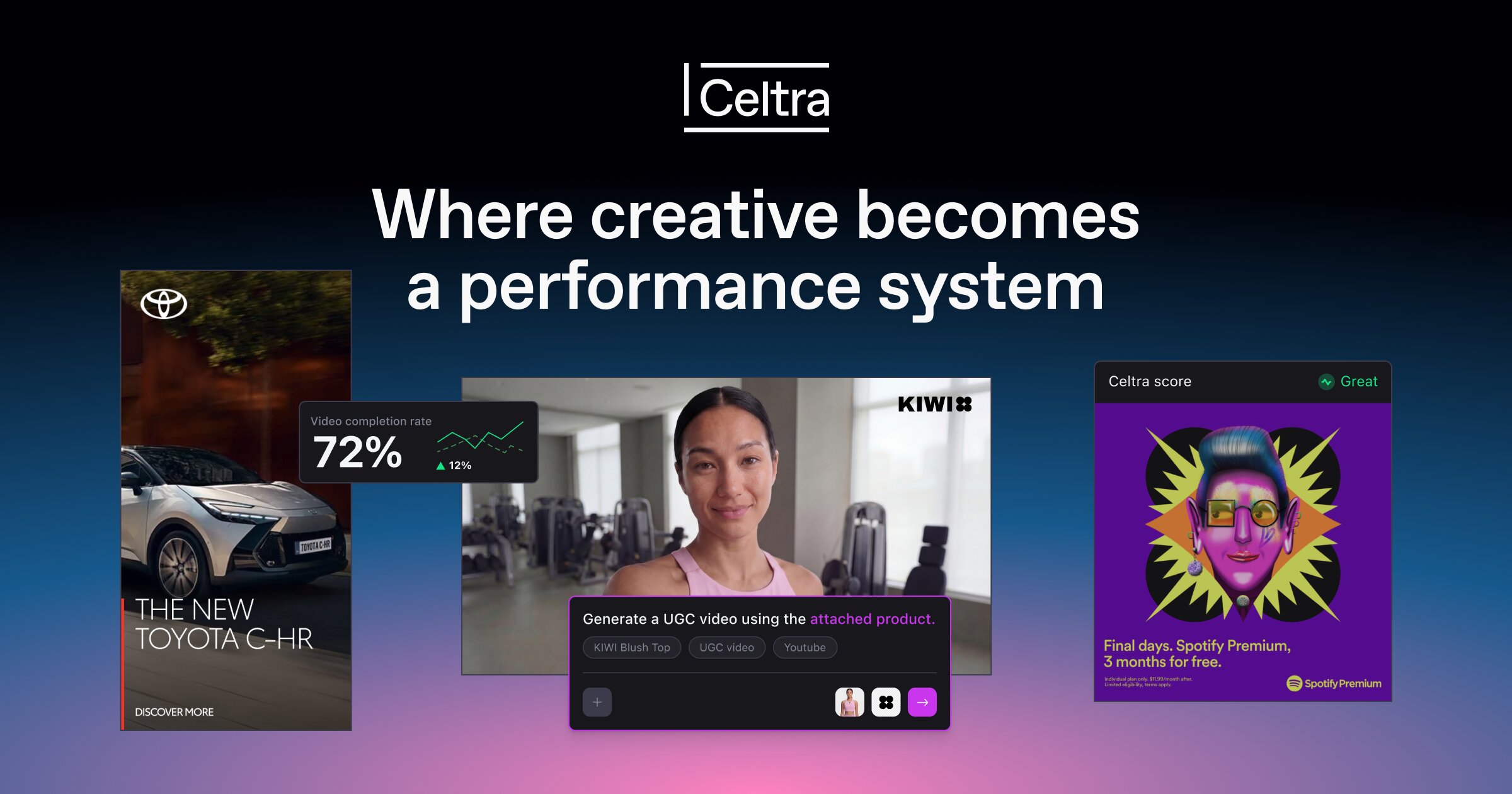
The lesson readers can copy does not require adopting every feature. Start with a campaign that will recur. Identify the components that can be reused, define which fields local teams may edit and agree on review authority. Measure the first launch and the repeats separately. Treat production speed as one result, and test the advertising’s effect as another.
Celtra’s appeal depends on having that repeated work, dependable content inputs and people willing to agree on the rules. A template cannot settle a disagreement about the offer. It can, however, preserve a decision once the argument is over. The next campaign then begins with something more useful than an empty folder.
See the machinery
Explore Celtra, its Creative Automation platform, Creative Enablement and pricing.
Watch the Creative Automation product explainer on YouTube or the AI Creative Flows demo. Read the Unilever webinar overview and browse company updates.