Celine King did not grow up sketching trucks in the margins of her notebooks. Before college, she has said, a truck was mostly the large thing in front of her on the highway. Her plan was veterinary medicine. Seven years later, the Philadelphia-area founder spends her days thinking about freight carriers, fuel records, telematics feeds and the stubborn gap between what a supply chain emits and what anyone can reliably prove about it.
This is less a reinvention than a chain reaction. Biology led to climate science. Climate science exposed the distance between evidence and action. Business analytics offered a way to close it. A renewable-energy finance internship showed how companies allocate money and responsibility. Then trucking presented a gloriously unpolished problem: an enormous, fragmented industry facing new reporting demands without a tidy data layer underneath them.
King's company, GreenIRR, works in that untidy middle. Its software connects to systems fleets already use, gathers primary vehicle-level data, and turns it into emissions reports and operational analytics. The proposition sounds modest until one notices the paperwork it replaces and the decisions it might sharpen. In an industry of thin margins, the road from carbon measurement to fuel efficiency is pleasingly short.
01 / The first turnA career changed by two Zoom windows
King arrived at Fairfield University in 2019 as a biology major on a pre-veterinary track. During her sophomore year, two courses rearranged the map. One covered climate change. The other, taught by Richard Hyman, examined environmental ethics. They met remotely during the pandemic, an uncinematic setting for a life pivot. King later described her reaction to the material as visceral. By the end of that year, she knew she wanted a climate career, even though she could not yet name the job.
The useful thing about not knowing the job was that she kept collecting methods. She added business analytics as a second major. Through Fairfield, she spent a summer conducting climate research with the National Oceanic and Atmospheric Administration at UConn's Coastal Biogeochemical Dynamics Lab. She later said a presentation of that work to policymakers was dismissed quickly. The experience left her looking for a route by which evidence could travel farther.
The next summer, she joined Greenbacker Capital, an investor in renewable infrastructure. There she encountered power-purchase agreements and the cross-functional machinery of corporate decisions. The work was useful, respectable and predictable. Predictability, she discovered, was precisely the itch. She wanted what she later called “decisions of consequence” - work in which she would own the result rather than pass an analysis to someone else.
02 / The buildNine months, one pitch and a sharper problem
Hyman also mentored students in Fairfield's entrepreneurship program. He invited his class to bring an idea into the nine-month StartUp program. The work was voluntary, not a shortcut to course credit. King arrived prepared. She and Hyman worked on the concept for nine months, and she eventually invited him to become a partner.
The first public version of GreenIRR was broader than the company that exists now. At Fairfield's 2022 showcase, King and teammate Logan MacDougall presented software that would give investment managers current environmental data about their holdings. The team won the People's Choice Award. GreenIRR also took first place in a Connecticut collegiate pitch-off at Yale and became a finalist in Smith College's Draper Competition.
But applause is not product-market fit. The idea narrowed toward freight, a sector where the reporting burden was becoming concrete and the raw information remained scattered. GreenIRR's current product is built for carriers and enterprise shippers. It pulls from telematics, fuel-card, OEM and other fleet systems; normalizes the records; and produces audit-ready emissions reporting alongside trucking-specific analysis.
Connect
Existing fleet and vehicle systems
Collect
Primary vehicle-level records
Normalize
Consistent, usable fleet data
Report
Emissions and operating insight
This sequence is the company's real argument. A carbon figure is only as persuasive as the records beneath it. Estimated miles and hand-entered spreadsheets might satisfy a rough internal exercise; they become awkward when a large customer asks for defensible Scope 3 freight data. GreenIRR begins closer to the engine.
“Uncertainty can be a superpower.”Celine King on choosing the founder's path
03 / The saleClimate language, translated into fleet language
The hardest technical system was not necessarily the code. King has called the larger challenge “bringing brand-new technology into a legacy industry.” Trucking is old, competitive, decentralized and correctly suspicious of anyone arriving with an abstract obligation and a fresh subscription. A fleet manager has a budget, a fuel bill, customers to retain and trucks that must keep moving.
King learned to make the climate case without leaning on climate sentiment. Fuel consumption can be discussed as cost. Vehicle performance can be discussed as efficiency. A customer's request for emissions information can be discussed as a bid requirement. The environmental benefit remains the reason she entered the work, but the operating evidence gives the product somewhere practical to stand.
That translation matters because reporting used to be remarkably manual. Fairfield's profile of King described spreadsheet-based emissions work that could consume 30 to 40 hours. GreenIRR was designed to generate reports in seconds once the systems are connected. The comparison is less about speed for its own sake than about attention. Hours returned to an operator can be spent on the fleet rather than on reconstructing it cell by cell.
Illustrative time comparison based on the workflow described in King's Fairfield alumni profile. Bar lengths are not to scale.
There is a neat chemical fact under the business model: burning fuel produces emissions in a fixed relationship. King often returns to this one-to-one logic. Reduce unnecessary fuel use and both the cost and the footprint move in the same direction. Software does not make that chemistry true. It makes the relationship visible enough to manage.
04 / The founderPressure, proof and the people in the corner
King founded GreenIRR at 20. Being young in fundraising rooms and in trucking meant credibility sometimes took longer. Her answer was expertise. She has described the question-and-answer portion of a pitch as a favorite arena: a polished deck can be practiced, but follow-ups reveal whether a founder understands the market. Years of what she cheerfully calls nerding out became a form of authority.
The pitch practice produced visible milestones. In August 2023, a federal filing reported that GreenIRR had sold $130,000 of a convertible-note offering to two investors. Later, King pitched live in New York on The Pitch at the SEEN Summit, where GreenIRR was funded. The point is not a fairy-tale ending. Each check merely purchased more time with the unglamorous questions: which integration comes next, which customer pain is urgent, which report has to survive scrutiny?
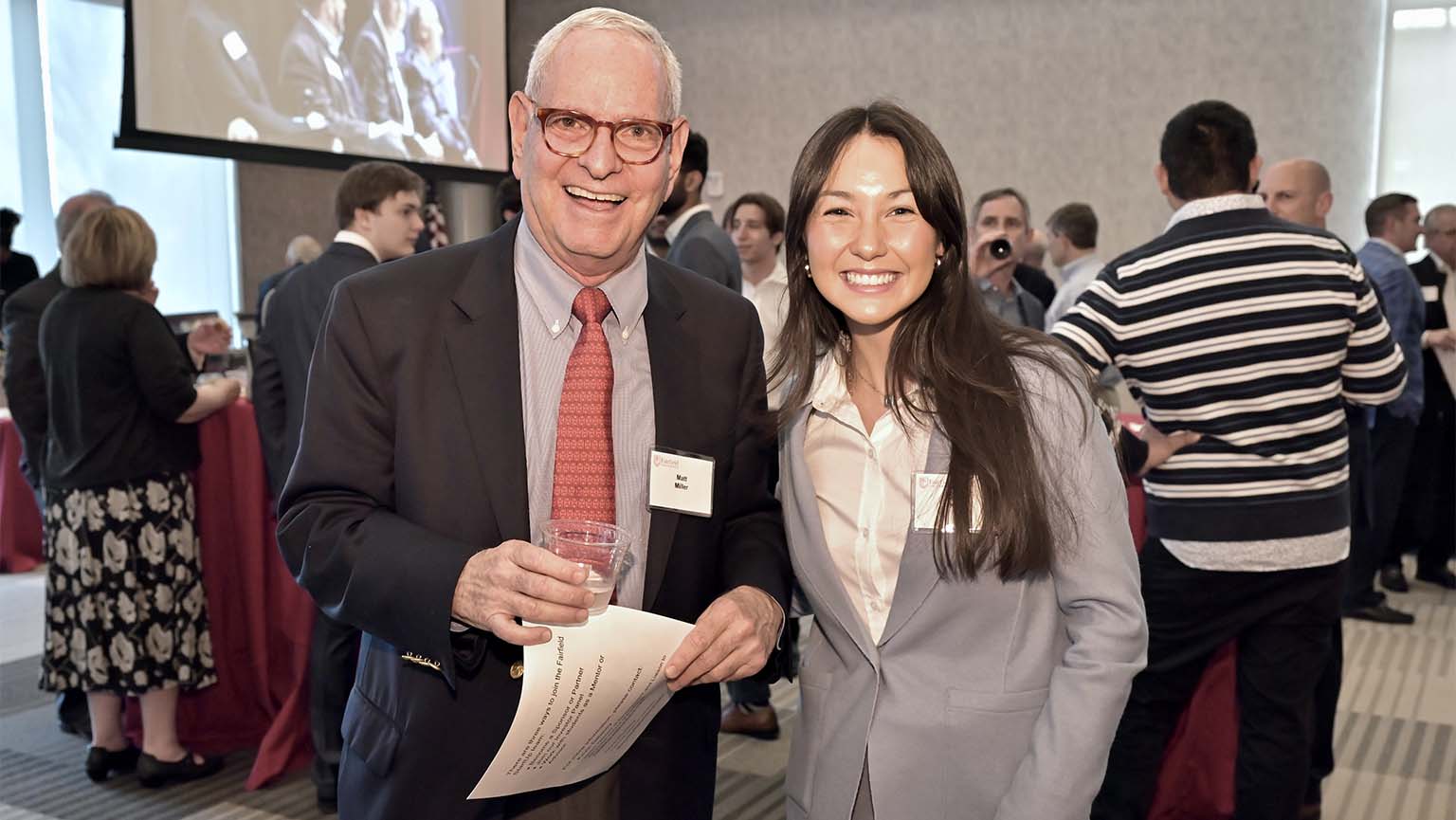
She speaks about ambition, but rarely as a solo act. King credits her parents, sisters, friends, team and investors with making the uncertain route possible. She names mentors generously. Peter Murrugarra helped advise the early startup. Hyman encouraged the first idea. Scientist and entrepreneur Matthew Miller treated her seriously at 19. “He taught me to believe in myself,” she later said.
Begins Fairfield on a pre-veterinary biology track.
Studies climate and environmental ethics; works in coastal climate research.
Develops GreenIRR, wins the campus audience award and interns in renewable finance.
Graduates with a double major in biology and business analytics; GreenIRR raises through a convertible note.
Launches the freight platform, pitches publicly and returns to Fairfield as mentor, panelist and adviser.
Her relationship with pressure is candid. She says she has long gravitated toward leadership because she likes responsibility for an outcome. She also calls pressure a double-edged sword. That qualification keeps the sentiment from becoming poster copy. Ownership supplies meaning, but it sends the bill directly to the owner.
05 / The road aheadA system of record for the work between warehouses
GreenIRR's near-term task is specific: make freight emissions data accurate, repeatable and useful for carriers and the companies that hire them. The broader ambition is more interesting. Finance has its ledgers. Sales has its customer systems. Warehouses have inventory software. Freight still lacks a shared, primary record that lets buyers compare performance and carriers demonstrate improvement without assembling the story anew for every request.
King wants to help build that missing layer. She talks about digitizing trucking, but her climate motive remains the deeper engine. The company is one vehicle for a problem she expects to keep pursuing even beyond GreenIRR. Her advice to founders is to “pick a problem that feels impossible to solve.” A problem larger than the company leaves room for more than one product, more than one career chapter and more than one answer.
There is something fitting in a former pre-vet student finding her vocation among eighteen-wheelers. Both worlds reward attention to complicated living systems, although only one comes with a fuel card. King's contribution is to insist that the system can be observed closely enough to improve. The truck on the highway is no longer anonymous scenery. It is a moving ledger of fuel, work, carbon and possibility - if someone bothers to read it.
“Experience is the best way to learn.”Celine King