Before there was a house, there was a camper. In 1965, Al Ghelfi began building truck campers behind his father’s lumberyard in Phoenix. The business depended on a particular American pleasure: putting gasoline in a vehicle and going somewhere. Then the gasoline shortage arrived. A perfectly serviceable product had acquired a problem its maker could not repair with better carpentry.
Cavco’s own history credits the 1973 fuel shock with pushing Ghelfi toward mobile homes. People could postpone a vacation. They still needed somewhere to live. The manufacturing knowledge had another use. That distinction explains a surprising amount about the company Cavco became: its product keeps changing around the practical obstacles between a household and a home.
- Cavco builds manufactured and modular housing, plus cabins and park model RVs.
- It reaches buyers through independent dealers and its own stores.
- Mortgage and insurance businesses help complete the purchase.
- The factory can lower construction friction. Land and local rules still matter.
The purchase has more than one door
Picture the questions a buyer brings to a model home. Can we afford it? Where can we put it? Who will lend against it? What happens after delivery? The floor plan answers only some of them. Cavco’s business makes more sense when you start with this list than when you start with a photograph of a factory.
The company designs and manufactures homes, then distributes them through company-owned stores and independent retailers. Its customers include individual households, community owners and developers. Outdoor hospitality operators buy park models and vacation cabins. Modular construction also serves commercial projects. This is a manufacturer with several routes to market, including customers who buy housing for other people to occupy.
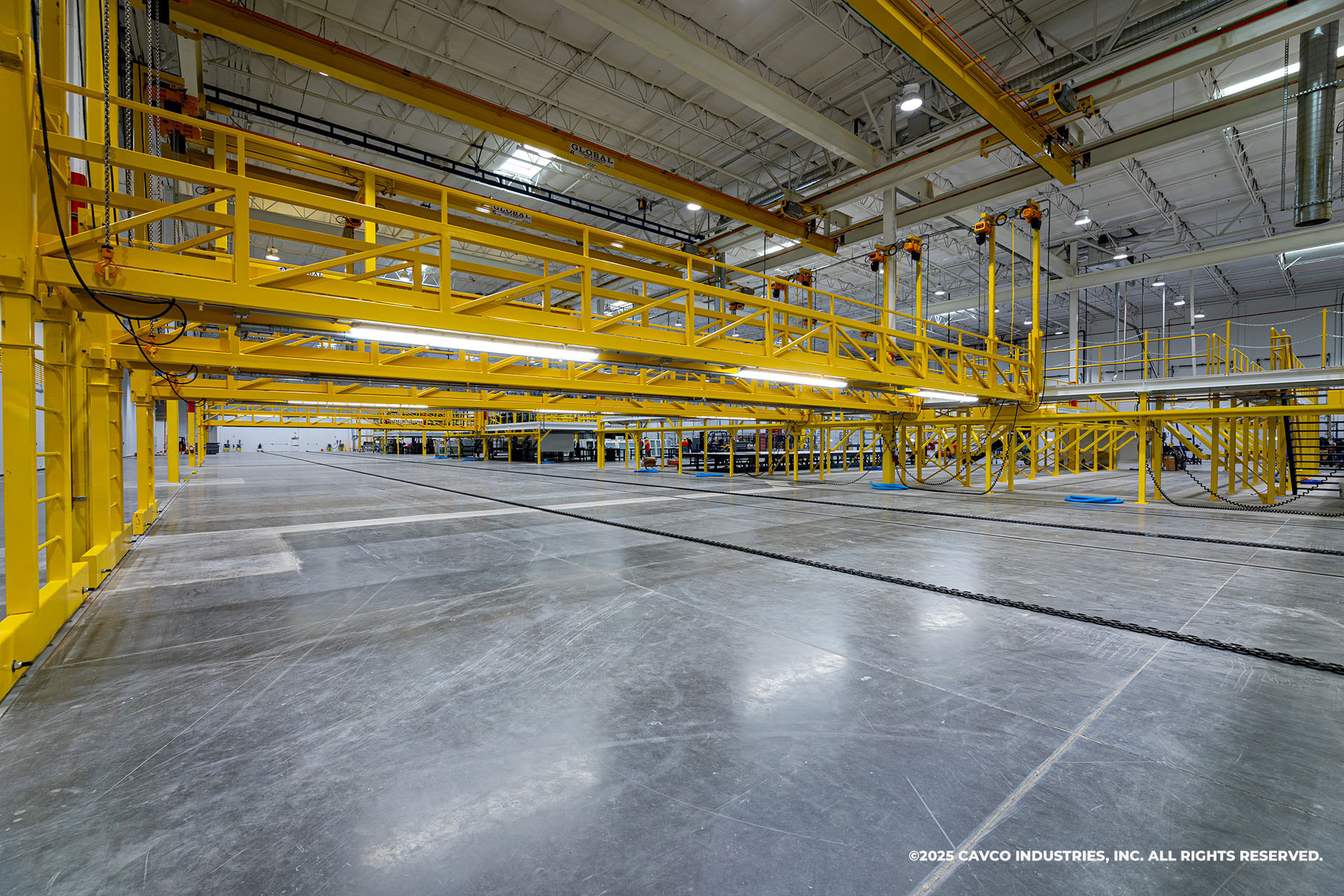
Factory production brings work indoors and makes repeated tasks easier to organize. Materials, crews and inspections meet along a production process instead of repeatedly converging on separate building sites. Cavco combines that repeatability with choices in layouts and finishes. The promise is useful precisely because buyers usually want both: the economics of repetition and a home that feels chosen.
In 2011, acquiring Palm Harbor also brought CountryPlace Mortgage and Standard Casualty. Today, CountryPlace offers home-only and land-home financing, among other options. Standard Casualty specializes in manufactured-home insurance. Cavco earns money from making and selling homes and from related financial services. Owning those businesses gives it more involvement in the transaction, while also bringing lending and insurance risks.
- 01Build
- 02Sell
- 03Finance
- 04Insure
A $10 million simplification
Acquisitions brought another complication: names. Fleetwood, Palm Harbor, Commodore and other businesses gave Cavco reach, but a collection of manufacturing identities is a lot for a homebuyer to decode. In March 2025, Cavco announced a unified manufacturing brand. National product lines would organize homes around characteristics rather than asking customers to understand the corporate family tree.
That decision had a measurable accounting consequence. Fiscal 2025 results included a $10 million noncash charge associated with abandoning legacy brand assets. It was a write-down, rather than a $10 million advertising bill. The distinction matters. Cavco was acknowledging that names acquired in earlier deals would no longer carry the same role in its future.
“We’re a tighter and more aligned company with a shared vision of making an impact in affordable housing.”
Bill Boor, President and CEO · June 2025

The buying continued. American Homestar, known for Oak Creek Homes, added two manufacturing facilities and 19 retail locations when the deal closed in September 2025. Announced at $190 million in cash, subject to adjustments, the acquisition ultimately carried $181.3 million in recorded consideration. These are substantial sums for a strategy that expands both production and access to customers.
Clayton Homes and Champion Homes are major alternatives in the same industry. Factory construction alone does not distinguish Cavco from them. Its particular proposition lies in the combination of its regional operations, product range, retail relationships and financial services. A buyer should still compare the actual local home, dealer and installation package. A national name cannot answer every local question.
Two households, one piece of land
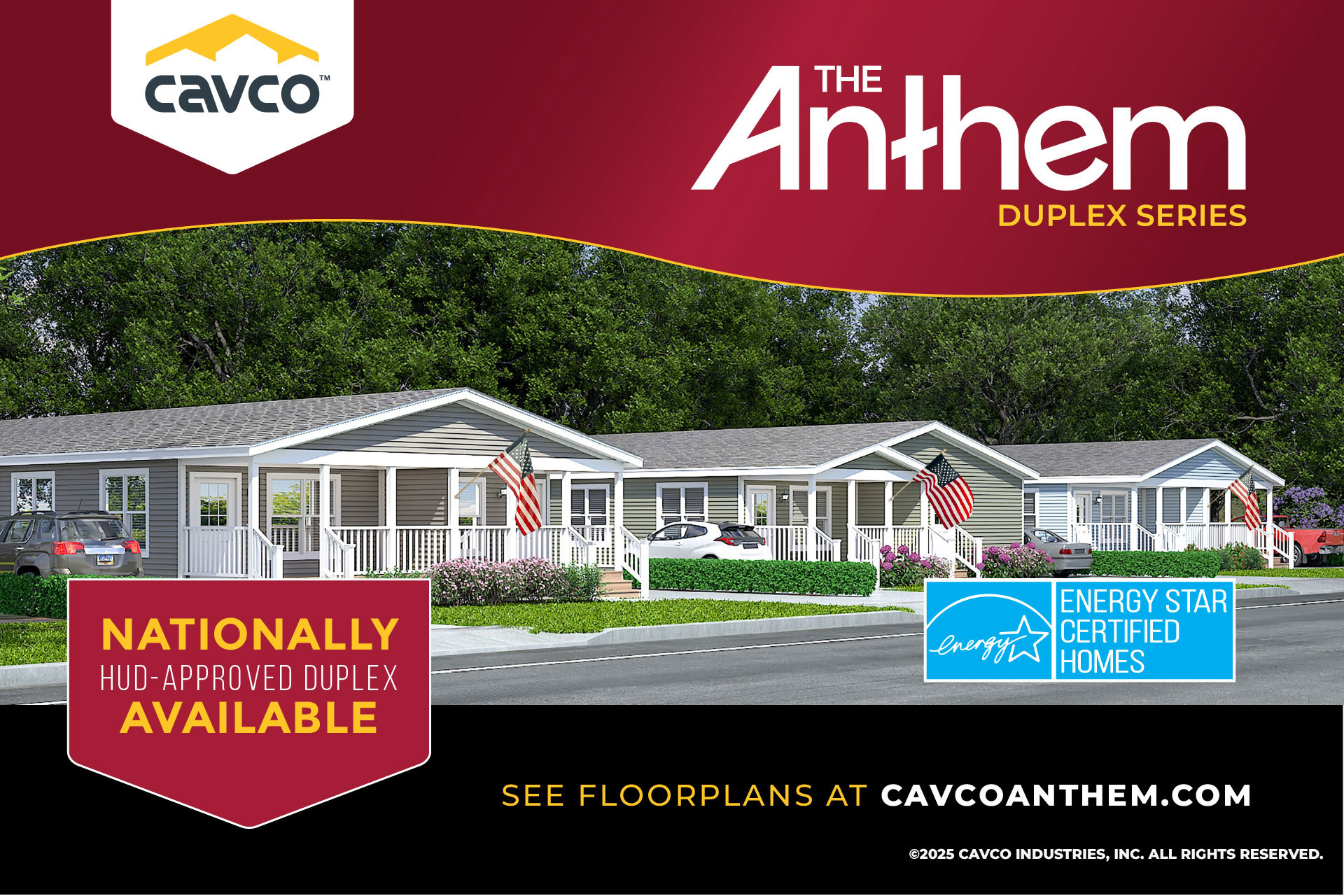
Consider Anthem, Cavco’s duplex series, launched in December 2023. Two homes on one lot change the arithmetic without requiring a new construction philosophy. The series originated at the Rocky Mount, Virginia operation. Its appeal to developers is straightforward: more households can occupy a parcel where the relevant approvals permit it. The constraint is equally straightforward: a factory cannot grant zoning permission.
In September 2026, Cavco announced Grande Arbor, describing it as the first HUD-code manufactured home built without a permanent steel chassis. Its two primary suites sit at opposite ends of shared living space. The company points to lower-profile installation and greater design flexibility. Those are proposed advantages worth watching as the design moves beyond a showcase setting.
The factory still needs a neighborhood
Scale is visible in the results: Cavco sold 20,842 homes in fiscal 2026 and generated approximately $2.2 billion in revenue. But the following quarter supplies a useful corrective. Revenue rose 9.5%, while factory-built housing gross margin fell from 22.6% to 20.8%. More sales and better profitability do not automatically arrive together.
Cavco is adding capacity, announcing a 616,000-square-foot El Mirage plant targeting operations in mid-2027. It is also developing workers through Master of Craft and helping qualifying employees pursue homeownership through Homes for Our Own. Factories require people who can build consistently. The company’s housing mission becomes especially tangible when those people need homes themselves.
For buyers, the sensible next step is an itemized installed quote: home, delivery, foundation, utilities, permits and land or site rent. For other businesses, the copyable idea is to study what blocks a customer after the product is ready. Cavco has spent decades buying and building answers. Its factories still need affordable sites, willing lenders and local permission. The house can travel. The neighborhood must agree to receive it.