Catherine Estrampes stepped up to an investor-day microphone in December 2019 with an economical introduction: “Changing continent and accent.” The previous speaker had been discussing North America. She was there to discuss Europe. In five words, she had supplied a geographical handover, acknowledged her French voice and allowed a little air into a room full of financial expectations.
It was a small joke with a considerable career behind it. Estrampes had already moved between Europe and the United States, between equipment businesses and finance, between responsibilities defined by a product and those defined by a region. An accent, in that company, was practically an item of professional equipment. It announced that she had been somewhere else.
By April 2026, those crossings had become preparation for a larger assignment. GE HealthCare appointed her Chief Commercial and Growth Officer, with responsibility for Global Markets. The region encompasses every market except China. Her earlier jobs had required her to understand particular territories. The new one asks her to connect commercial work across them.
A degree in other people’s words
Before the regional appointments came an education that crossed subjects. Estrampes studied foreign languages, political science and economics, and later earned an MBA. Sciences Po Toulouse counts her among its class of 1982. The combination offers an appealing introduction to an executive whose work has repeatedly involved entering another place and learning how it operates.
Languages, economics and management each attend to a different part of a business conversation. There is what someone says, what they can afford, and what an organization can actually deliver. No degree guarantees the ability to reconcile those things. Still, her educational route gives the eventual commercial career a little more texture than the usual succession of titles.
Her move to the United States with GE Capital in 1999 added a financial chapter. She held general management assignments in equipment finance and the global vendor business. In 2010, she returned to GE HealthCare’s operating side to lead its Mid-America business. The job brought responsibility for a business reported at $1.4 billion.
In February 2013, her remit expanded to the $2.5 billion Central Corridor operation. These were successive assignments with different boundaries. Reading them together, the useful detail is the movement between understanding equipment, financing it and running a regional business. The same customer can look rather different from each of those desks.
- 1999United States
GE Capital - 2017Europe
Regional leadership - 2021U.S. & Canada
President & CEO - 2026Global Markets
Commercial & growth
Europe, with the borders left in
In 2017, Estrampes returned to Europe as the imaging business leader. Her appointment as regional president and CEO followed that year, effective October 1. She succeeded Jean-Michel Malbrancq and reported to Kieran Murphy. The return put an executive with substantial American experience into a European leadership role.
At the 2019 investor meeting, she described a region of 40 countries, encompassing Western and Eastern Europe, Russia and the Baltics. She discussed the mix of mature and emerging markets and how their different rhythms affected the overall business. The word Europe did considerable administrative work. It did very little to erase the differences beneath it.
Her opening joke suited that presentation. A continent is a convenient heading on a slide; working across it requires attention to the particulars. Her explanation moved between the regional total and the markets that made it up. For an executive, keeping both in view is part of the assignment. A large number becomes useful only when someone understands its ingredients.
Her responsibilities expanded in 2020 to include the Middle East and Africa. Then came another crossing. In a public announcement of her own, she said she would become President and CEO for the United States and Canada on October 11, 2021, after almost five years leading Europe and then EMEA. The route had brought her back across the Atlantic.
The confidence question
Alongside those appointments, Estrampes was writing about the experience of becoming a leader. In March 2019, she recalled being one of very few women in leadership at the company when she began. She credited purpose, building capabilities, coaches, sponsors and assignments outside her comfort zone with helping her advance.
That list is revealing in its allocation of credit. Individual courage has a place, alongside the people who help someone prepare and the people willing to sponsor the next move. A promotion has a name attached to it. The preparation often has several names, most of which never reach the announcement.
In a 2021 essay, she returned to the hesitation that can accompany ambition: waiting for others to notice a contribution, struggling to claim an achievement, expecting perfection before stepping forward. Her advice allowed uncertainty into the process. Readiness and a supportive environment mattered, she wrote, even though complete preparation would remain elusive.
“You need to be capable of accepting uncertainties and taking a leap of faith.”
Catherine Estrampes / 2021
There is a practical generosity in that formulation. It leaves room for the person who has done the work and still feels uneasy. The next job can require confidence before it has supplied the experiences that would make confidence comfortable. Her account gives colleagues, family and friends a part in helping someone make that move.
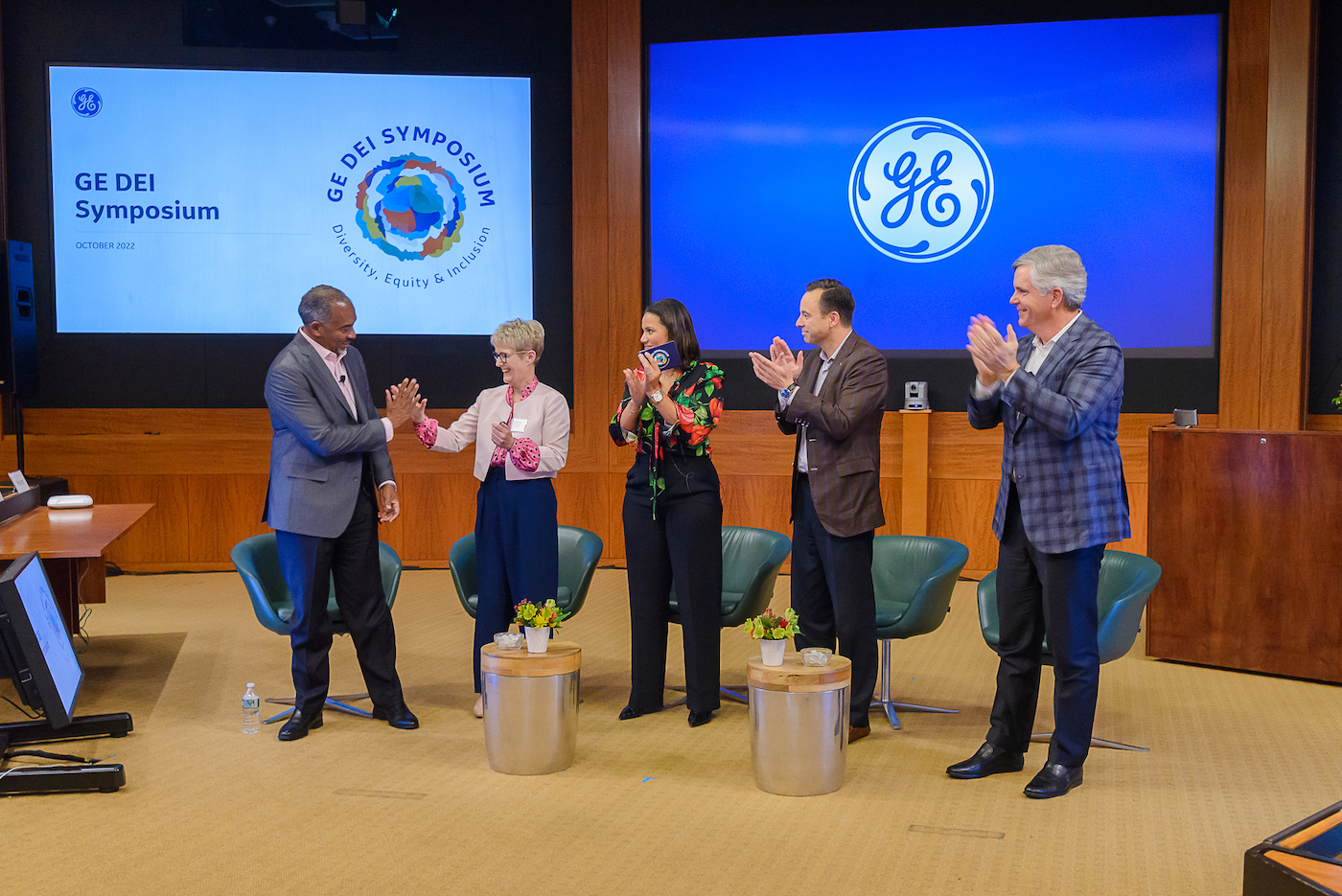
The photograph catches her celebrating another person’s recognition. At GE’s October 2022 Diversity, Equity and Inclusion Symposium at Crotonville, Colin Parris learned he would receive the 2023 Black Engineer of the Year Award. Estrampes stood alongside him with Brandi Thomas, Scott Strazik and Larry Culp. For once, the executive photograph contains an actual occasion for applause.
Presidents on the reading list
Estrampes’s leadership interests have also taken her into history. In August 2019, she wrote about reading Doris Kearns Goodwin’s Leadership in Turbulent Times, which examines Abraham Lincoln, Theodore Roosevelt, Franklin D. Roosevelt and Lyndon Johnson. She was interested in the qualities they shared and the ways different circumstances called for different strengths.
She singled out empathy and resilience. In her reading, understanding another person’s motives mattered to inspiring action and developing leaders. Difficult experiences mattered through the way a person responded to them. She also described her own role models as changing with the stages of her life and career.
A changing set of role models is an interesting companion to a changing set of responsibilities. It permits a leader to keep learning after becoming someone other people might look up to. Presidential history provides ample company for that exercise, though even the most absorbing book is mercifully unable to schedule a meeting.
Her interest in other people’s development appears in more ordinary professional settings too. In a 2024 post, she described meeting a Phase 2 Commercial Leadership Program cohort in Waukesha, Wisconsin. Their conversation included authentic leadership and following one’s interests. She welcomed the group as future leaders joining the company.
When the company changed its own address
In January 2023, the organization around Estrampes underwent a transition of its own. GE HealthCare became a standalone public company, marking its Nasdaq debut by remotely ringing the opening bell from its Waukesha manufacturing facility. She was then leading the United States and Canada business.
She described the separation as “a catalyst moment for us.” Her public explanation emphasized retaining the GE inheritance while gaining the focus and agility of an independent company. It was an institutional version of a question familiar from a long career: which accumulated strengths travel well into the next assignment?
The commercial work continued to depend on relationships over time. In an October 2025 interview, she described starting with a customer’s challenges, opportunities and ambitions before designing an agreement. She discussed multi-year partnerships and predictable investment, moving beyond separate purchasing decisions made one year at a time.
Her finance background makes that part of her career particularly interesting. A commercial relationship involves a proposal, a budget and a future that neither party controls entirely. Agreeing on the equipment is one task. Agreeing on how the relationship can keep working over several years introduces a longer conversation.
One such relationship placed her at a November 2024 celebration at the University of Wisconsin-Madison. With Robert Golden, she presented Thomas Grist with a plaque marking a professorship supported by the GE HealthCare Foundation. The university described a partnership renewed for another decade. It was a public moment in a collaboration whose timescale extended well beyond an individual meeting.
The next room
There is another way Estrampes practices paying attention. She has described going to the theatre each week, including performances in languages she does not speak. When she knows the script, she can follow the body language, scenery, lighting and atmosphere. The missing vocabulary gives the rest of the production more work to do.
Her childhood involved frequent moves between countries as the daughter of diplomats. As an adult, she speaks three languages and learns local expressions when travelling. During a 2026 visit to São Paulo, she added the Portuguese word for thank you to her daily vocabulary. These are small details beside a global appointment. They are also rather more memorable than an organizational chart.
The April 2026 assignment now gives that international experience a broad commercial remit. Global Markets brings markets together under her leadership while China remains separately led by Will Song. The stated ambition is to strengthen how commercial teams share expertise and bring the company’s portfolio to customers.
Another region, another conversation, another set of particulars to understand. Estrampes’s career has repeatedly returned to that work. The accent that opened her 2019 presentation belonged to someone accustomed to arriving from elsewhere. The interesting question has always been what she would learn after arriving.