Cary Gunn has spent much of his working life making large systems smaller. First the system was a satellite launch, where small mistakes remain stubbornly large. Then it was a rack of optical equipment, compressed toward a sliver of silicon. Later it was the diagnostic laboratory, reconsidered as a machine that could sit nearer the people waiting for its answers. Today, at an Encinitas company called Tenure Health, the system is care itself: many specialists, tests, decisions, and follow-ups gathered behind a simpler relationship.
The industries have changed. The reflex has not. Gunn looks for distance in a system - between electrons and photons, a sample and a result, expertise and the person trying to use it - then goes after that distance with engineering. It is a wonderfully literal sort of ambition. No metaverse. No vibes. There is usually a chip somewhere, quietly being asked to perform a trick that formerly required a room.
Mississippi, orbit, Pasadena
Lawrence Cary Gunn III came from Eastabuchie, Mississippi, attended Petal High School, and graduated in 1991 from the Mississippi School for Mathematics and Science. From there he went to the United States Air Force Academy, earning a degree in applied physics in 1995. His military career lasted roughly nine years and included work in Space Command connected to launching GPS satellites.
It is easy to make that chapter sound cinematic. Rockets oblige the biographer. Its more durable contribution may have been procedural: complicated hardware, unforgiving interfaces, and outcomes that cannot be rescued by an eloquent product update. Space systems encourage respect for the dull verbs - test, check, repeat. Gunn would later carry those verbs into young companies working at the edge of what fabrication could reliably do.
Satellite systems
Optics on silicon
Diagnostics on chips
Coordinated service
At Caltech, Gunn entered the nanofabrication world of Axel Scherer. He earned a master's degree in 2001 and a doctorate in electrical engineering in 2004. His dissertation, Integration of Complex Optical Functionality in a Production CMOS Process, contains the hinge on which his career turns. The early work was performed largely by Gunn himself: conception, simulation, cleanroom fabrication, and optical-bench testing, one after another. He called the best outputs “hero” devices. The phrase is affectionate and suspicious at once. A hero device can prove that physics permits something. It cannot prove that a factory, a budget, or a customer will tolerate it.
“Silicon always wins.”
Light, meet the assembly line
Gunn co-founded Luxtera in 2001 while still at Caltech and served as its chief technology officer until 2008. The company's wager was that optical components could be built within the production logic of ordinary complementary metal-oxide-semiconductor chips. Photons could carry data. Silicon manufacturing could supply the scale. The marriage was technically awkward and commercially irresistible.
In the early 2000s, optical links were already essential for long-distance telecommunications, but their components were expensive and exotic compared with mass-produced electronics. Luxtera worked to put modulators, filters, detectors, and their supporting circuits together on silicon. In 2005, it demonstrated a 10-gigabit-per-second modulator made with production methods. In 2006, Gunn wrote that the era of silicon photonics was beginning. This was less prophecy than a progress report with a long delivery date.
Recognition arrived while the engineering was still young. MIT Technology Review named Gunn a Top Young Innovator in 2003. Optica awarded him the Adolph Lomb Medal in 2008 for an early-career contribution to optics. That same year, his CMOS photonics work received third prize in the Berthold Leibinger Innovation Award. Awards provide a neat date; manufacturing resists neatness. Luxtera's work continued for years after Gunn left his operating role. Cisco completed its acquisition of the company in 2019, paying $660 million in cash and assumed equity awards, then folded its technology into data-center and networking products.
The exit is the sort of number that makes a startup story feel inevitable. It was not. Gunn's thesis describes the real sequence: find the deficiencies, choose among imperfect architectures, and push a promising platform toward a commercially realizable process. In other words, make fewer heroes and more units.
Luxtera was also a collective act, born from a Caltech network that included faculty and fellow researchers. Gunn's role placed him at the junction of that group: the graduate student who could fabricate a device, the technical executive who could argue for a process, and the founder who had to make a new category legible to customers. It is one thing to know that a ring of silicon can steer light. It is another to organize people and capital around the proposition that the ring can become a dependable business.
One pattern, three companies
A photonics founder walks into a laboratory
Gunn founded Genalyte in San Diego in 2007. The move from networking to diagnostics was a change of market, not of medium. Genalyte's Maverick platform used arrays of photonic ring resonators. When molecules bound to the treated surface of a ring, its optical resonance shifted. Light became a way to measure many targets on a compact chip.
The proposition carried the same structure as Luxtera's: take equipment associated with a specialized central facility and compress important parts of it into a manufacturable silicon system. But the new setting demanded a different standard of proof. A faster network component may drop packets when it fails. A diagnostic instrument carries consequences of another order. Data, validation, and regulatory review are not scenery around the product. They are the product's permission to matter.
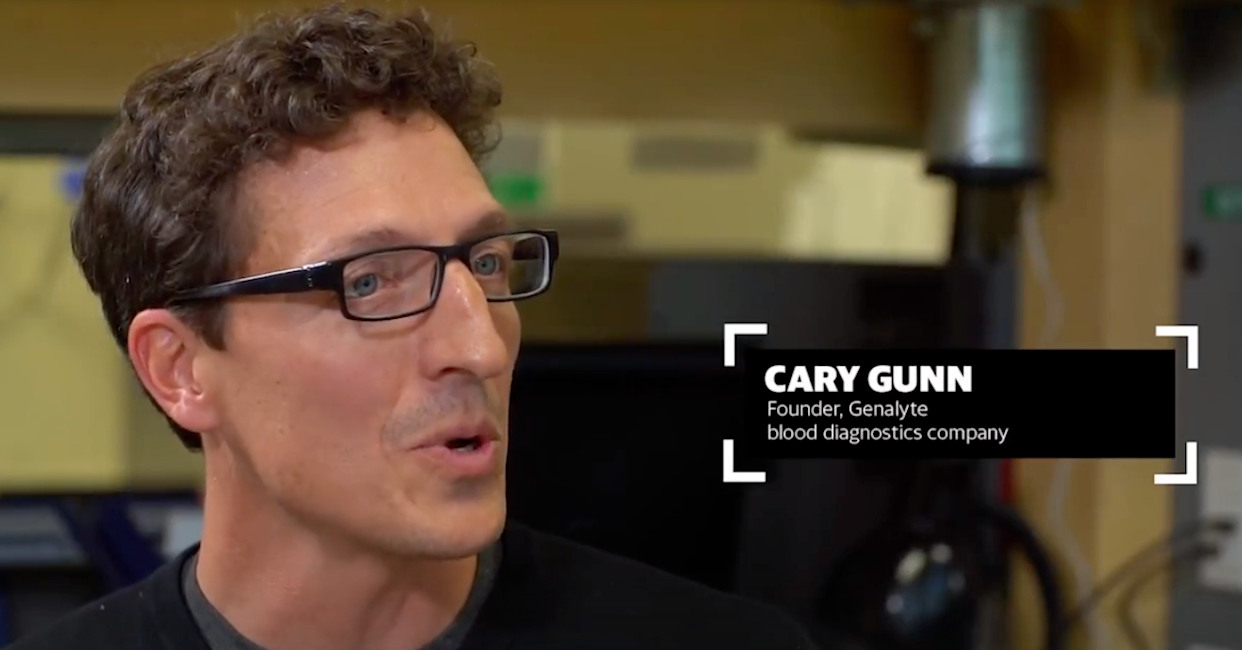
That point became unusually public after Theranos collapsed. Gunn told reporters that direct-to-consumer testing created serious regulatory difficulty and defended keeping physicians involved. Speaking to Wired in 2018, he noted that people now asked Genalyte to show its data. “As they should,” the article concluded. The remark fits the engineer who had already distinguished a heroic device from a production platform. Possibility is the beginning of the conversation, not the end.
“People definitely ask us to see the data.”
Gunn led Genalyte as founder and chief executive for more than thirteen years. In 2020, Ashraf Hanna took the chief executive role while Gunn remained founder, chief technology officer, and a director. Four years later, Genalyte announced an FDA clearance for a quantitative immunoassay performed on its silicon-chip platform. By then Gunn was no longer running the company, but the milestone belonged to the long arc of technology he had started building in 2007.
In 2017, midway through that long build, Gunn returned to Columbus, Mississippi, to address the graduating class at MSMS. The invitation came from students at the residential science school he had attended before the Academy, before Space Command, before Caltech. Their class president described MSMS as a transformative experience and asked Gunn to speak about college and giving back to Mississippi. The circle is almost suspiciously well composed: a public school for mathematically inclined teenagers sends one student toward physics, and twenty-six years later he returns carrying patents, companies, and a speech. No silicon was required for the connection.
The third interface
In 2021, Gunn became chief executive of Tenure Health in Encinitas. This Tenure Health is a preventive-care business, distinct from the New York Medicare-navigation company that used the tenure.com domain. Gunn's company presents a coordinated team, ongoing testing, and a mobile relationship with members. The public-facing product is no longer a component or an instrument. It is continuity.
Yet the family resemblance is visible. Luxtera moved optical functions into a chip. Genalyte moved laboratory capabilities toward a compact machine. Tenure tries to move a collection of expertise behind one accessible service. Each business absorbs complexity so the person at the other end sees less of the machinery.
This may be Gunn's most stealable founder habit: he does not confuse a simple experience with a simple system. Simplicity on the surface is usually purchased with extravagantly complicated work underneath. The optical link looks like a cable. The result looks like a number. The care relationship looks like a conversation. Behind each sits a thicket of fabrication, calibration, software, people, and decisions.
There is also patience in the record, though patience is too passive a word. Luxtera was eighteen years old when Cisco bought it. Genalyte spent years moving from platform work toward cleared products. Gunn's career suggests active patience: stay with a hard constraint, keep changing the implementation, and let evidence shorten the argument.
No magic, please
Deep technology is often narrated as a parade of revelations. Gunn's version is more useful. His Caltech work uncovered deficiencies. Luxtera turned those deficiencies into architectural choices. Genalyte entered a field where every claim attracted necessary scrutiny. Tenure now applies the same systems appetite at the level of service.
The result is a career held together not by a single industry but by a preference: move the capability closer. Close the physical gap. Close the waiting gap. Hide the complexity only after doing the difficult work, never before. The glamorous verb in technology is “invent.” Gunn's story makes a case for the quieter ones: integrate, manufacture, validate, deliver.
Silicon may indeed always win. But it takes a particular kind of founder to spend decades teaching it the game.