Three or four days before Hurricane Harvey reached the Texas coast, Carmine DeNardo's pharmacies began making calls. The storm had not yet closed a road. The phones still worked. Coolers, couriers and approvals could still be arranged. So ReCept Pharmacy teams contacted patients, secured permission to fill prescriptions early and shifted deliveries among stores. Some people insisted they had enough. The calls continued anyway.
DeNardo, then ReCept's president and chief executive, later described four parts of the company's disaster routine: outreach, security, medication storage and emergency services. As conditions worsened, calls were rerouted offsite. Work moved through Fort Worth, Dallas and San Antonio. The first task was practical and immediate: make sure people had what they needed before the city stopped moving.
Business profiles usually begin with the big number. DeNardo has one ready: during his tenure, ReCept grew from $32 million to more than $600 million in revenue. But the early phone calls reveal more about how that number was built. Scale, in his career, has rarely meant standing farther from the details. It has meant arranging the details so hundreds of people can act before the obvious moment arrives.
“We prepare our patients way in advance.”Carmine DeNardo, during Hurricane Harvey preparations, 2017
The pharmacist who learned to build systems
DeNardo earned a Bachelor of Science in Pharmacy from Northeastern University. His working life then ran through the changing machinery of American pharmacy: the neighborhood counter, the specialty storefront, the service hub, the health-system partnership and the technology platform. More than 35 years of executive work have made him fluent in an industry where the product may fit in a box but the service around it emphatically does not.
At CVS Caremark, he held a succession of operating roles. He managed field operations and training for CVS ProCare, became a director of operations, and later served as vice president of specialty operations for PharmaCare. By the time he led specialty retail operations, the footprint covered 25 states. He also served as chief operating officer of TheraCom, a CVS Caremark service business. The titles changed; the assignment did not. Build infrastructure that lets complicated work travel.
CVS Caremark operations, from field training to national specialty pharmacy leadership and TheraCom.
Joins ReCept Pharmacy and takes responsibility for long-term national growth.
Chairs the National Association of Specialty Pharmacy board.
Guides ReCept into a $100 million acquisition agreement with Omnicell.
Becomes president and CEO of Medix Infusion.
There is an unfashionable steadiness to this résumé. DeNardo did not bounce between unrelated industries, nor does his public language depend on a dazzling new noun. He stayed close to pharmacy operations and accumulated adjacent capabilities: payer contracting, manufacturer relationships, retail sites, managed services, technology and 340B administration. A pharmacist might call it compounding. A strategist would probably charge more for the phrase.
A regional company discovers its map
DeNardo joined ReCept in 2009. The company dated to 1978 and had deep Texas roots. Under his leadership, it kept the physical stores but widened the business around them. By 2015, ReCept owned eight Texas locations, managed 17 more pharmacies for physician groups and health settings, and had reported $151.4 million in sales for the previous year. It jumped 26 places on the Fort Worth Business Top 100 list.
His explanation at the time was notably free of magic. New specialty drugs had created demand, and ReCept had diversified beyond dispensing into pharmacy management, wholesale distribution and prescription-management services. The company placed stores in and around medical districts. Local presence was not treated as quaint nostalgia. It was part of the operating design.
One arrangement from that period captures DeNardo's appetite for practical hybrids. ReCept's Plaza Supply division kept a warehouse inside the headquarters of MedStar Mobile Healthcare, the ambulance provider serving much of Tarrant County. Inventory belonged to ReCept until it crossed into MedStar's logistics department. The provider could collect supplies within minutes, while the pharmacy watched expiration dates, shifted stock among locations and buffered shortages. It was local enough to involve a short walk and systematic enough to manage scarcity across a network.
The model also complicates the easy story that modern scale must erase physical presence. ReCept had no online sales in 2015. Its stores sat near clinicians and patients, while its management arm carried expertise outward. The storefront supplied proximity; the service platform supplied reach. DeNardo's achievement was not choosing one over the other. It was making them useful to each other.
ReCept revenue under DeNardo's leadership
Company-reported figures describe total revenue growth during his ReCept tenure. Bars use $600 million as the conservative endpoint.
The national part arrived through services as much as geography. ReCept helped health systems, clinics and physician groups operate their own specialty pharmacies. That meant taking on the pieces most patients never see: licensing, quality procedures, staffing, payer access, analytics and workflow. The business sold competence in the backstage area.
That backstage work is easy to underrate because success often looks like nothing happening. A claim clears. A shipment stays at the right temperature. A store reopens. A patient does not have to understand which team negotiated an exception. During Harvey, DeNardo divided the response into phases, ending with business continuity after the immediate storm. The distinction matters. Emergency management draws attention to the extraordinary day; continuity is the discipline of making the next ordinary day possible.
By 2021, Omnicell wanted that competence. The medication-management company agreed to acquire ReCept for $100 million in cash. In announcing the deal, DeNardo said the combination would give pharmacy partners broader infrastructure and health systems deeper expertise across medication management. Then he stayed. As an Omnicell vice president and general manager, he led ReCept's integration and expansion and introduced new recurring-revenue services. Selling the machine is one skill. Helping it run in somebody else's factory is another.
The industry room
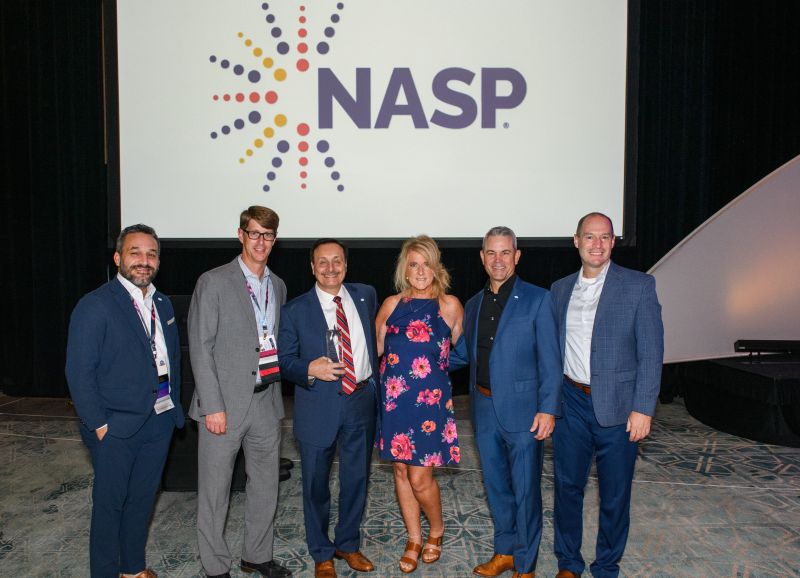
DeNardo also spent years helping convene the people who operate in that backstage area. He served as chairman of the National Association of Specialty Pharmacy board from 2018 to 2020 and remained involved afterward. At the association's 2019 annual meeting, his outgoing remarks emphasized collaboration: benefit navigation, financial assistance, education and access all required different corners of the industry to work together.
He used the occasion to thank committee members and welcome the next board. That may sound like standard conference behavior, yet it fits the broader pattern. DeNardo's public persona is less oracle than organizer. He talks about teams, foundations and the next person holding the gavel. In 2022, NASP presented him with its Distinguished Service Award.
His chairmanship ran from 2018 through 2020, ending at a virtual annual meeting attended by more than 970 people. When he passed the gavel to Michael Einodshofer, DeNardo praised his successor's experience and judgment. The ceremony was digital, the metaphor stubbornly physical. Associations survive on that sort of ritual: an industry agrees to become a community, then invents committees to prove it.
His 2024 writing made the operator's case in another form. DeNardo argued that hospitals could use in-house specialty pharmacies to improve access and add a durable line of business. He also listed the impediments with the patience of someone who has met them all before: accreditation, payer contracts, prior authorization, cold-chain logistics, space and restricted distribution. His solution was not to pretend the complexity away. It was to match local knowledge with experienced outside support, then use data and automation to make the model repeatable.
Another platform, the same test
On April 28, 2026, Medix Infusion named DeNardo president and chief executive officer. The Addison, Texas-based company operates ambulatory infusion centers across seven states and provides services in homes as well. Its board handed him a familiar brief: accelerate growth, strengthen operations and extend a regional platform nationally.
He arrived with the credibility of the ReCept expansion, the scar tissue of integration and a vocabulary formed by long exposure to operational reality. His stated goal was to expand Medix's reach and capabilities while keeping patient experience at the center. The interesting word there is “while.” Expansion can make a service broader and less personal at the same time. DeNardo's career has been a sustained attempt to refuse that trade.
“I'm excited to partner with this talented team to build on its strong foundation, expanding our reach, strengthening our capabilities, and delivering meaningful, sustainable growth while keeping the patient experience at the center of everything we do.”Carmine DeNardo on joining Medix Infusion, 2026
No executive can guarantee that every system will hold. Markets change. Acquisitions introduce seams. National maps create long distances between the office and the moment a service is delivered. But there is evidence in DeNardo's record of what he notices first. In a storm, he noticed the time before the roads closed. At ReCept, he saw that physical pharmacies and national management services could reinforce one another. At Omnicell, he treated the acquisition as the beginning of integration rather than the end of a transaction.
Now the map belongs to Medix. The assignment will produce its own visible measures: locations, revenue, states, partnerships. The less visible measure will be whether a larger company can still behave as if each early call matters. DeNardo has spent a career making that proposition operational. The future may arrive dramatically, but good operators, inconveniently for storytellers, tend to get there by Tuesday.