The distance between a medical decision and a person who can benefit from it is rarely measured in miles. It is measured in missed calls, incompatible schedules, insurance rules, specialist shortages and the peculiar fatigue produced by telling one's story again. Aleksandr Zverinskiy's career has been spent inside that distance. He trained to make clinical judgments, acquired the administrative vocabulary to see why good judgments sometimes fail to travel, and then moved into jobs where the map itself became part of the work.
On paper, the sequence is orderly. Biology at Stony Brook. Medical school at the American University of Antigua. A master's degree in healthcare administration from Walden. Psychiatry residency at Richmond University Medical Center, followed by fellowship training at Stony Brook Medicine. Medical director. National medical director. Chief medical officer. Yet the order disguises the interesting bit. Zverinskiy did not abandon the clinic for administration. He kept arranging the two beside each other, like lenses that make the same object sharper.
Learning the person, then the machinery
The MD and the MHA are a revealing pair. Medicine teaches the encounter: history, evidence, uncertainty, decision. Administration teaches the machinery around it: staffing, incentives, regulation, handoffs, capacity. One degree asks what ought to happen. The other asks what must be true for it to happen reliably on a wet Tuesday afternoon when every calendar is full.
Zverinskiy earned both before his residency was complete. At Richmond, he took on work as a resident physician and associate medical director. The hospital also became the place where his appetite for explanation surfaced. He developed teaching material, supervised learners and competed in research. In 2014, he received an American Psychiatric Association resident recognition award and took first place in the Richmond County Medical Society's research paper competition. A year later came the Lawrence G. Miller Award, given to a resident whose work showed clinical excellence, empathy, compassion and dignity toward patients, colleagues and staff.
Awards often arrive as polished nouns, detached from the untidy verbs that earned them. This one is unusually specific. It describes conduct, not celebrity. The distinction matters because care systems depend upon qualities that are difficult to place on a dashboard: whether somebody listens, whether a colleague trusts the handoff, whether a patient is treated as a person while the machinery insists on treating everyone as a unit.
Before the organization chart
The strongest clue to Zverinskiy's later career comes before the executive titles. Richmond named him Attending of the Year in 2017, then did it again in 2018, and once more in 2019. A single award can catch a bright season. Three in succession suggest something more prosaic and more durable: colleagues repeatedly noticed the daily work.
By then he had completed a fellowship in psychosomatic medicine, the branch of psychiatry concerned with the overlap between medical illness and psychiatric care, and had contributed to peer-reviewed research. He would add certification in addiction medicine to existing credentials in psychiatry and psychosomatic medicine. The certifications form a triangle around complexity. Each requires attention to problems that refuse to remain politely inside one department.
A career drawn in handoffs
That professional breadth can look restless from a distance. Up close, it has a consistent subject: the space between specialties. Zverinskiy has presented on care integration and coordination, pain management, clinician burnout and psychopharmacology. Different rooms, same architectural question. How do people and institutions share a difficult problem without dropping it?
The national map on a laptop screen
Brave Health enlarged the canvas. The company was built around virtual delivery, accepting public and commercial insurance and connecting dispersed patients with clinicians by video. Zverinskiy advanced from national medical director to chief medical officer; current professional directories use the title founding chief medical officer. His remit crossed clinical strategy, standards and integrated models designed to connect psychiatry with primary-care and community settings.
Virtual care is often marketed as a technological event. Its harder work is operational. A screen removes the drive but not the need for licensure, scheduling, documentation, escalation and follow-through. The browser window is the visible inch of a long institutional cable. Clinical leaders are responsible for the rest of it.
The distinction is easy to miss because technology photographs better than coordination. A video window looks like the product. Behind it sit the people who answer, route, document, interpret and reconnect. The clinical plan has to remain recognizable as it passes among them. Every transfer introduces a chance for delay or dilution; every added state brings another set of professional boundaries. National leadership in this setting is less like commanding a ship than tuning a switchboard while the calls continue.
Zverinskiy's credentials gave him authority in that work, but the more important qualification may have been range. He had occupied the roles that a central policy eventually reaches: trainee, attending, educator, researcher, medical director. He knew that a standard written at altitude acquires consequences on the ground. A sensible metric can produce silly behavior. A tidy workflow can conceal an awkward conversation. The job is not to mistrust measurement; it is to keep measurement attached to the reality it claims to describe.
This is where the two halves of Zverinskiy's education meet. The physician can recognize what fidelity requires. The administrator can ask whether the system makes fidelity repeatable. Neither discipline is sufficient alone. A humane intention without an operating model remains an intention; an efficient model without clinical judgment merely processes people faster.
The executive returns to the lectern
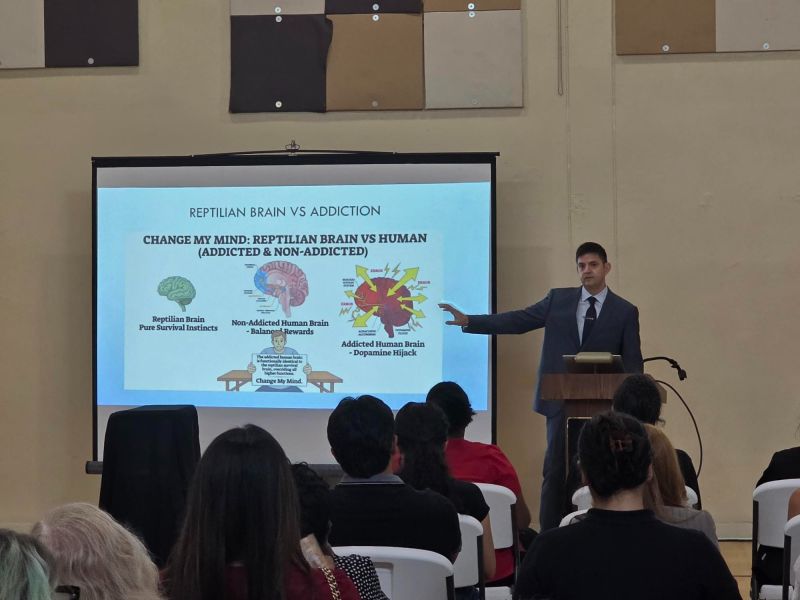
In June 2026, a full room at Central Florida Behavioral Hospital watched Zverinskiy stand beside a projected slide and teach. The host introduced him as a medical director within BayCare Health System and a triple board-certified specialist. There was a podium, rows of white chairs and the familiar conference-room acoustics in which every cough becomes a public statement. The scene could have belonged to his residency years, except that the map of responsibility had grown.
The return to teaching is more than a pleasing circle. Medicine scales partly through instruction. A clinical executive can write standards, monitor performance and approve programs, but a teacher must expose the reasoning. The audience gets to see where certainty ends, where judgment begins and why a neat rule may fail an untidy case.
Regional Psychiatry now lists Zverinskiy as director of consult and integrated care services. The title is nearly a synopsis of his career. Consultation means bringing expertise into another professional's problem. Integration means ensuring the expertise does not arrive as a visiting dignitary, wave grandly and leave. It must fit the surrounding work.
His parallel public affiliations in 2026 make that theme unusually concrete. One biography points to a national virtual-care organization. Another places him inside an integrated practice. A public appearance identifies a health-system role. The labels overlap because the work overlaps. Hospital, community practice and remote network are no longer separate worlds with courteous borders. People move among them, and an executive who understands only one setting will eventually design a bridge that ends several feet above the opposite bank.
There is little theatrical about a successful handoff. Nobody cuts a ribbon when the record arrives before the appointment, the referral reaches the correct team or a person does not have to start again. Good integration is often visible only by the absence of irritation. It is the kind of achievement that disappears into an ordinary day.
Zverinskiy's public career contains the expected markers of expertise: board certifications, fellowships in professional societies, research, awards, senior titles. Its more distinctive feature is the repeated movement between scales. One person. One classroom. One hospital service. One national organization. Then back to a room of practitioners, explaining.
A useful suspicion of distance
Healthcare produces distance naturally. Specialization creates it. Regulation creates it. Growth creates it. Technology can shorten one distance while adding another. The useful leader is not the one who pretends those distances have vanished. It is the one who notices which mile is missing and assigns the unglamorous work of building it.
That is the point of view hiding in Zverinskiy's résumé. Clinical excellence matters. So does the route by which excellence reaches somebody. Empathy matters. So does a system that leaves enough time and continuity for empathy to be more than a sentence on a values page. Teaching matters because the knowledge must outlive the meeting.
The story is still being written across overlapping roles in Florida and a national network that does not fit neatly on a business card. The through-line, however, is already legible. Learn the person. Learn the machinery. Teach both. Then check the handoff.