Calvin Goforth once described working on space-shuttle performance analysis as “taking a breather.” It is an arresting choice of words for a job involving rocket engines. Most people would reserve the expression for a walk around the block. For Goforth, the work at Rocketdyne was a pause between college and graduate school, a chance to earn money and watch shuttle testing from close range.
His father was a chemist. Science was already part of the family background when Goforth went to the University of Texas at Austin to study aerospace engineering. While pursuing his bachelor’s degree, he alternated semesters of study with work at NASA. He graduated with highest honors, then worked in Rocketdyne’s space-shuttle main-engine performance analysis group. The early sequence puts actual machinery alongside the academic credentials.
Graduate school took him to Stanford for a doctorate in mechanical engineering, with a minor in electrical engineering. Then he returned to his home state of Arkansas and became an assistant professor of mechanical engineering at the University of Arkansas. Three consecutive Halliburton Outstanding Researcher Awards followed. He had an academic career with tangible recognition. Leaving it would mean exchanging a familiar professional setting for a business he would have to build himself.
The professor who left the faculty
In 1994, Goforth started a computer-based machine-control business. The company, Vector, pursued open-architecture controllers built around personal computers. He financed it himself. Its first product arrived within a year, sales grew, and the company was sold at the end of its second year of operations. That compressed sequence carried him from faculty member to product developer to seller of a business.
The sale gave him an entrepreneurial outcome. His recollection of the process also included mistakes. “I made a lot of mistakes in that first business,” he said. “I’m a lifelong learner.” A successful sale does not require the founder to have known everything at the beginning. Goforth’s account leaves room for both the result and the education that preceded it.
His subsequent work with early-stage technology companies helped lead him to VIC. The professional problem had widened. A controller needed engineering, development, and customers. A company needed people who could make all those activities happen together. Goforth began working on that second set of requirements, the operating structure around an invention. It would become the central preoccupation of his next business.
“I’m a lifelong learner.”
Calvin Goforth
An invention need not cost a professor a career
VIC began as a consulting operation in the early 2000s and shifted to a development model in 2003. The change addressed a practical obstacle: university researchers could have technologies worth commercializing without wanting to leave their faculty jobs. Goforth had made that departure himself. Building a business around the assumption that every inventor would follow him would narrow the pool of willing participants.
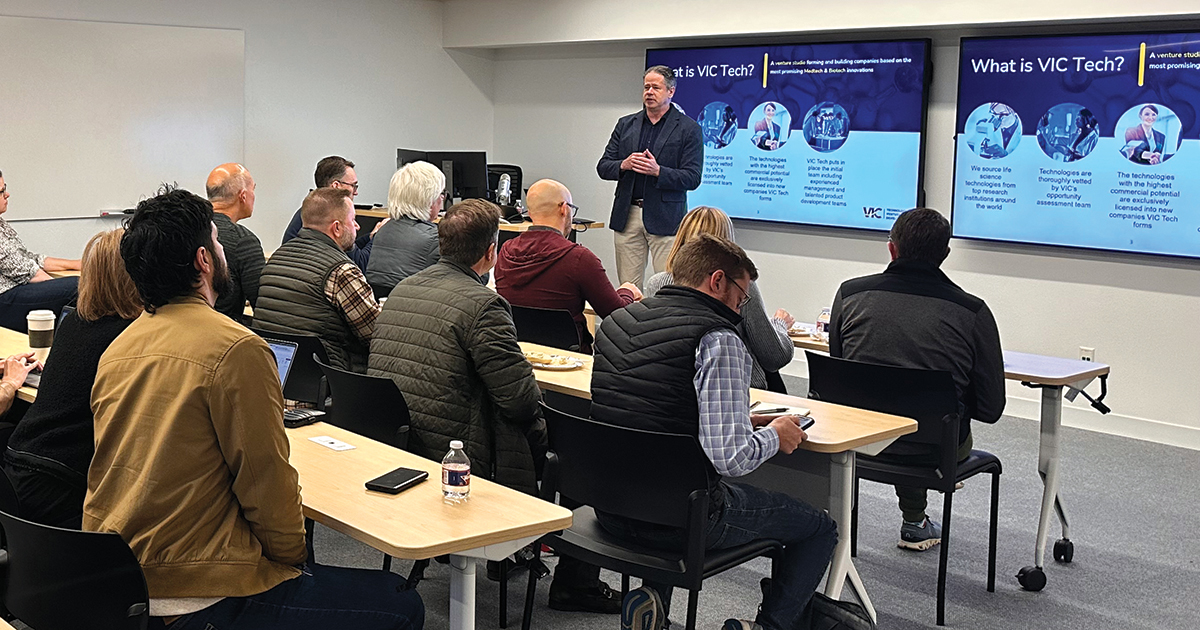
In a 2023 conversation with Carol Schultz on Evolving Your Workplace, he discussed the move from advising startups to forming companies around university inventions. The episode’s premise is wonderfully literal: companies within a company. VIC evaluates technologies and their commercial risks before committing to a new venture. The research pipeline and the talent pipeline have to come together. A promising invention, on its own, leaves a rather long list of vacancies.
The arrangement gives the inventor a continuing technical role. In Goforth’s explanation of the model, professors can become co-founders and technical advisors while the studio supplies the initial team and capital. VIC’s involvement continues through company development toward an eventual exit. That division of responsibility makes the inventor’s knowledge available without requiring the inventor to personally run every function of the business.
For Goforth, this is a repeatable way to participate in company formation. His first business depended on his departure from the university. His later business offers researchers a way to remain connected to their institutions while their inventions move into a separate commercial organization. The distinction matters because a faculty position and an executive position each carry work that cannot be wished away.
A patent meets a customer
Goforth’s writing is particularly revealing when he borrows the investor’s horse-and-jockey metaphor. In a June 2024 essay, the horse is the technology and the jockey is the team. He argues that choosing one as the sole basis for confidence misses the demands of company-building. Intellectual property needs capable operators; capable operators need an opportunity with enough commercial substance to support them.
He also warns about inventors’ attachment to their own work. His concern is specific: enthusiasm can distort judgments about demand, competition, and adoption. It is an interesting caution from a former professor who became a founder. The argument asks researchers to allow outside scrutiny of the business opportunity. Having created something technically valuable does not settle the question of who will pay for it.
VIC’s assessment process gives that scrutiny a structure. Its team reviews competition and intellectual property, talks with potential customers, examines the market, identifies barriers, and sketches a commercialization route. Licensing a technology into a newly formed business follows favorable findings across those initial criteria. The order is consequential: investigate the opportunity before giving it an organization, a budget, and a payroll.
The same attention to sequence appears in staffing. VIC shares executive and advisory resources across young companies, then installs permanent management as a business matures. Senior experience can be useful well before a company can afford a full roster of executives. Sharing the cost across ventures is part of Goforth’s answer to that awkward interval between needing expertise and being able to hire it.
- 01 / ExamineCompetition & intellectual property
- 02 / AskPotential customers & market needs
- 03 / MapBarriers & commercialization path
- 04 / DecideLicense into a new venture if the criteria hold
Money has to arrive in the right order
Goforth founded the VIC Investor Network in 2013. It added a route for seed capital alongside the company-development operation. For a founder whose first venture was self-financed, arranging a repeatable source of initial investment was a meaningful change in the machinery. A new company would need more than a favorable assessment and willing advisors. It would need money to begin the work.
The Foundry addresses an earlier stage. Goforth is also its chief executive. Some technologies have enough promise to merit further investigation but too many unknowns to attract private investment. VIC Foundry uses grant programs, including SBIR and STTR, to advance them. When the work supports a commercial venture, VIC can form the company and place an initial executive team into it.
The published Foundry model allows a founding investment of up to $500,000 from the VIC Investor Network. The inventor can serve as a technical advisor and receive equity and consulting compensation. Universities can participate through licensing and research work. Each participant has a role at a particular stage, rather than everyone being asked to act as the founder, financier, and operator at once.
In his October 2025 funding roadmap, Goforth carries this attention to stages into his discussion of investors. He considers the merits and limitations of angel networks, funds, accelerators, and studios. He asks readers to examine follow-on funding, governance, and realized returns. He also describes studios’ weaknesses, including dependence on the quality of the technology pipeline. Building the machinery does not abolish the possibility of choosing badly.
Founding investment from the VIC Investor Network after a technology advances to company formation.
Fayetteville, with several doors out
Goforth’s base remains Fayetteville. VIC’s work has extended through a network of regional executives and relationships with research institutions. By March 2024, the firm had six offices: Fayetteville, Boulder, Albuquerque, Dallas, San Francisco, and Minneapolis. The regional executives could act as interim chief executives for new portfolio companies, putting operating experience closer to the technologies and teams they were developing.
The geography fits a business that begins with discovery. Research institutions are spread across the country, and relationships with their inventors cannot all be conducted from one Arkansas meeting room. Goforth’s organization combines a home base with people positioned elsewhere. It is an operational answer to a dispersed supply of inventions, with company-building expertise available where the next venture might begin.
In June 2026, VIC added another arrangement: its Regional Innovation Partners program, with Phoenix-based 4 Peaks Tech as the first partner. Local knowledge would help identify technologies; selected projects could then access VIC’s management framework and initial funding. The announcement describes a wider effort to establish similar regional relationships. It adds local connections to the organization’s existing company-formation process.
The longer experiment
Goforth’s recent letters make patience a recurring business requirement. His January 2025 letter reported approximately $66 million raised by VIC’s portfolio companies during 2024. The money belonged to the portfolio companies collectively, rather than representing a personal fortune or a single financing round for VIC. He described drawing on several kinds of funding, including strategic partners, angel syndicates, grants, and contracts.
By September 2025, his writing emphasized tighter cash management and flexible operating costs. He discussed prioritizing core research programs and broadening the sources of capital. The themes are consistent with the shared-management model: preserve access to experience while keeping fixed commitments manageable. It is a founder’s interest in what a company can continue to do when conditions become less accommodating.
His January 2026 letter looked ahead to at least two new company formations and a possible liquidity event. Those were expectations. The wording left uncertainty intact. For someone whose first company reached a sale in two years, the subsequent work has involved a much longer relationship with the businesses he helps create. The studio’s ambition requires persistence as well as a good starting idea.
Goforth’s career has moved from analyzing engines to organizing ventures, with a university post and a self-financed company in between. The common thread is an interest in how parts work together. His current work puts people, intellectual property, money, and management into that question. An inventor can finish an experiment and still have a business to build. Goforth has made that unfinished work his occupation.
New funding across VIC portfolio companies, reported in Goforth’s January 2025 letter.