The founding insight behind Caliber Corporate Advisers was not especially glamorous. It was an irritation. In 2010, Harvey Hudes was working in financial media and kept watching companies with intricate products hire communications firms that did not understand the products. Before a story could be sharpened, it had to be translated for the people hired to sharpen it. The client paid for the privilege of tutoring the agency.
Hudes began Caliber in a small New York apartment to remove that extra layer. The agency would learn the language first: payments rails, asset management, underwriting, banking regulation, property data. Then it could do the visible work - public relations, content, social media and advertising - without mistaking a technical feature for the point of the story.
This sounds obvious until you notice how the agency business usually expands. A firm wins in one niche, adds another, then another, until its website promises expertise in everything from orthodontics to orbital vehicles. Caliber went the other way. Its orbit widened inside a boundary: financial services and fintech, insurance and insurtech, real estate and proptech, plus the professional firms that serve them.
01 / The hard part is not the press release
Caliber's customers range from growth-stage startups to banks, insurers, funds and multinational brands. Its published client history includes names such as The Clearing House, Northern Trust, DriveWealth, Episode Six, Grasshopper Bank and FinTech Sandbox. Founder Hudes says the wider record includes work with Goldman Sachs, Blackstone, KKR and Berkshire Hathaway.
These companies do not merely want attention. They need the right attention from buyers, investors, regulators, partners and a shrinking population of specialist reporters. A payment infrastructure company may have a product that works beautifully and a description that lands like wet cement. An insurtech founder may understand risk down to the decimal point and still struggle to explain why anyone outside the underwriting department should care.
“Data without context is noise. A story without purpose is forgettable.”Caliber, reflecting on storytelling at its 2025 offsite
The agency's four service lines are less a collection than a relay. Public relations builds third-party credibility. Content gives an executive room to develop an argument. Social media repeats and tests the idea in public. Digital advertising puts it in front of a deliberately chosen audience. The work can include analyst relations, media training, awards, conference speaking, white papers, case studies, organic social and programmatic campaigns.
Public relations
Messaging, press relationships, analysts, awards, speaking and executive preparation.
Content
Articles, research, white papers and case studies that make expertise legible.
Social
Organic and paid distribution for industry conversations, customers and partners.
Advertising
Programmatic campaigns ranging from broad awareness to narrow B2B targeting.
Caliber does not publish a rate card. It starts with an intake and builds a plan around the client's business goals. That model suits companies buying judgment and continuity. It is a poor fit for a buyer seeking the cheapest standalone press release or a general consumer splash far outside Caliber's sectors. Specialization saves onboarding time only when the client actually lives in the specialty.
02 / The office failed first - usefully
In 2020, the conventional office stopped being the center of Caliber. The company became remote, finished the year with record team and revenue growth, and began hiring more broadly across the United States. What could have been a temporary accommodation became part of the operating design. New York remained the headquarters; the talent map stopped ending at commuting distance.
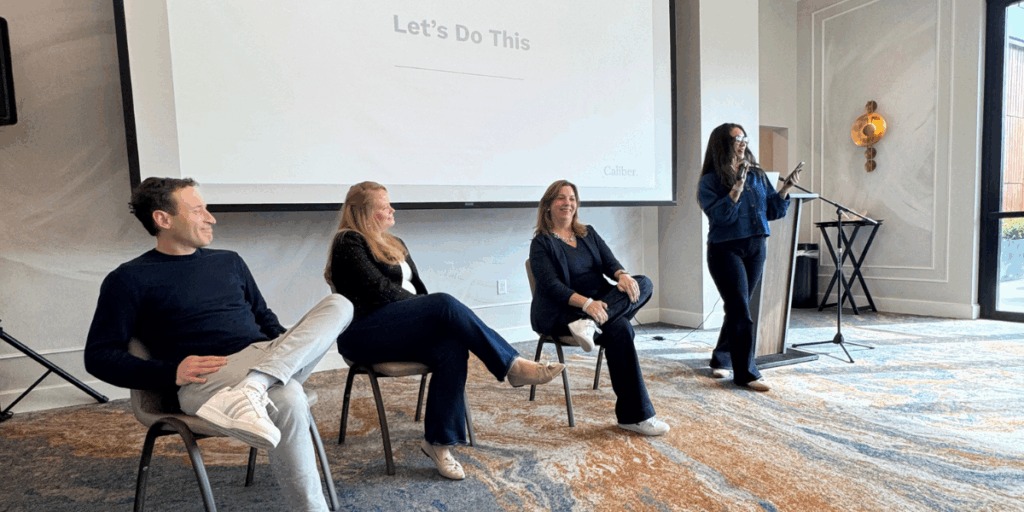
Remote work created an obvious cultural problem: expertise can pool in private calls. Caliber's response has been unusually explicit. Grace Keith Rodriguez, who joined in 2014 and became CEO in 2024, built Caliber College of Public Relations. The company also runs peer mentoring, guest-speaker sessions and an annual in-person offsite. In 2026, every employee completed an internal Digital Metrics Certification covering SEO, analytics and AI-driven search.
That certification reveals what changed the agency's mind about measurement. Earned media used to be treated as the top of a funnel that belonged to somebody else. Search and answer engines have blurred the border. A credible article can shape not only what a prospect reads but what a machine retrieves, summarizes and repeats. Caliber now treats visibility, authority and measurement as connected work.
Indexed revenue / 2021 to 2024
Caliber reported 75.6% revenue growth across the period. The Financial Times placed it among the Americas' fastest-growing companies for four consecutive years, 2023 through 2026.
03 / Build the room, then listen to it
Some agencies attend conferences to be seen attending conferences. Caliber turns them into infrastructure. As the official marketing communications partner of ITC Vegas, it runs the media lounge and coordinates press activity for a gathering of insurers, technology companies and journalists. Its recurring Fin & Juice events, hosted with The Financial Revolutionist and changing groups of partners, make networking sound less like calendar maintenance.
The cleverness is not the cocktail name. Live events compress the market. Reporters reveal which pitches they are tired of. Founders reveal which ideas cannot survive a follow-up question. Buyers reveal what has moved from interesting to budgeted. Caliber can carry that intelligence back into client messaging. The event is simultaneously service, relationship building and research.
The firm's partnerships follow the same logic. It acquired Austin-based Leverage PR in 2017 to add people and networks in familiar sectors. Vested bought a minority stake in 2019, giving both specialist firms a deeper bench and a conflict-agency option; the price was not disclosed. Caliber invested in reporter-source platform Qwoted in 2021 to get closer to the mechanics of the news cycle. The holding company around Caliber also owns fintech publication The Financial Revolutionist.
Hudes opens a specialist communications firm from a New York apartment.
Leverage PR joins, adding an Austin presence and a larger specialist bench.
Caliber becomes remote and finishes with record team and revenue growth.
Rodriguez becomes CEO; Hudes moves into the chief innovation role.
The full team completes digital metrics training as search itself changes.
04 / A playbook worth borrowing
The useful part of Caliber's story is portable. First, pick a market where ignorance has a visible cost. A specialist bakery and a specialist communications agency do not benefit equally from knowing financial regulation; Caliber chose a field where context changes the work. Second, make learning an operating system, not a lunch-and-learn. Training every employee creates a common standard that clients can feel.
Third, occupy the places where information changes hands. Running a press room is more revealing than reading a conference recap. Fourth, let the service mix follow the customer's problem. A strong opinion can begin in an executive interview, become an article, earn press, travel through social and reach a narrow buying committee through paid distribution. The handoffs matter more than the labels.
The honest fit
Caliber makes the most sense when the subject is complex, the audience is specific and credibility compounds over time. It makes less sense when the brief is mass-market entertainment, a one-day publicity stunt or bargain distribution without strategic counsel.
The result is a company that sits in an interesting market position. It is not a software platform, though it increasingly thinks about search data and measurement. It is not a giant holding-company agency, though it can serve global brands. It is a 44-person specialist whose scale comes partly from accumulated memory: sixteen years of knowing which distinction matters, which reporter will care and which impressive-sounding sentence says nothing.
Caliber's wager is that complexity will not disappear. Finance will keep inventing products faster than ordinary language can absorb them. Newsrooms will stay lean. Search will keep changing. In that environment, knowing the footnotes is not the opposite of telling a good story. It is how you earn the right to tell one.