Public relations has always contained a slightly comic transaction. A company pays an agency for the possibility that a third party, owing nothing to either of them, might decide the company is interesting. Everyone uses firm nouns - strategy, campaign, placement - to describe an arrangement built on maybe. Society22 PR has a wonderfully blunt response to this problem. It puts a clock on the maybe.
The agency's website offers top-tier media opportunities within 30 days or a client's money back. Notice the careful noun. It promises an opportunity, not a favorable article and not a cover story. A newsroom still owns the newsroom. Yet the guarantee does something important: it transfers the risk of inertia from the buyer to the agency. If no meaningful door opens, Society22 pays for the silence.
The product is borrowed trust
Society22 works mainly with B2B technology companies - SaaS, healthtech, fintech, cybersecurity and businesses heading toward funding rounds, mergers or public markets. These firms often have the same peculiar problem: the product can be technically impressive and commercially invisible. A buyer does not want one more assertion from the vendor. A buyer wants an independent reason to believe.
That is what earned media supplies. A reporter's interest, an industry award, a bylined argument or a well-timed executive interview lends outside credibility to the inside sales story. Society22 builds that credibility through media relations, ghostwriting, executive branding, newsjacking, award submissions, crisis work, analyst relations and media training. The agency's line is that attention should lead somewhere - a sales conversation, an investor meeting, a partnership, a better search result.
Make the story legible
Turn technical claims and founder experience into a narrative an audience can repeat.
Find the right room
Connect the narrative to relevant journalists, outlets and industry conversations.
Give attention a job
Reuse earned authority across sales, search, recruiting, fundraising and partnerships.
One verified software client described the machinery in unusually useful numbers: 135 thought-leadership pieces, placements in Forbes, Entrepreneur and VentureBeat, and introductions to nearly 200 business prospects. Those figures reveal the difference between publicity as decoration and publicity as distribution. The article is not the finish line. It is material for every conversation after it.
“They don't use the same playbook over and over. They learn about your company and adjust their recommendations.”Verified software client review
The menu has prices, which is rarer than it sounds
Agency pricing is often a small theater of concealment: book the call, describe the ambition, wait for the proposal. Society22 publishes a ladder that looks closer to SaaS than Madison Avenue. Its Core plan is $4,500 a month. Expert is $7,500. Growth is $12,500. Enterprise is custom.
The increments also explain the business. Core buys continuous pitching and story creation. Expert adds television, podcasts, radio, newsjacking and ghostwriting. Growth adds a senior strategist, research, design, print outreach, speaking and awards. Enterprise wraps communications around the company itself. This is a retainer business, but the tiers give buyers a way to see what more money actually changes.
A former trader follows the signal
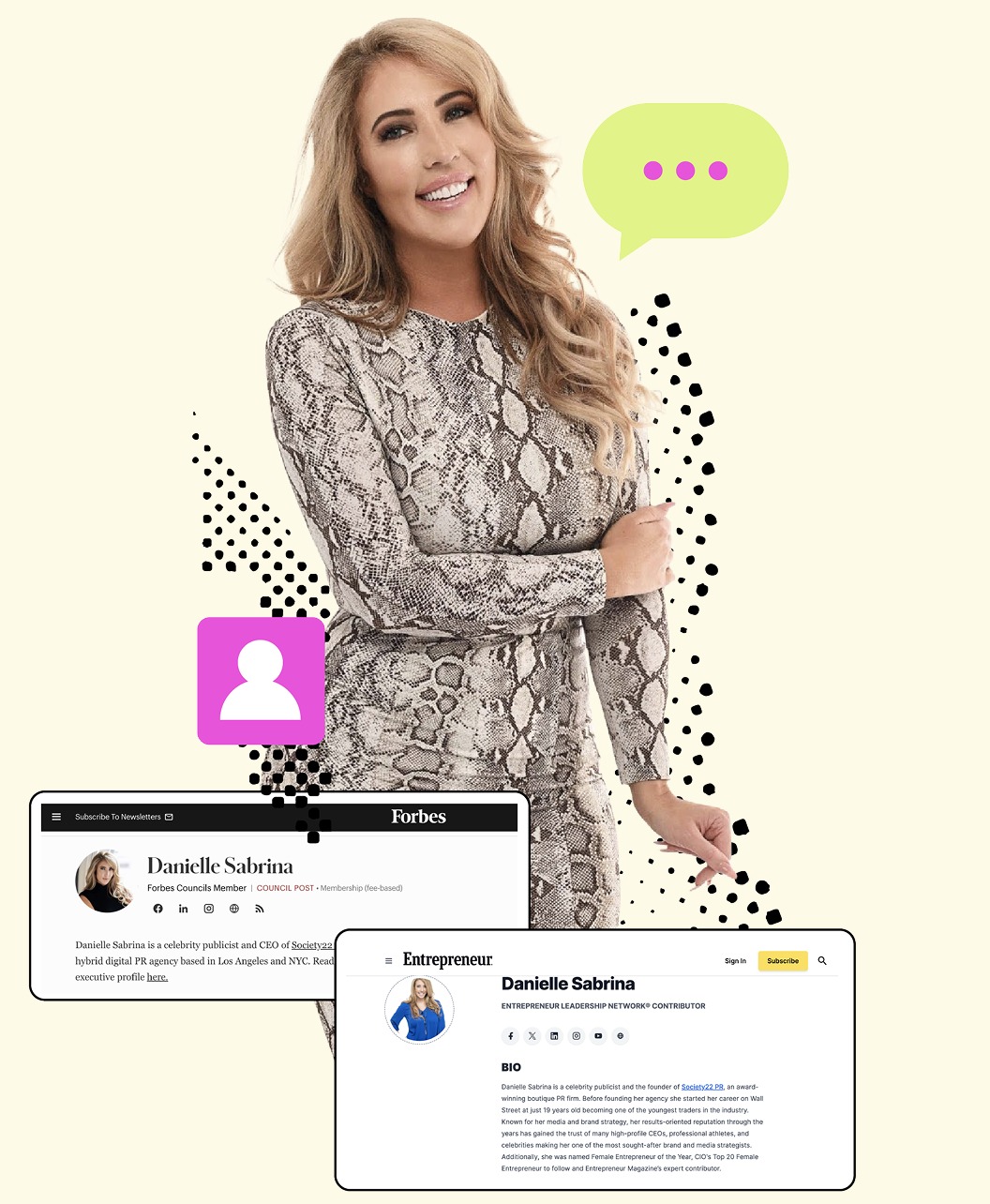
Founder Danielle Sabrina began her career in finance and says she became an equity trader at 19. That background survives in Society22's vocabulary. The agency talks about sales cycles, enterprise deals, funding, valuation and share of voice. It positions communications as something that should sit beside business development, not in a distant department polishing adjectives.
The company began in 2016 as Tribe Builder Media. By 2022, the old name had become too narrow for work that now stretched from earned media into creative strategy, digital campaigns and business development. The replacement took a year. In February 2023, Tribe Builder became Society22 - “22” chosen for its numerological association with the master builder. Mystical name, operational ambition.
The rebrand did not invent the firm's central claim. Entrepreneur was reporting its stated 97 percent placement rate back in 2019. What changed was the frame around it: less publicity shop, more growth partner. By 2026, Inc. listed Society22 at No. 2,223 on the Inc. 5000, with 152 percent growth over three years. Clutch showed 24 verified reviews averaging 5.0 as of February that year.
The first thing to strain was capacity
Fast agency growth creates an unglamorous crisis. Every new account adds meetings, drafts, approvals, reporter follow-ups and moments when somebody must know precisely what happens next. Society22's public account of its own expansion is revealing: it grew from three people to more than 20 in less than six months. The useful discovery was not a better pitch template. It was the real client-to-account-executive ratio.
In 2023, the firm deliberately sought mentors who had already solved its immediate scaling problems. It invested in repeatable processes and began tracking team bandwidth. The numbers changed management's mind about how many clients one person could serve well. This is the hidden half of the 30-day promise. Speed at the front of the house requires capacity math in the back.
The culture is designed around the same bargain. Sabrina has described “kindness first” and flexible schedules set with employees, rejecting the rigid 9-to-5. Flexibility without systems becomes chaos; systems without flexibility becomes a call center. Society22's attempt is to keep enough structure to protect the creative work and enough freedom to keep creative people.
What another company can steal
Turn invisible expertise into something a buyer can inspect.
- Name a short process. Society22 uses craft, match and secure.
- Publish a real entry price and show what each increase buys.
- Guarantee the part you control - preparation, access and speed - not a third party's verdict.
- Track the action after attention: introductions, qualified traffic, deal velocity and search authority.
- Measure capacity before growth turns responsiveness into theater.
There is a condition attached. This system works when a company has evidence, a credible point of view and a spokesperson willing to show up quickly. It is weak medicine for a bad product, a nonexistent market or an executive who wants attention without scrutiny. Nor can any ethical agency command a journalist to publish. A guaranteed opportunity is valuable only if the client understands the difference between an open door and a favorable verdict.
That distinction is what makes Society22 interesting. It sells confidence without pretending to own the press. The clock is not magic. It is a constraint that forces a narrative to be ready, a network to be relevant and an agency to move. In a business famous for billing by the fog, thirty days is wonderfully easy to understand.