A robot can walk into a hazardous room, step over a threshold and carry a sensor. The more interesting question begins after the applause: can it repeat the right route tomorrow, keep the instrument where procedure requires, notice the chair that moved overnight and leave behind a record an operator can actually use? Caleb Horan has spent much of his career in that unphotogenic gap between a robot demonstration and a completed shift.
His answer now has a company attached. Salem Robotics, which Horan co-founded with Janak Panthi in Austin, builds autonomy software for surveys and inspections in hazardous facilities. Nuclear is the first market. The pitch is not a new mechanical marvel. Salem wants to turn robots that facilities already own into independent workers that can navigate sites, manipulate instruments, collect measurements and assemble auditable reports.
This is industrial robotics with its collar buttoned. The machine must do the job and account for itself afterward. In a regulated facility, a graceful gait is a pleasant detail. A reliable measurement and a reviewable record pay the rent.
A furnace, a laboratory and the long way into a startup
Horan completed a bachelor of science in mechanical engineering at Colorado State University in spring 2022. His honors thesis had a title that sounds borrowed from an engineer's especially specific dream: “The Design and Deployment of a Novel Molten Salt Neutron Imaging Furnace.” Before graduation, he had already spent five years in a year-round research appointment at Los Alamos National Laboratory.
The details matter because Salem did not begin with a tour of fashionable markets. Horan learned around equipment, procedures and physical environments where error has consequences. His early published work included research on detecting defects in metal additive manufacturing with in-situ temperature measurements. He later deployed multi-robot teams in Los Alamos's Plutonium Division.
In fall 2022 he joined the Nuclear and Applied Robotics Group at the University of Texas at Austin for graduate work in mechanical engineering. UT would eventually award him a master's in robotics. The laboratory gave a more complete shape to the problem: radiation surveys are not one movement repeated by one universal machine. They are a choreography of mapping, floor coverage, elevated-surface inspection, obstacle handling and data management.
Three robots enter a nuclear facility
A 2024 paper co-authored by Horan presented a Robot Radiation Survey System made of three notably different machines. Minibots handled low-clearance mapping. A wheeled platform called Magni covered floors with an alpha detector. Alph, a Boston Dynamics Spot fitted with an arm, reached elevated surfaces, opened doors and moved obstacles. There is a faint air of a caper film to the cast, except the prize is a comprehensive alpha, beta and gamma survey.
The division of labor captured a practical truth. Wheels are efficient for floors. Small robots fit beneath equipment. A quadruped with an arm can negotiate uneven terrain and interact with the room. Each platform contributes what its body is good at. Software turns their separate talents into one survey.
From clipboard route to auditable result
The paper was candid about unfinished problems. A robot might be able to move a trash can, but where should it put the trash can? One platform could map under tables, while another still needed to use those maps properly. This is the honest texture of field robotics: an impressive capability often arrives carrying three smaller questions.
For Horan, those questions became commercial clues. Facilities had purchased capable machines, but autonomy often meant replaying a pre-recorded route. Real sites contain doors, stairs, altered layouts and multi-step work. When each robot still requires its own operator, the economic promise collapses into remote control with better publicity.
As we build systems … that are designed to do specific tasks, we don't build them in isolation. We build them for people.Caleb Horan, at the Texas Robotics parade
The useful robot may already be in the closet
Salem's product begins with an operator defining work in a dashboard. The robot then navigates, handles instruments, opens doors, turns valves and collects measurements. Finally, the software produces structured, compliance-ready records. The company reduces the sequence to three verbs: plan, execute, report.
The hardware-agnostic approach is the sharper business choice. Plants can run Salem's software on compatible robots already on site, or Salem can provide a suitable turnkey system. Horan and Panthi call some idle machines “$200k paperweights.” It is a funny phrase because the object in question may have four legs, expensive sensors and a talent for promotional video. None of that makes it useful at 2 a.m. on a recurring survey route.
Salem favors deterministic planning for safety-critical work. The distinction is less glamorous than a robot improvising, and more valuable in a place that needs consistent behavior. An operator must understand what the machine will do. A regulator or facility leader must be able to inspect what it did. The record is not administrative exhaust. It is part of the product.
The initial use case is radiological surveys, which trained technicians routinely conduct with handheld detectors and paper maps before transcribing results into digital systems. Automating the repetition does not remove the trained team from the equation. It changes where their attention goes.
Let's not replace the people. Let's enhance the people.Caleb Horan
Keep the judgment, lose the unnecessary exposure
Horan's line is useful because “human-centered robotics” can otherwise dissolve into conference language. Here it has a concrete meaning. A technician's judgment remains scarce and valuable. Walking a predetermined route, holding a detector, marking a paper map and retyping measurements consumes that judgment's time while adding exposure and opportunities for inconsistency.
The robot gets the dull, repeatable route. The person keeps supervision, interpretation and the higher-value work waiting elsewhere in the facility. It is a division based on comparative advantage, with the additional virtue that machines do not accumulate radiation dose.
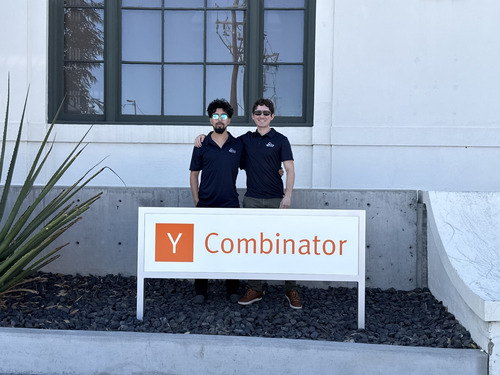
Salem's early company milestones arrived quickly. The team was selected for the 2026 Rice Business Plan Competition, received a $25,000 investment prize from non sibi ventures and won the James D. Pippin Award at the Jon Brumley Texas Venture Labs Investment Competition. In summer 2026, Salem joined Y Combinator. The company reported active contract-scoping conversations in nuclear and oil and gas around its launch.
The partnership also reflects the work's mixed demands. Horan serves as CEO, carrying experience in task planning and multi-robot deployments. Panthi, Salem's CTO, has researched deterministic manipulation and spent years deploying quadruped robots in nuclear facilities. Salem lists Mitchell Pryor, a UT Austin research professor with long experience in hazardous-environment robotics, as scientific adviser. Jim Nelson, an entrepreneur and UT McCombs faculty member, advises the business. The roster joins laboratory knowledge to the less forgiving questions of deployment, purchasing and support.
That mix will matter because industrial customers do not buy a mathematical guarantee in isolation. They buy a system that fits a procedure, works with familiar instruments and can be maintained after the pilot team goes home. Salem's public materials emphasize short validation engagements and optional human oversight. Both are reminders that autonomy enters a facility through a series of earned permissions. The robot has to prove one route, then prove it can repeat it.
The founding pair is small. Salem's YC profile listed two team members at launch. Its scope is not. The company sees nuclear as the proving ground for an autonomy platform that may later serve oil and gas, chemical, biological, emergency-response and space infrastructure. Each field presents its own procedures and perils. The common denominator is work that must happen where human exposure is costly and records matter.
What the next shift asks
The distance between a research system and a dependable industrial product is measured in edge cases, procurement cycles and nights when the layout is not quite what the map promised. Salem still has to cross it. A robot that can open a laboratory door once is interesting. A system trusted to perform recurring work, return consistent data and explain the result is an operating tool.
Horan's preparation for that crossing is unusually literal. The undergraduate furnace, the additive-manufacturing measurements, the Los Alamos deployments and the three-robot survey all orbit the same concern: how does a machine produce trustworthy work under physical constraint?
There is a pleasing restraint in building software for robots that already exist. Industrial technology has no shortage of splendid objects. The quieter opportunity is to make them earn a place on the schedule. If Salem succeeds, the proof will not be a dramatic leap across a stage. It will be a completed route in a room where nobody needed to go, followed by a report that leaves no mystery about what happened there.