The cash register used to be a place. You walked toward it, waited beside it, and submitted to its little ceremony of beeps, paper, plastic, and impatience. Bruce Bennett has spent much of his career turning that place into a moving target. At Mad Mobile, the Tampa software company he co-founded in 2010, checkout can happen in an aisle, beside a restaurant table, on a phone, through an online order, or anywhere else a customer decides the transaction should end.
Bennett’s part in this shift is not the familiar story of a young founder arriving with a flamethrower for the old order. He graduated from the University of Texas at El Paso with a computer science degree in 1983, where his LinkedIn profile also records a stint as a student-athlete on the football team. By the time “mobile first” became a pitch-deck reflex, he had already spent decades building, operating, and selling software businesses. His advantage was not innocence. It was pattern recognition.
The pattern is simple enough to fit on a receipt: complicated systems accumulate; customers grow impatient; the useful company is often the one that makes the complexity disappear. Bennett’s career has repeatedly occupied that middle layer. Image Technologies Group, which he founded in 1989, worked across consulting, web design, database programming, integration, multimedia, and wireless applications. Later came World Color New Media, the fishing site eAngler.com, the e-commerce delivery venture Mediacentric Group, and voice-and-data provider GoSolutions. From 2005 to 2010 he served as chief operating officer and a board member at SOE Software, which built e-government products.
Five companies before the phone took over
The prehistory matters because each business sat close to a technological handoff. Image Technologies arrived when databases, multimedia, and networked services were becoming commercial tools. World Color New Media put “new” directly in the name, a period detail as crisp as a dial-up tone. eAngler.com mixed specialist content, community, and shopping for fishing enthusiasts before that combination became an ordinary internet business model. Mediacentric explored e-commerce delivery. GoSolutions sold voice and data communications. None was Mad Mobile in miniature, but each required translation between new technical capacity and an organization trying to use it.
The ventures also trained Bennett on both sides of a transaction. He founded, grew, operated, and sold multiple technology companies. Image Technologies became connected to World Color, GoSolutions was acquired by V-eDocs, and eAngler was acquired by Ritz Interactive. At SOE Software, Bennett shifted from founder to COO and board member. The product category changed to election and e-government software, where reliability and institutional trust carry more weight than a clever demo.
By 2010, he had accumulated a useful collection of scar tissue: integration work, service delivery, executive oversight, acquisitions, and software that served people who had jobs to finish. Mad Mobile would apply that experience to a device suddenly appearing in every pocket. The smartphone looked like the novelty. The actual opportunity was the old software it could finally make accessible.
A napkin, then the unromantic work
Mad Mobile’s own history begins with a bar-napkin sketch. This is a charming origin because napkins cannot host status meetings. The romance ends quickly, and the work begins: connect to inventory, customer records, orders, and payments; make the interface behave; keep the system alive during a Saturday rush.
Bennett co-founded the company with Greg Schmitzer, a mobile-industry operator with deep retail experience. Their first platform powered mobile commerce sites for more than 90 retailers. In 2013, MICROS, later bought by Oracle, engaged the company to build a mobile tool for store associates. Sysco followed with mobile ordering. Talbots became the first customer for a Concierge mobile point-of-sale and clienteling product offered with Oracle. Apple, Salesforce, and Samsung became partners in later chapters.
The strategic choice underneath those milestones matters more than the logos. Mad Mobile did not demand that a large retailer throw away the systems already controlling its business. It connected to them. A store associate could carry a better interface while inventory, order management, and customer data remained in their existing homes. Modernization arrived as a layer, not a demolition crew.
“There is an enormous opportunity to modernize the restaurant experience with mobile.”Bruce Bennett, announcing the CAKE acquisition in 2020
The restaurant was hiding inside the retailer
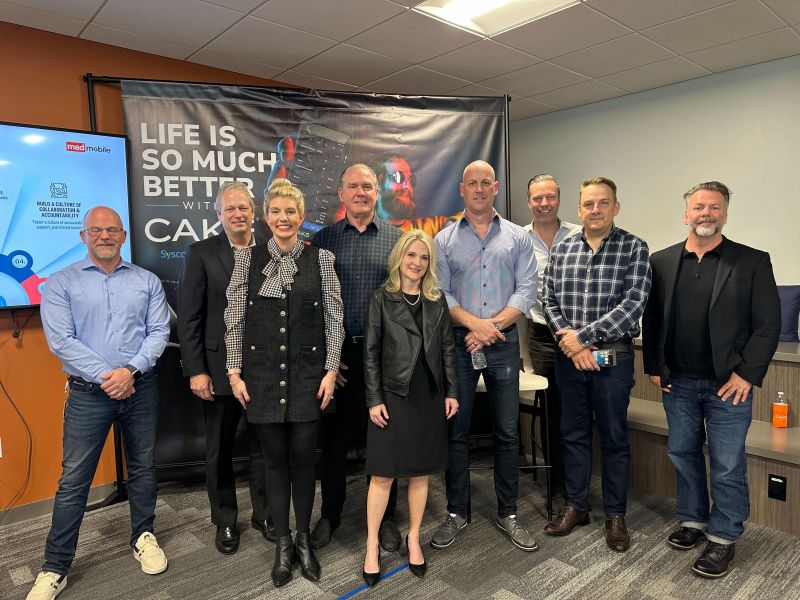
The move into restaurants made the original thesis larger. In 2020, Mad Mobile acquired CAKE, a point-of-sale business, from Sysco. The deal brought thousands of restaurant locations, an established product, and a team ready to extend it. Bennett described the moment as a chance to modernize the restaurant experience with mobile. It was also a test of whether the retail playbook could survive a hotter, louder room.
Restaurants compress every software problem into dinner. Orders change, tables turn, staff move, cards fail, kitchens fall behind, and no guest wishes to hear a thoughtful explanation of middleware. A mobile system is useful only when it coordinates the old machinery without becoming another chore. CAKE gave Mad Mobile an all-in-one product for operators ready to replace their register, while MenuPad offered mobility to restaurants with legacy point-of-sale systems. The company could now sell replacement and restraint.
That duality is one of Bennett’s recurring operating instincts. Replace what is ready to be replaced. Integrate with what is not. The policy is less theatrical than “move fast and break things,” but a restaurant at 8 p.m. has already supplied enough breaking things. Reliability is allowed to be the innovation.
Money for the plumbing
Mad Mobile raised $20 million from Eastward Capital Partners in January 2023. Bennett tied the investment to sales gains and labor efficiencies that large retailers and restaurants were seeing from connected commerce. In June 2024, Morgan Stanley Expansion Capital and Bridge Bank provided another $50 million in financing. The company said the money would support its SaaS and payments technology, refinance existing debt, and accelerate sales.
The sequence reveals the widening ambition. A mobile interface starts close to the worker and customer. Payments run underneath both. By late 2025, Mad Mobile had announced Premier Acquirer Services with Visa’s Cybersource, SouthState Bank, and RS2, bringing it closer to the processing, tokenization, fraud controls, and merchant funding that follow a tap. The disappearing cash register was becoming financial infrastructure.
Artificial intelligence arrived in the same pragmatic costume. Mad Mobile introduced Neo as a modernization platform for AI-native workflows and agents across restaurant and retail systems. The pitch is not that an agent replaces the store. It is that it can coordinate work across the software already there. Bennett’s LinkedIn activity offers a small clue to his posture: he recently shared a list urging leaders to learn fundamentals, verify outputs, protect sensitive data, and keep humans involved. Curiosity, with a seat belt.
The hardware changes. The durable business is the one that removes an awkward moment between a customer and a sale.
What an operator can steal
Bennett’s public biography emphasizes value propositions and people, language so corporate it practically arrives wearing a badge. A more revealing moment appeared in 2025, when he publicly congratulated product manager Mirunaaliny Iyer while presenting Mad Mobile’s Founders’ Award. The company describes the prize as recognition for service, leadership, and lasting impact. Bennett’s note was brief: he was proud, the award was deserved, and he appreciated what she did for the company, her team, and customers. Three constituencies, one sentence.
Integrate before you invade
A better front end can create value before a customer is ready to replace the core.
Let the wedge travel
Mobility opened retail, then restaurants, payments, and AI-assisted operations.
Buy a working doorway
KidoZen added enterprise capability; CAKE brought a product, customers, and a new market.
Make reliability visible
When software enters a store or dining room, uptime becomes part of the customer experience.
There is continuity here, but not repetition. Bennett began in a world where “new media” needed its own division. He built an online fishing community when e-commerce still required explanation. He moved through communications and government software, then bet on a phone as the employee’s new terminal. Now the terminal is less important than the web of data and money behind it.
The aspiration Mad Mobile publishes is broad: modernize enterprise commerce from the inside out. Bennett’s career gives that phrase a long history. He has spent nearly four decades working from the difficult middle, where a clean customer moment depends on untidy systems agreeing with one another. The cash register has not vanished, of course. It has dissolved into everything around us. Somewhere in Tampa, Bruce Bennett is still working on the plumbing.