At a business dinner, Bruce Anderson encountered a proposition that seemed to him to miss the point of television’s future: connected TV could get along without common standards. The dinner became the opening scene of an argument he published in 2023. Television had acquired new screens, new delivery methods and a formidable wardrobe of acronyms. Anderson’s concern was whether the machinery underneath could work together.
It is an unusually revealing place to begin a technology executive’s story. Nobody was unveiling a device. There was no ceremonial button to press. The dispute concerned the rules that let different businesses transact with one another, the sort of thing that rarely earns applause until its absence ruins everyone’s afternoon.
Anderson, INVIDI Technologies’ co-founder, Co-CEO and Global Chief Technology Officer, has spent much of his career around these less visible arrangements. His work has touched digital television standards, satellite delivery, video on demand and the software that decides which advertisement reaches a household. A television can look perfectly satisfactory from the sofa while presenting an engineer with a long list of unfinished business.
Before the break, build the television
Before INVIDI, Anderson worked at Sarnoff, where he spent ten years and became Managing Director of Digital Television and Entertainment. His responsibilities concerned the design and development of digital video systems. He was part of a senior team involved in developing the ATSC Digital Television Standard, DIRECTV and DIVA. These were collective engineering undertakings, with the television picture at the visible end of a considerable amount of coordination.
He subsequently served as Vice President of Broadcast Products at DIVA, a video-on-demand business. The progression matters: broadcast standards, satellite television and on-demand delivery each ask different things of the systems behind a screen. Anderson’s career moved through those differences before addressable advertising became his central occupation.
His INVIDI biography dates his arrival to 2001. It also credits three projects he managed at Sarnoff with leading to Technical Emmy Awards. Later, Anderson and the INVIDI team received Technical Emmys in 2016 and 2021. These awards concern television engineering. The work happens a fair distance from the acceptance speech most viewers imagine.
One programme. Several commercial breaks.
Addressable advertising begins with a simple observation: households watching the same programme need not receive the same commercial. A broadcast provides a shared schedule. Software can make the advertising within that schedule more selective. The programme stays communal; the break becomes a collection of different deliveries.
Anderson has explained the idea through the everyday business of television distribution. INVIDI’s software operated inside customers’ set-top boxes, helping select advertisements according to household characteristics. Its task included accommodating the different infrastructure used by television providers. Getting the right advertisement selected was only part of the job; it also had to arrive through the system already serving the viewer.
That distinction helps explain why a familiar television set could become the setting for a different advertising business. A commercial slot could carry different campaigns to different households. The economic opportunity came from making an existing interval more useful to advertisers, rather than asking a viewer to find another hour in the day.
Anderson’s public explanations tend to move between these two scales: the engineering decision at a device and the commercial decision behind an advertising buy. The connection is essential to understanding his role. Code has to deliver something a distributor can sell, an advertiser can use and a household can watch without having to think about the code.
An Emmy for knowing where the viewer lives
One example is admirably concrete. In February 2021, INVIDI announced a Technology & Engineering Emmy for work that enabled DIRECTV and DISH advertising sales into local markets. Satellite television reaches across large areas. A local advertising order needs a much smaller destination.
The system translated local cable advertising schedules into geographically targeted satellite spots. After an advertisement aired, records went back to the originating operator so the delivery could be reconciled and billed. That final step deserves a place in the story. Advertising technology has to survive the journey from a booking to an invoice.
For a local advertiser, the significance was access to satellite households within the relevant market. For Anderson’s engineering team, it meant making national distribution behave locally at the required moment. The award recognised a solution to a distribution problem that a viewer might never notice. That is a respectable ambition for television machinery: do the difficult thing while the audience reaches for its tea.
Engineering awards shared by Anderson and the INVIDI team.
The screen changes; the coordination problem remains
In 2018, INVIDI acquired Ooyala’s advertising technology business, formerly Videoplaza. The transaction brought in Pulse, a digital video advertising platform, along with an engineering and account-management team. Anderson described the move as part of taking INVIDI’s capabilities into online streaming.
The acquisition provides a useful hinge in his career. Experience with broadcast distribution remained relevant, while streaming introduced another set of systems and commercial practices. Bringing a product and its people into INVIDI offered a route into that environment. Anderson’s explanation concerned extending capability across delivery methods, a theme that would become more explicit in subsequent launches.
In July 2021, INVIDI became a certified Project OAR partner. OAR, short for Open Addressable Ready, was a consortium developing common technology for addressable television advertising. The certification covered 11.2 million enabled VIZIO televisions in the United States at the time. That is a dated footprint, rather than a claim about how many televisions the system reaches today.
In April 2022 came Conexus, a platform for running national addressable campaigns across multiple distributors. Its proposition was to let a programmer enter a campaign once and coordinate its execution through a consolidated interface. Anderson presented it as a way to connect INVIDI’s distribution partners while preserving customers’ ability to use existing tools. Fewer separate instructions, more shared procedure: an engineer’s fairly persuasive contribution to office happiness.
A standards argument with a commercial consequence
At the Advanced Advertising Summit in Los Angeles in June 2022, Anderson discussed the difficulty of making addressable advertising easy to buy across platforms. He expressed hope that advertiser demand would push the industry toward common solutions. His optimism came with an acknowledgment that the anticipated breakthrough had been predicted before.
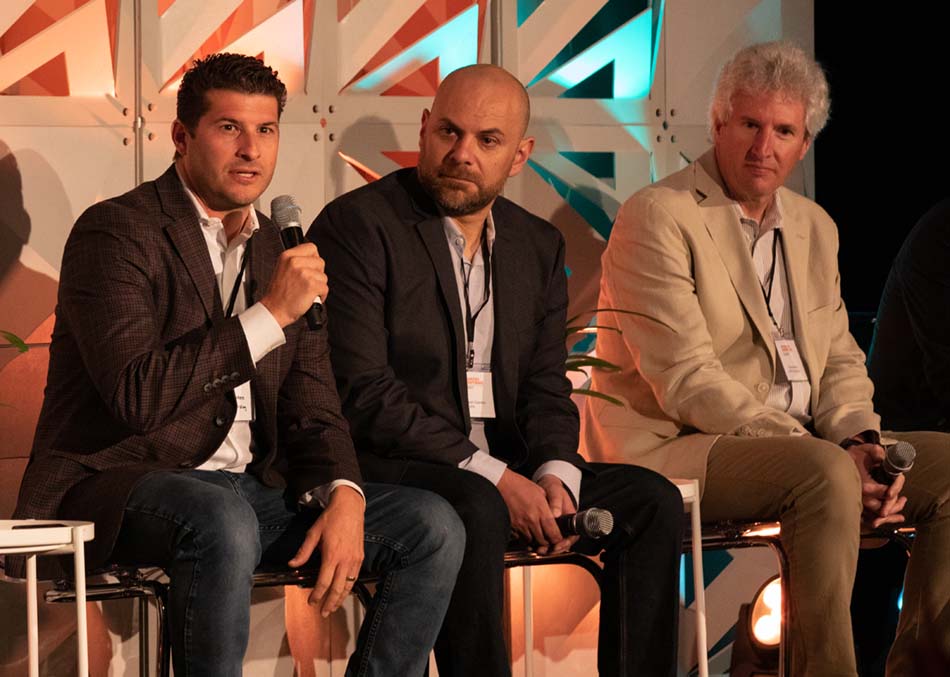
The panel brought together people from distribution, advertising buying, data and competing technology businesses. The photograph catches something useful about his professional setting: Anderson sitting alongside people whose organisations approach the same advertising transaction from different directions. Making their systems cooperate involves commercial interests as well as technical interfaces.
His 2023 standards argument gave that practical problem a wider frame. He contended that separate platforms and closed systems put limits on the growth of connected television advertising. He also acknowledged INVIDI’s own position in a concentrated addressable advertising market. His case for cooperation included the business he helped build.
The argument is especially interesting coming from someone who has worked on television’s underlying standards. A new delivery method can create excitement, but a functioning industry needs repeatable ways to exchange instructions and execute transactions. Read against his career, the essay sounds like accumulated experience with what happens when different pieces must agree.
Still working with the television people already own
Anderson applied a similar principle inside INVIDI. When the company announced changes to its senior leadership structure in December 2021, he described clients seeking guidance in building advanced advertising businesses. The changes combined responsibilities and were intended to make the company more responsive. His account made the customer relationship part of the product’s practical operation.
In January 2025, INVIDI announced that DIRECTV had acquired majority ownership. Anderson pointed to a longstanding relationship with DIRECTV as both customer and investor, and outlined plans for further work in the United States and international markets. The announcement said INVIDI would continue operating independently under its existing leadership.
The more recent product work continues to meet television in its existing forms. In April 2026, INVIDI and igolgi announced an integrated solution linking Pulse’s advertising decisions with live server-side insertion. Later that month, an Enghouse Networks partnership addressed targeted advertising across live and on-demand IP video. Both involved fitting advertising decisions into operational delivery systems.
In July 2026, INVIDI announced a Google collaboration extending programmatic advertising to unconnected set-top boxes. Its India team had identified the customer need and worked with Google on the solution. For a career repeatedly concerned with the equipment between a programme and its audience, it is an apt continuing chapter: even a box without an internet connection remains worth accommodating.
The thank-you behind the title
When Anderson was named a 2025 Philadelphia TITAN 100 honoree, his response turned toward other people. He thanked early managers at Lockheed, colleagues at Sarnoff and the professionals he had worked with at INVIDI. The individual recognition prompted an account of shared work.
“You all make me look good,” he wrote. That small sentence offers a more personal ending than a list of platforms. It also fits a career built around teams and interdependent systems. Television requires many contributions before a picture appears, and many more before a commercial can reach a particular household and be accounted for.
Anderson’s public ambition for the industry follows the same direction. He wants addressable television to become easier for its participants to use together. The future he argues for depends on agreements, interfaces and partners. After decades inside television’s machinery, he is still concerned with what can happen when the pieces fit.
“You all make me look good.”Bruce Anderson, responding to his 2025 TITAN 100 recognition