Before Brian Price helped organizations keep track of their cloud accounts, he wrote software to keep track of his DVDs. He lent them to friends and neighbors, and wanted a way to manage the inventory. The problem was small, recognizable, and close to home. Someone had a film. Someone else wanted it. A little application could make the arrangement easier.
Years later, the objects would change. Accounts, permissions, budgets, and policies would replace discs. The useful question would remain: how do you let people use something without losing control of it? Price’s career offers an unusually concrete way into an abstract business. Cloud governance sounds forbidding. Lending out your movies sounds like an excellent way to discover why records matter.
A coffee shop before a software company
Price grew up in Crisfield, on Maryland’s Eastern Shore. During high school, he worked at his uncle’s coffee shop, Gordon’s Confectionery. An only child, he learned to deal with people in a business that doubled as a gathering place. The shop belonged to a town where conversation traveled readily and technology jobs were scarce. His early working life involved customers long before it involved enterprise customers.
He graduated as valedictorian and wanted to find opportunities beyond the shore. His own phrase for that ambition was to cross the bridge. He became the first person in his extended family to graduate from college, earning a computer science degree at Salisbury University. The journey led to Northrop Grumman, where he began as a Java developer. Running a startup had not been the destination he originally imagined.
The DVD application makes a fitting opening to that journey because it needs no founder mythology. There was no requirement for a grand pronouncement about the future. An inconvenience was enough. In enterprise software, the inconvenience can arrive wearing a procurement badge and carrying a very long spreadsheet. It still needs someone willing to look closely at the work.
The cloud acquired a queue
Before Kion, Price built software and led teams at Northrop Grumman, Booz Allen Hamilton, and Jacobs Engineering. At Booz Allen, one application introduced an internal self-service cloud provisioning platform using AWS and VMware vSphere. That is a revealing piece of his professional history: software that helped other people get access to the infrastructure they needed to do their jobs.
His subsequent roles broadened the assignment. At Van Dyke Technology Group, he managed cyber solutions, oversaw research and development, and introduced an internship program. At Stratus Solutions, he became a vice president, working on commercial growth across DevOps, cybersecurity, and cloud infrastructure services. Technical delivery, business systems, and customer relationships all became part of the work.
Cloudtamer.io grew out of Stratus Solutions. An early deployment supported a large Department of Defense agency moving application development from decentralized physical data centers into AWS. Developers gained speed, while the organization faced a fresh collection of questions about account provisioning, spending, and compliance. The machinery had become more flexible. Keeping track of its use still required considerable attention.
The team built controls that followed an organizational hierarchy, applying appropriate rules and spending limits to projects. Developers retained native access to AWS rather than being confined to a separate, restricted interface. NASA was among the early adopters. In June 2018, Price described plans to announce the product’s general availability at the AWS Public Sector Summit in Washington.
Three responsibilities, designed to work together.
An alert cannot answer its own email
Price’s early writing about the product gets specific quickly. In his account-management essay, he argued that cloud projects should mirror the structure of the organization using them. Access, money, and policy could then follow the same lines of responsibility. He wanted account requests and approvals to move promptly, with automation handling consistent setup after the decision.
He also described a customer whose cloud broker supported basic AWS services but failed to keep up with newer capabilities. Engineers had to recreate functionality they could otherwise have used directly. For Price, that was a design problem: governance should let people reach the cloud provider’s own tools while applying appropriate safeguards. A system intended to simplify work could become another obstacle.
The budget essay was equally practical. Different funding sources came with different restrictions and spending periods. A warning that a project was approaching its limit could help, but the person receiving it might be away. Price advocated configurable enforcement that could limit or pause spending without waiting for someone to react. The scenario is ordinary enough to be persuasive. An email can report a problem with impeccable manners while the bill continues to grow.
His compliance essay carried the same concern into policy. Written rules needed consistent enforcement inside the environment. Exceptions also needed a workable approval process, with decisions assigned to appropriate people and changes applied through automation. That detail matters. Price allowed for customers trying a new service or designing a new system, rather than assuming every useful action would fit neatly into an existing rule.
Together, these essays show the decisions behind the product. Who can approve access? Where does a budget belong? What should happen when a limit approaches? Who may authorize an exception? The language is technical, but the questions concern responsibility and time. Price keeps returning to the point at which a person must decide something, and the repetitive work that software can perform afterward.
Eight people, then a shorter name
In his October 2021 funding announcement, Price recalled starting cloudtamer.io in September 2018 with eight people. The Series A brought $9.5 million, led by Blue Heron Capital and TDF Ventures, with support from other investors. He described the funding as a means to extend the company into new markets. The business was growing around a problem already encountered in customers’ daily operations.
Series A funding for cloudtamer.io, before its change of name to Kion.
A few weeks later, cloudtamer.io became Kion. Price thought the old name had grown too narrow for the product. Taming suggested a limited assignment; combining governance and management had taken the company further. The new name’s explanation joined an open hand with action and purpose. It was an attempt to describe a relationship with customers as well as a collection of features.
The redesign involved Focus Lab, which developed the identity and helped clarify the company’s message. Price valued the agency’s willingness to understand the technical complexity. A brand project in this business had to explain what the software actually did. The attractive colors still needed to earn their place beside account provisioning and budget enforcement.
By 2023, Price was a finalist for WashingtonExec’s Cloud Executive of the Year award. He spoke about removing obstacles to federal cloud adoption and sharing knowledge between agencies. He also singled out Kion’s partnership with Booz Allen Hamilton as a return to an earlier chapter: he had worked there for more than seven years. A former employer had become part of the company’s wider network.
The founder changes seats
On October 7, 2025, Kion announced Brian Wilson as its new CEO. Price stayed, becoming Chief Product Officer. The announcement assigned him a focus on innovation and product vision. It was a change in how he would contribute to the company he had co-founded, with Wilson taking responsibility for its next phase of business growth.
“Leading Kion has been the privilege of my career.”
Brian Price · October 2025
In his own account of the transition, Price named customer discovery, product vision, and innovation as the parts of the business he loved most. He reported more than 70 customers and over $10 million in annual recurring revenue at that point. Those figures belong to the handoff in 2025; they describe the company he was handing over, rather than a running total for today.
He also described the texture of working together: Slack emojis, difficult conversations, karaoke, and hard quarters. For a founder announcing a new role, it was a notably human inventory. Customers and revenue supplied the business context. The people supplied his explanation of what he valued. He emphasized transparency, purpose, and empathy as qualities he wanted to carry into the new job.
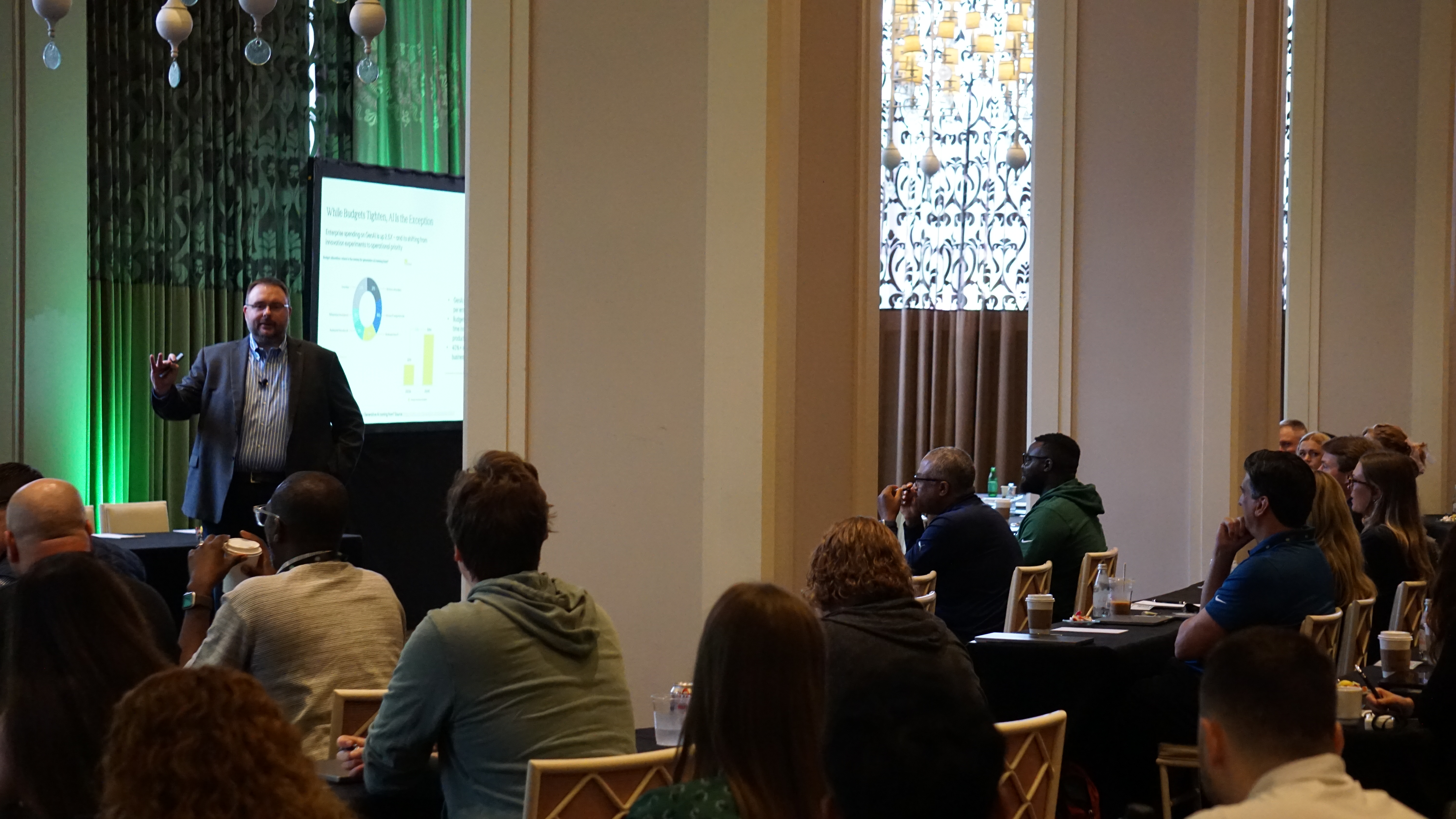
At the company’s Philadelphia All Hands gathering, Price used clips and metaphors from the Rocky films in a talk about perseverance. The event also included an AI hackathon and time for colleagues to meet in person. A remote company had made room for shared activity. The movie choice supplied a little local flavor, along with the useful reminder that a gathering needs something people can remember.
A product job with a growing bill to explain
Price’s current work sits inside a company extending its financial controls into AI consumption. In June 2026, Kion announced version 3.16, including an Anthropic integration that brought token spending alongside cloud costs. Teams could allocate usage to people or business units and establish budgets. Automation policies covered tasks such as tagging resources and turning off instances outside business hours.
In September, Kion announced FinOps Foundation Premier membership, founding membership in the Tokenomics Foundation, and FinOps Certified Platform status. These were company developments, with Wilson representing Kion on the FinOps Foundation’s Governing Board. For Price’s product remit, they describe the surrounding work: extending familiar questions about ownership, consumption, and control into another kind of technology spending.
His public-sector writing continues to argue for prevention and automation. He described a customer with more than 40 manual steps in account provisioning, where automation reduced delivery from days to minutes. The example gives his mission a tangible unit of measurement. A person waiting for an account does not need a more elaborate description of the cloud. They need the account.
Dinner arrives sooner than a release
Away from software, Price likes to cook. He grew up watching cooking shows, learning techniques, and preparing meals with family. He enjoys teaching people about ingredients and pairings. He has also explained the appeal of the shorter production cycle: software can take months, while a dish can be completed and enjoyed in an hour or two.
That is an agreeable ambition for anyone accustomed to a product roadmap. Dinner offers a finished result and people who can respond to it immediately. Price talks about food as an experience almost anyone can share, where technology can be harder to relate to. His interest in helping someone understand a dish gives the portrait another register, far from account hierarchies.
There is a modest continuity across the borrowed movies, the provisioning platform, the cloud controls, and the kitchen. Each involves something another person wants to use or enjoy. Price’s work has grown considerably in scale, and his title has changed. The practical assignment is still recognizable: understand what people are trying to do, then make the arrangement easier to live with.