The cloud has a remarkable talent for making a purchase feel like an action. An engineer starts a server; a team launches an experiment; an application grows. Then an invoice arrives with thousands of rows and a question that no one can answer without calling three other people. In 2012, Joe Kinsella saw a company in that awkward pause between the bill and the explanation. He had spent time at Sonian, a cloud archiving company, writing scripts to pull AWS pricing and wrestling with which machines were the right size. He knew the problem from inside the bill.
- CloudHealth turns cloud usage and invoices into reports, forecasts, policies and cost-saving recommendations.
- Its original audience grew from AWS users to enterprises and managed service providers working across AWS, Azure and Google Cloud.
- VMware acquired the company in 2018; CloudHealth now sits in Broadcom's software portfolio.
- The latest frontier is measuring AI spend by model, vendor and token.
Kinsella did not begin with the finished dashboard. He ran short experiments, including a concierge service that required read-only AWS access. One test ended with a customer signing up, almost by accident. A second followed. By the end of 2012, Dan Phillips had joined as chief executive and the pair had a business to pitch. Dave Eicher joined as a co-founder in early 2013. Kinsella later wrote that the company reached product-market fit in 2014, a phrase that sounds tidier than the work it describes: persuading customers to hand over complicated account data and proving that the analysis was worth paying for.
A bill is also an org chart
CloudHealth's central trick is to connect a technical event to a financial owner. Its platform collects cost and usage data, groups it by business unit or application, and gives teams reports they can act on. A finance leader can see where the money went. An engineering manager can see idle resources, oversized machines or a reservation that no longer matches demand. A managed service provider can show several customers their own accounts without building a separate reporting system for each one. Budget alerts and policies move some of that work from a monthly argument to a routine process.
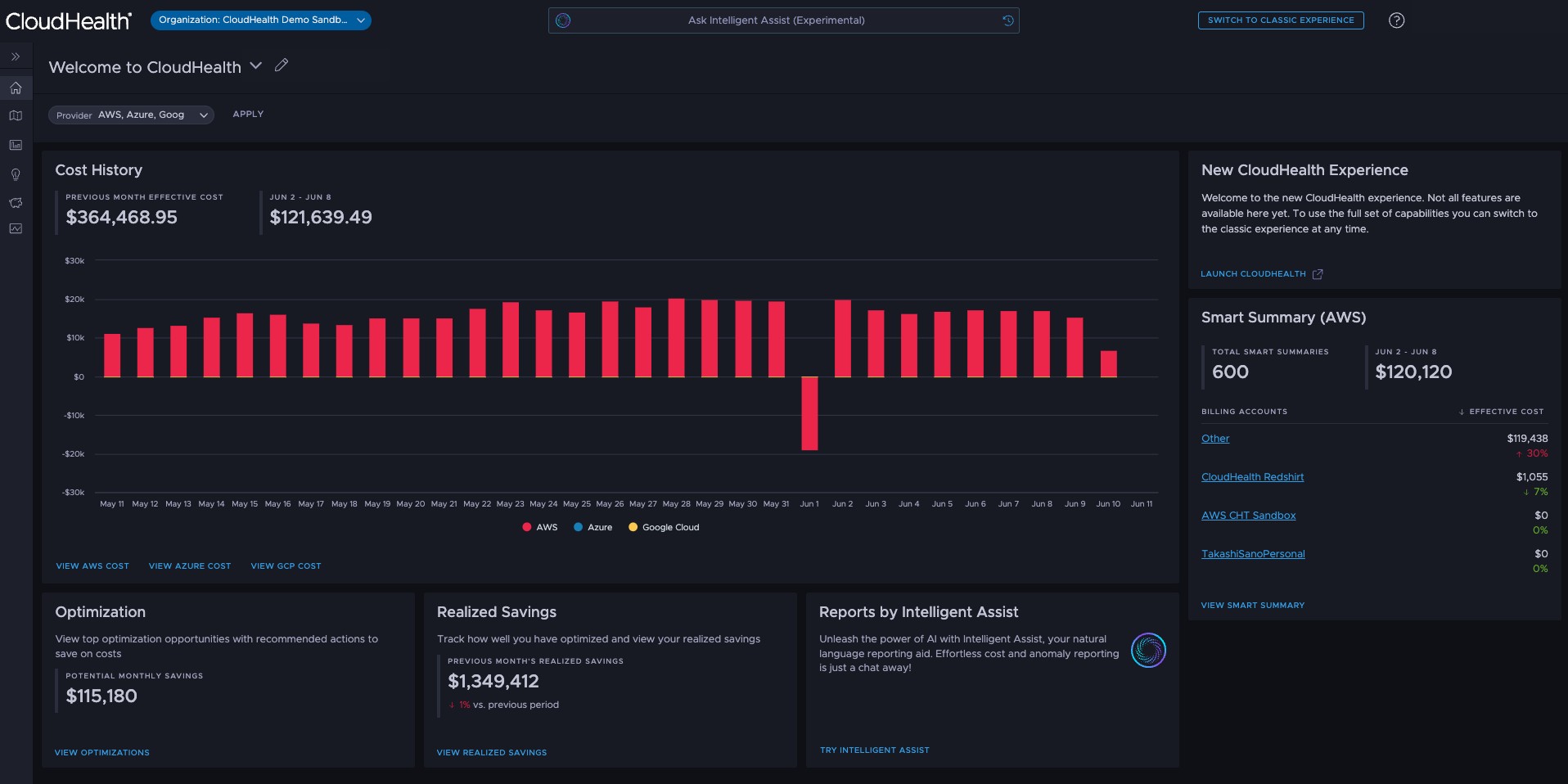
That makes the product broader than a coupon book for cloud computing. It includes forecasts, anomaly detection, rightsizing suggestions, commitment discount management and governance rules. CloudHealth's Perspectives feature groups infrastructure according to the business's own categories. FlexOrgs controls which people see and manage which data. Its partner platform adds customer management and billing workflows for service providers. The current product also offers an optimization dashboard, custom datasets and Intelligent Assist, an AI interface for asking questions about costs. Those features serve different jobs, but all depend on the same unglamorous act: naming the cost correctly.
The distinction matters because the alternatives solve narrower versions of the question. AWS, Azure and Google Cloud each provide native cost tools for their own estates. Other independent FinOps platforms, including Apptio Cloudability and Flexera, compete for the multi-cloud budget. CloudHealth's pitch is strongest where the cost data crosses provider boundaries and organizational ones: a large enterprise with many teams, or a service provider that must make a client's bill both accurate and understandable. A small company living in one cloud may have enough in the native console; scale and divided responsibility are what make a shared platform valuable.
The savings had a method
VMware became an unusually revealing customer of the company it bought. Its internal team first tried putting public cloud accounts under one umbrella account. That made the spend more visible, but did not give each business unit the tailored view it needed. With CloudHealth, VMware used reporting, reservation management and policy alerts. The team set an alert at 80 percent of a monthly budget and looked for disconnected storage volumes, unused IP addresses and aging snapshots. Its case study reports that public cloud expenditures fell by more than 30 percent. Another account says its reserved instance program saved 35 percent across its EC2 fleet compared with on-demand pricing.
Those numbers should not be treated as a promise to a new buyer. VMware had substantial scale, expert operators and enough predictable demand to make long-term cloud commitments useful. The lesson is more modest and more portable: find waste, decide who can remove it, and keep checking whether a discount still fits the workload. The software supplied evidence and alerts; people made the calls. In an SHI case, a managed mobility customer's storage and compute costs reportedly fell after rightsizing, with savings over several years. Riley, an Australian service provider, estimated nearly $1 million in annual run-rate savings for its customers through a program built with CloudHealth.
“Prior to [Tanzu CloudHealth], we had been reactionary.”Anees Iqbal, VMware cloud services
The business model follows the same division of labor. CloudHealth sells subscription software to organizations and works through managed service providers that can package it with their own advice and operations. Public list pricing is not posted, so a buyer needs a quote. Professional help can matter: a recommendation to turn off an apparently idle machine is only useful when someone knows whether it runs the month-end close. CloudHealth's expertise lies in turning disparate usage data into a decision a finance team and a cloud engineer can both inspect.
The buyer became the owner
By 2017, the startup had raised a $46 million Series D led by Kleiner Perkins. Kinsella recalls that the company was planning for a long independent run and a possible public listing. VMware approached in the spring of 2018 about a strategic partnership; the conversation became an acquisition. It announced the deal in August and closed it in October. VMware's annual report records a purchase price of $495 million net of $26 million in acquired cash. The often repeated figure of roughly $500 million was, for once, close to the filing.
CloudHealth then acquired a string of names: CloudHealth by VMware, VMware Aria Cost powered by CloudHealth, Tanzu CloudHealth. Broadcom acquired VMware in 2023, and CloudHealth now appears under Broadcom's FinOps portfolio. A new experience became generally available in June 2025, bringing updated reporting, Smart Summary and Intelligent Assist. In 2026, Broadcom added an AI and Tokenomics Dashboard and a FOCUS-based dataset intended to normalize cost data across AWS, Azure and Google Cloud. The invoice has changed shape. Instead of only asking who left a server running, teams can now ask which model consumed the tokens and what the application earned in return.
The founder's most copyable move is still the first one. Kinsella did not wait for the perfect category name or a giant product suite. He started with a costly task he understood, tested it against real accounts and let paying customers reveal the next question. CloudHealth's later growth required capital, sales and a very large buyer; those conditions do not arrive on command. The experiment does. Somewhere in a company today, an invoice is arriving with a line nobody can explain. That is a small mystery, and perhaps a business.