Brian Niccol opened Starbucks’ January 2026 Investor Day with a coffee tasting. Onstage in New York, alongside master coffee developer Sergio Alvarez, he introduced investors to 1971 Roast. Before the growth forecasts came the drink itself. For an executive whose career has taken him from packaged goods to pizza, tacos and burritos, it was a neat piece of staging: please examine the product before examining the spreadsheet.
The ceremony contained the problem he had been hired to solve. Starbucks could sell coffee through an app, a drive-thru or a café. Yet the company had to persuade people that the experience deserved a place in their day. Its chairman and chief executive was asking a sprawling organization to deliver something customers could recognize immediately: a good drink, a reasonable wait and a welcome.
His proposed test was small enough to fit on a kitchen timer. In October 2024, shortly after arriving, Niccol set a goal of getting café orders into customers’ hands in four minutes or less. A stopwatch makes an unusually blunt companion to a discussion of belonging. It also gives belonging a practical chance. Hospitality gets harder to appreciate when you are late for work.
An engineer walks into the marketing department
Niccol graduated from Miami University in Ohio in 1996 with a bachelor’s degree in applied science, engineering management. A marketing class had caught his attention during his studies. He went on to brand management at Procter & Gamble and earned an MBA from the University of Chicago Booth School of Business, whose alumni records identify him with the class of 2003.
That combination helps explain the appeal of his subsequent career, although a degree cannot explain a person. Engineering asks how a process works. Marketing asks why anybody should care. A restaurant needs satisfactory answers to both. The advertising can promise a pleasant morning; the store still needs enough people behind the counter to supply one.
He entered the quick-service restaurant business at Pizza Hut in 2005, serving in leadership jobs that included chief marketing officer and general manager. In 2011 he moved to Taco Bell as chief marketing and innovation officer. President followed in 2013; chief executive followed in January 2015. The progression took him from communicating the proposition to being responsible for the machinery that delivered it.
His first job, he later recalled, was as a caddie. Asked about interests outside work, he listed photography, golf, baseball and American history. Those answers have the pleasant specificity of an actual person escaping an executive biography. Asked which leaders inspired him, he answered with his dad. No management bestseller required.
Breakfast, with a side of mischief
Taco Bell offered room for a marketer with a sense of play. Under its Live Más positioning, the chain pursued an identity built around experience and youthful appetite. The Doritos Locos Taco, launched in 2012 while Niccol was marketing chief, made that approach edible. The product was also an almost impolite rebuttal to the idea that every innovation needs a lengthy explanation.
Then came the morning. Taco Bell’s national breakfast launch in March 2014 challenged an established routine, complete with advertisements featuring real people named Ronald McDonald endorsing the rival chain’s food. A waffle folded around breakfast ingredients had acquired an accomplice: a joke customers could repeat.
Niccol joined Reddit for an ask-me-anything session on launch day. When someone asked when Canada would get breakfast, he replied, “When you take Justin Bieber back.” Corporate diplomacy briefly went out for a walk. Elsewhere in the exchange, he addressed a photograph of a badly assembled Waffle Taco and offered to put it right. The promotional banter sat beside a mundane service complaint, as it usually does in public-facing businesses.
The episode is useful because it puts limits on the marketer caricature. Winning attention and fixing the disappointing product were part of the same conversation. A successful joke gets a customer through the door once. The next visit has to earn its own existence.
The burrito had to keep its appointment
In March 2018, Niccol became Chipotle’s chief executive, succeeding founder Steve Ells. He added the chairmanship in 2020. The move brought a different task: preserve the appeal of an established food brand while improving the ways people could buy it. Digital ordering and dedicated pickup lanes, called Chipotlanes, became central parts of that effort.
A Chipotlane lets customers collect an order placed ahead of time. That distinction matters. The ordering decision happens before the vehicle reaches the window. The physical restaurant has been adjusted to accommodate a behavior the phone made possible. For Niccol, technology became a question of where the customer should stand, drive or wait.
By the second quarter of 2024, digital sales represented 35.3 percent of Chipotle’s food and beverage revenue. Of the 52 company-operated restaurants opened that quarter, 46 included a Chipotlane. Comparable restaurant sales rose 11.1 percent, with transaction growth of 8.7 percent. These were results from the business he was still running, rather than a retrospective legend about his tenure.
The work also belonged to a team. Scott Boatwright, Chipotle’s operations chief, was named interim CEO when Niccol’s departure was announced in August 2024. Boatwright had joined in 2017 and helped integrate technology and improve restaurant operations. A turnaround story becomes more believable when there is room in it for the people who actually run the restaurants.
Looking back at Chipotle, the attraction of Niccol’s approach is its attention to the distance between wanting a product and receiving it. The customer does not experience the strategy presentation. The customer experiences the handoff. Every extra step in between asks for a little more patience.
New company-operated restaurants opened with a Chipotlane.
A coffeehouse cannot live in a slogan
Starbucks appointed Niccol chairman and CEO effective September 9, 2024. Howard Schultz publicly backed the choice; Mellody Hobson became lead independent director. The new arrival inherited a brand with a distinctive place in everyday life and a store experience that had become uneven. In his opening letter, he described crowded handoffs, complicated menus and waits that ran too long.
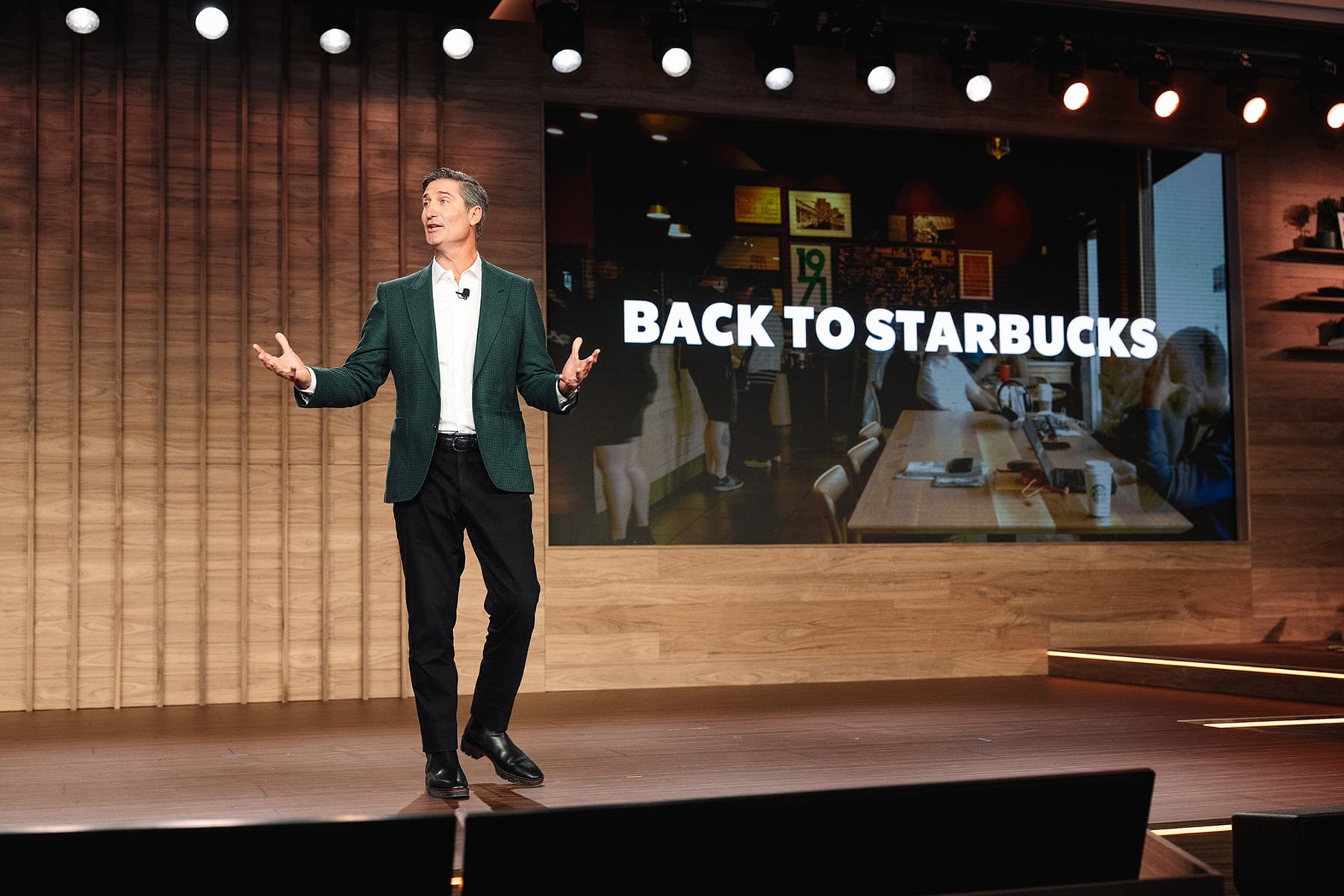
His name for the response was Back to Starbucks. The initial priorities included giving baristas better support, getting the morning right, restoring the community coffeehouse and telling the brand’s story. It was a restoration pitch from someone whose earlier fame involved encouraging customers to try something unfamiliar. At Starbucks, familiarity itself was an asset in need of repair.
The four-minute goal gave the pitch an operational edge. At the time he outlined it, roughly half of transactions were already being completed within that window. The task was to find what delayed the rest. A slow oven or an understaffed rush can defeat a perfectly sensible brand promise without ever attending a branding meeting.
By January 2025, he was planning to reduce food and beverage offerings by roughly 30 percent over the year. Variety has a hidden audience: the employee who must remember how to make everything. Simplifying a menu changes the work behind the counter as well as the choices in front of it.
Personnel changes showed another part of the method. Mike Grams, a longtime Taco Bell executive, joined as chief stores officer. Meredith Sandland, whose experience included Taco Bell store development, was named chief store development officer. Niccol was bringing familiar operating experience into an unfamiliar company. Whether those habits fit a coffeehouse would have to be demonstrated inside one.
The welcome has a balance sheet
By September 2026, two years into the job, Niccol could point to tangible changes. His anniversary message described the return of ceramic mugs, condiment bars, cup writing and free refills. He also described larger rosters, scheduling improvements and Smart Queue, intended to organize orders across different channels. The old-fashioned details and the software were serving the same ambition.
The numbers supplied evidence of progress, with qualifications. In Starbucks’ fiscal third quarter of 2026, global comparable store sales rose 7.9 percent, including a 4.2 percent increase in transactions. That measures sales at eligible established company-operated stores, rather than growth supplied simply by opening more locations. Consolidated revenue nevertheless fell about one percent, reflecting the changed structure of the China business.
Starbucks completed its China joint-venture transaction with Boyu Capital in April 2026, retaining a 40 percent interest. The change is a reminder that Niccol’s job stretches well beyond the American café counter. Running a global brand includes deciding how much of the local business the parent company should own.
Costs keep the recovery from becoming a victory lap. The business had invested heavily in staffing, while investors continued to press for stronger profitability. More sharply, Starbucks announced another 250 North American store closures in September 2026. A year earlier it had closed 627 locations across North America and Europe. For employees and regulars at a closing café, the promise of a neighborhood gathering place has an immediate, uncomfortable boundary.
Labor relations remained unfinished business too: by September, Starbucks and its U.S. barista union had yet to reach a first contract. A strategy built around personal connection is exposed to scrutiny about how the company treats the people doing the connecting. Warmth in the room and confidence in the employer are related ambitions, with different tests.
store sales
transactions
The next customer gets a vote
Niccol’s leadership language often returns to people. In his Booth alumni remarks, he said, “People don’t follow spreadsheets.” It is a memorable line from somebody whose work is repeatedly judged through them. The sentence is most useful as a demand on management: the arithmetic still matters, but somebody has to make the plan worth carrying out.
“People don’t follow spreadsheets.”
Brian Niccol · Chicago Booth alumni remarks
His ties beyond the office include Miami University. He returned as its 2024 commencement speaker, and he and his wife Jennifer gave $2 million to the men’s basketball program. They also provided an award recognizing academics and athletics. The institution that supplied his engineering education remained part of his life after restaurants became his profession.
In a September 2026 interview with Bob Safian, Niccol described starting with the reasons people love a brand and then understanding its economics. That sequence is revealing. Affection gives the business something to preserve; economics determines whether it can afford to preserve it. Neither can be delegated entirely to a slogan.
His stated ambitions for Starbucks now include improving customer service, making retail work more attractive and restoring the community coffeehouse. They are public commitments whose results remain open to inspection. The next chapter will be written by staffing decisions, store choices, repeat visits and the cost of delivering them.
There is something pleasingly unglamorous about the final examination. After the investor event, the executive appointments and the international deal, someone will walk into a café and order a coffee. Niccol’s plan has four minutes to make a good first impression. If that customer chooses to stay longer, the chairs will have a job to do as well.