A model Goodyear Blimp is an unlikely place to look for the beginnings of a Hollywood advertising career. Yet Brian D. Fox had already worked on a miniature airship with illuminated messages before his agency was selling an evening at the movies. At Revell, the thing he designed could entertain its owner while delivering a message. A modest ambition for a blimp; a rather useful one for an advertiser.
The model reached the market in 1973. Fox later described its appeal in terms that could have served as a creative brief: entertainment, participation, communication. The object had to give someone a reason to pay attention. Long before the movie titles accumulated, he was working on the small transaction that precedes a sale: persuading a stranger to look.
A bedroom, a laser show, a beginning
Born in New York City, Fox graduated from the Institute of Design at the Illinois Institute of Technology in 1973. His early working life included designing toys and managing undiscovered rock bands. Neither occupation offers much shelter from other people's taste. A toy must earn its place in somebody's hands; a band must make somebody stay in the room.
After Revell, he became an artist at a small advertising agency. The business closed. Fox opened his own operation in a spare bedroom, starting with one client, Laserium, the laser-light attraction associated with planetariums and museums. His first assignment as an agency owner was therefore already a peculiar selling problem: how do you advertise an experience made largely of light?
That beginning gives his career a more interesting shape than a procession of film credits. He arrived at movie advertising through objects, music and spectacle. Each involved arranging an encounter between an audience and something it had yet to experience. The spare bedroom supplied the office. Laserium supplied the first reason for the office to exist.
Revell blimp reaches market
75 people
key managers
The pumpkin belonged to an illustrator, too
Film advertising is collaborative work, even when a finished image seems to have sprung fully formed from a single mind. At B.D. Fox & Friends, illustrators and art directors turned competing approaches into campaigns. The name on the agency door mattered. So did the person holding the brush.
Consider the original Halloween poster. Illustrator Bob Gleason conceived the knife-holding hand whose repeated contours become a jack-o'-lantern. He brought a rough sketch to B.D. Fox & Friends. The agency initially wanted an image featuring the mask, then reconsidered. Gleason remembered getting the call about three days later. The final painting took another three or four days.
The picture contains a small optical joke with unpleasant intentions. A seasonal decoration becomes a weapon; the eye discovers the second meaning while examining the first. Its economy is part of its force. It also makes a useful reminder about creative credit: the agency's history includes the judgment to commission and approve work, while Gleason's idea and execution remain his own.
Batman takes the road less travelled
An unused Batman design credited to Brian D. Fox offers another view of the process. Its Art Deco treatment appeared in a 2013 exhibition of alternative movie posters. The familiar logo treatment won the public assignment. The other design survived as evidence of a different possible introduction to the same film.
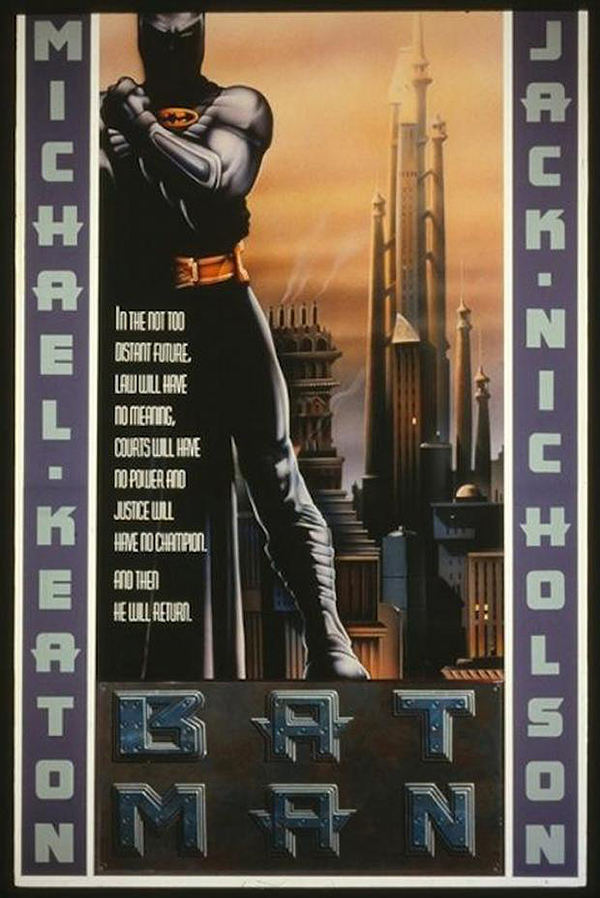
Looking at an unselected proposal is pleasantly disruptive. The film remains the film, but its personality at the cinema entrance changes. A campaign can invite an audience through atmosphere, a character or a symbol. Choosing among them means deciding which part of the experience should arrive first.
For a designer, the archive of rejected work can be as revealing as the successful campaign. Here it preserves Fox's alternative without requiring a fairy tale about the decision. The image was considered and another direction prevailed. Even Batman, apparently, has to endure a wardrobe meeting.
The friends in the credits
Illustrator Lee MacLeod remembered being introduced to Fox by his representative as a possible artist for Halloween II. More work followed. MacLeod described several illustrators preparing comprehensive concepts for a project, with the artist behind a selected concept usually taking it through to the finished painting.
That account puts useful texture into the word “agency.” There were alternatives, confidential production stills, art directors and artists working toward a decision. MacLeod singled out B.D. Fox & Friends as his favorite among the design firms he worked with. The relationship was sustained through assignments rather than a single celebrated commission.
Bill Morrison's memories supply another angle. His first Hollywood illustration job was at B.D. Fox Advertising, in a Sunset Boulevard building shaped like an Art Deco ocean liner. He painted finished posters, made rough sketches and handled retouching. Fox was his boss. The work could move from horror to art-house films without giving the in-house illustrator much opportunity to become precious about a preferred genre.
These recollections make the enterprise feel inhabited. Behind a polished campaign were people changing tasks, trying ideas and learning what a client might accept. The grand image on the wall began with rather less glamorous materials: reference photographs, a sketch and somebody else's comments.
The office had a walking schedule
By April 1997, Fox was heading a 75-person company. Its work extended across film, television and interactive entertainment. But one of the more revealing descriptions of the office concerned its dogs. Fox encouraged employees to bring them to work, and said there were usually four to eight around the premises.
He owned two Dobermans. Dogs slept on office pillows; barriers turned balconies into dog runs. Employees took breaks to walk them. A visitor looking for a solemn temple of image-making might instead have had to negotiate a sleeping animal on the way to the next presentation.
The affection also reached the work. B.D. Fox & Friends designed a new logo for Los Angeles's Department of Animal Regulation and worked on a pro bono public campaign. There is something agreeable about an agency accustomed to selling fictional adventures lending its attention to the animals already occupying the building.
“It’s all about image and attitude.”Brian Fox, 1997
Attention changes its address
Fox's professional history spans much more than cinema posters. His agency worked on campaigns for CBS, and his biography lists involvement with the launches of Survivor, CSI and The Amazing Race. It also records work on the launch of Microsoft's Xbox platform and the SCI-FI channel's identity.
The movement between those assignments is striking. A film, a network and a games platform ask for different kinds of commitment from an audience. A movie wants a visit. A channel wants repeat company. A new console wants a place in the home. Visual communication has to accommodate the purchase being proposed.
Fox's credits and agency history put him at those intersections. They also show why a career in entertainment advertising cannot be told entirely through a gallery of posters. The business expanded into audiovisual work, software and television, carrying the problem of attracting attention into new settings.
From selling the picture to releasing it
In 2006, B.D. Fox & Friends was preparing an overseas sales operation for Berlin's European Film Market. Fox and sales and acquisitions head Kristina Kreska were offering four completed films. The move put the agency closer to the commercial machinery behind the pictures it promoted.
In August 2007, Fox sold the agency to key managers. He went on to consult for independent-film distributors under B.D. Fox Independent. By March 2009, the business had launched a self-distribution service and handled distribution, marketing and publicity for the theatrical release of Hope and Redemption: The Lena Baker Story.
The shift is a substantial one. A campaign gives a film its invitation. Distribution determines where that invitation can be accepted, and how the resulting income reaches the people who made the film. Fox's next chapter joined those questions in a single business proposition.
Five theatres, a particular audience
For Down for Life, released theatrically in 2011, Fox described a campaign aimed at young Latino audiences. Its opening run in five Rio Grande Valley theatres used television, radio, promotions, appearances and local outreach. High-school and college assemblies were followed by trips to matinee screenings.
The approach brought advertising down to the level of a community and a timetable. A poster could establish an identity, but a screening still needed people in seats at a particular hour. The work involved finding a plausible route from interest to attendance, rather than assuming that awareness would make the journey by itself.
That same year, B.D. Fox Independent and Viva Pictures announced a release for Zach Galifianakis's Visioneers. Fox promoted a deal based on gross revenue from DVD sales, video-on-demand transactions and digital downloads, with payments from first receipts. His stated concern had moved into how filmmakers shared in the business their films generated.
The message outlasts the miniature
Across those changes, Fox's career keeps returning to the practical relationship between an image and its audience. A blimp lights up. A poster offers a first encounter. A theatrical campaign finds a local constituency. A distribution agreement decides what follows the transaction.
The amusing detail is that his early working model was already a working model: a little airship that made communication part of the entertainment. The later business became larger and considerably more complicated. The original problem remained small enough to fit on a designer's desk. Give someone a reason to look, then make the message worth the attention.
Continue exploring
- The 1997 Fox profile ↗
- Dogs in the agency office ↗
- Professional biography and symposium archive ↗
- Film credits ↗
- Bob Gleason on Halloween ↗
- Alternative movie posters ↗
- Lee MacLeod interview ↗
- Bill Morrison remembers the studio ↗
- Self-distribution launch ↗
- The Down for Life campaign ↗
- Visioneers release announcement ↗