The pass everyone remembers traveled 32 yards. Branndon Stewart threw it to Sirr Parker in the second overtime of the 1998 Big 12 championship game, and Texas A&M beat Kansas State, 36-33. It is a satisfying place to begin a biography: a ball in flight, a receiver finding room, a scoreboard that settles the argument. Stewart’s subsequent working life has involved a less accommodating kind of audience. Customers can ignore you without even buying a ticket.
Years later, in Austin, he would build OutboundEngine around independent professionals who needed to keep in touch with their customers but lacked the time to do it. He would then join Press Sports, where athletes wanted their achievements to reach someone beyond their immediate circle. Today he leads DONUT Press Media. A quarterback, a marketing founder and a media operator make an unusual résumé. Each job, however, depends on somebody paying attention.
A starting job is a temporary possession
Stewart arrived at college with reasons to expect a hearing. In 1993, he helped Stephenville High School win its first state football championship. The Yellow Jackets finished 16-0. In the title game against La Marque, he passed for 205 yards and a touchdown and ran for 94 yards and two more scores. Texas football eventually put him in its high school hall of fame, in the class of 2008.
He signed with Tennessee, which also signed Peyton Manning. Two highly recruited quarterbacks had arrived for a position with a famously inconvenient head count: one. They both played as freshmen in 1994; Manning became the starter, and Stewart transferred to Texas A&M. The easy retrospective is to make him a supporting character in Manning’s story. College Station supplied a separate plot.
After the 1997 season, Stewart’s teammates named him offensive MVP. He had completed 56.6 percent of his passes, with 10 touchdowns against four interceptions, as A&M won the Big 12 South. Yet in September 1998, Randy McCown replaced him during the North Texas game and completed 11 of 13 passes. Past performance had not secured Stewart a permanent reservation.
The championship brought him back to the center of events. In the fourth quarter against Kansas State, he found Leroy Hodge for a 13-yard touchdown. Matt Bumgardner’s 36-yard catch helped set up the tying score. Then came Parker, the second overtime and the winning pass. Read the sequence closely and the quarterback’s achievement includes a collection of other people’s names. A fine preparation, perhaps, for a career in which an org chart would replace the depth chart.
The customer waiting beside the phone
Austin gave Stewart another education. He worked in technology marketing at Motive and Troux Technologies, then in marketing at Boundless Network. At Boundless, his work coincided with the company’s growth from $8 million to more than $30 million in annual revenue. These were businesses with products to explain and buyers to persuade. Athletic recognition could make an introduction; it could hardly do the product demonstration.
The small operators interested him. At the promotional-products business, independent sales representatives worked on commission and carried many of the burdens of running their own companies. Their way of attracting business could amount to waiting for an incoming call. Stewart saw the difficulty: the person responsible for selling and serving customers also had to find time to remind those customers that the business existed.
OutboundEngine, which he started in 2012, took on that recurring work through content, email and social media marketing. The appeal was practical. A customer could buy help keeping the business visible without first becoming an expert in producing campaigns. For a sole proprietor, every new task arrives at the desk of an employee who is already busy. That employee is usually the proprietor.
A football camp, and a very dry joke
Stewart had encountered a related problem in a business of his own. After A&M, he ran a football camp and private training business in Austin. Finding athletes and managing a coaching operation gave him a close view of how difficult it could be for private instructors to market themselves beyond word of mouth.
In 2012, he was working on CoachCrowd with Allan Branch and Steve Bristol. The proposed service would help parents and young athletes find private coaches, while giving those coaches a way to find customers. The idea connected his sporting past with the small-business questions occupying his technology career.
Asked about a competing startup, Stewart praised it, then offered the advantage that his own team was “1,000 times better looking.” It was a useful interruption to the usual startup interview, in which a founder is expected to explain why a modest website will shortly reorganize civilization. He could discuss a market without pretending that competition was a personal insult.
When the quiet work starts adding up
OutboundEngine’s numbers made the less theatrical case. In May 2016, it announced a $16 million Series C led by S3 Ventures. Later that year, it placed No. 95 on the Inc. 5000. The company’s announcement put it first among Austin companies on that list and fifth among software businesses nationwide. It thanked more than 8,000 customers. The business of helping others stay visible had become visible itself.
Growth also meant finding routes beyond selling to each small business individually. In October 2016, OutboundEngine launched an agency reseller program after testing it with pilot partners. Agencies could offer its email and social marketing service to their clients and add recurring revenue alongside project work. Launch participants included the Albany Times-Union, Angelson Group and Oneighty.io.
The arrangement suited Stewart’s recurring interest in professionals with too much to do. An agency could extend its offering without assembling every supporting function itself. A small business could get marketing through a company it already knew. Distribution, in this version, was a matter of working through existing relationships.
Texas A&M’s Aggie 100 recognized OutboundEngine in three successive years: fourth in 2016, seventh in 2017 and twenty-third in 2018. In September 2021, Elm Street Technology acquired the company. Stewart’s tenure as founder and CEO belonged to an earlier period; the acquisition was a later event in the life of the business he had started.
Twenty minutes outside your own head
His own writing about email marketing had a similar preference for practical detail. In 2015, he advised businesses to make the sender feel personal, pay attention to subject lines and invest in content worth reading. He also described testing two versions of a subject line: one offering marketing tips, another warning about marketing mistakes. The warning performed better. Even a customer looking for help, apparently, might first want reassurance that someone understood what could go wrong.
When Stewart offered advice to Aggie entrepreneurs, he gave them a ratio: spend twenty minutes speaking with potential customers for each minute spent dreaming about a product. The point was to establish whether anybody cared enough to pay. A founder’s enthusiasm is readily available. A customer’s budget is a more demanding witness.
“Entrepreneurs need to have grit”
Branndon Stewart · Aggie Entrepreneurship Saturday, 2017
He opened the January 2017 Aggie Entrepreneurship Saturday event in Round Rock, where more than 100 people gathered for talks and discussions. By then, his audiences included people hoping to build companies themselves. The photograph from that day catches him at a lectern, addressing a room rather than a huddle. The subject had changed; the need to hold people’s attention had survived intact.
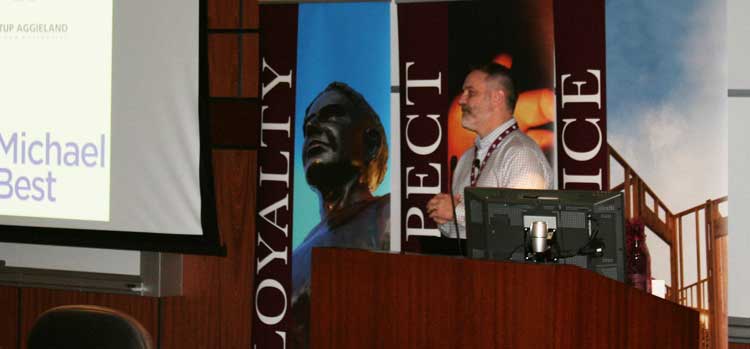
There was also the day-to-day question of how he treated employees. Former colleague Corby Weeaks described Stewart as accessible, candid and possessed of a dry sense of humor. He recalled a CEO who declined an office so that people could reach him. It is a smaller detail than a funding round, but considerably more useful to someone deciding whether to spend Monday morning working with you.
Back among athletes, with a different job
In 2021, Press Sports hired Stewart as chief operating officer. The app gave athletes, coaches and fans somewhere to share sporting achievements. Its $1.5 million seed round was led by General Catalyst, with participation from Overline and Sound Media Ventures. Conrad Cornell and Drew Williams had identified a problem familiar to former competitors: their own sporting careers had been poorly documented.
Press Sports offered a place for highlight reels and connections. As the business developed, its scope widened from a sports social network toward sports media. The distinction mattered commercially. Gathering an audience and supporting a business with that audience require different kinds of work. Stewart had spent years close to both sides of that equation.
The DONUT acquired Press Sports in August 2024. At the time, Press Sports reported more than 450,000 email and text-message subscribers and 1.7 million social followers. Those were figures for different channels, rather than a single count of separate people. Stewart, identified in the deal as co-founder and COO, stayed to oversee daily operations at DONUT Press Media.
The fit joined Press Sports’ sporting community with a business accustomed to newsletters and advertising. Cornell described a future with more frequent sports coverage through email. For Stewart, the route had returned to an old medium with a new audience: the inbox, this time carrying sports rather than a small business’s next campaign.
In June 2026, he revisited his football years on The Big Honker Podcast with Jeff Stanfield and Andy Shaver. The old games still draw an audience. His business career gives the conversation somewhere else to go. The throw to Parker lasts a few seconds on a replay; the work after football has occupied decades. Along the way, Stewart has repeatedly found customers, coaches and athletes with something worth showing somebody. He has made a career of helping arrange the introduction.