A horoscope and a hotel reservation make an unlikely pair. One asks what the future holds; the other asks whether breakfast is included. Both sit inside the business interests of BrahmVeda Ventures, a Surat venture studio whose early moves offer a concrete view of what it means to build companies around artificial intelligence.
In November 2024, BrahmVeda acquired VedVaani, an astrology platform, through a cash-and-equity transaction. In October 2025, it announced pre-seed backing for Apycue, a hospitality technology startup. The distance between those markets is considerable. The connecting thread is a team that wants to help turn an application of AI into a product, and a product into a business.
That makes BrahmVeda interesting for reasons beyond the technology label. Its proposition bundles several jobs that founders often have to assemble separately: investigating demand, designing software, building it, finding a route to customers and arranging support for growth. The portfolio gives that proposition something tangible to stand on.
An acquisition before a hotel investment
VedVaani was BrahmVeda’s first reported acquisition. Founded by Rushabh Agarwal, the platform brought an existing consumer proposition into the studio: astrology delivered through a digital product. Coverage of the transaction described personalized predictions and habit-building features, with BrahmVeda seeking to expand the app’s reach and capabilities.
The deal structure matters. Cash and equity made this an acquisition, rather than simply a software development assignment. It also shows that BrahmVeda’s route to a portfolio can include taking over an existing venture. An organization that describes a process for developing ideas can still buy a starting point.
For an entrepreneur studying the move, the useful question is what already exists at the moment a studio enters. A functioning product has a different starting position from a sketch. It offers something to inspect, improve and take to customers. That observation explains the appeal of acquisition as a tool; it does not establish the return on this particular transaction.
The job titles have a little theatre
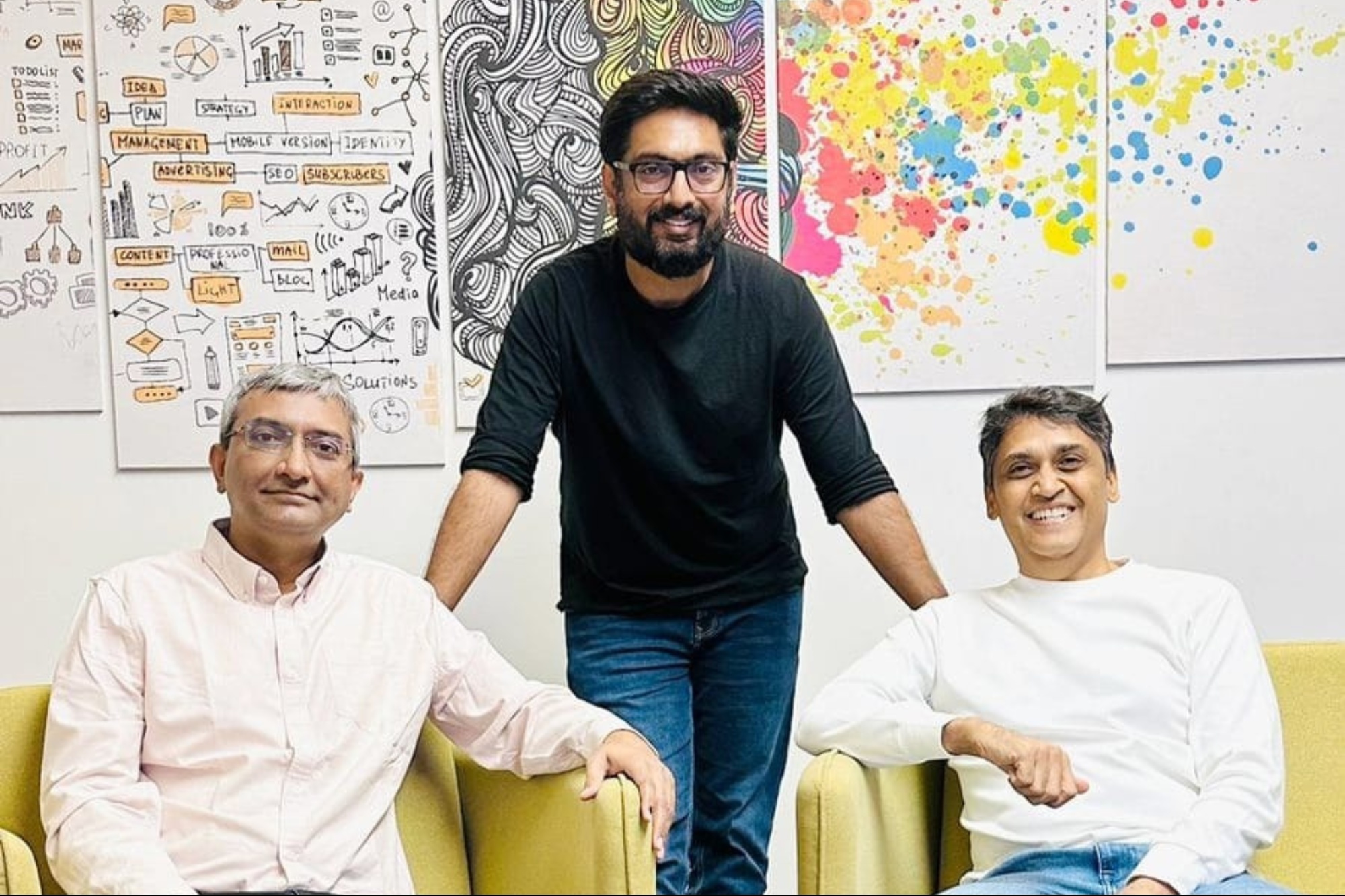
BrahmVeda calls Nachiket Patel its “AI Alchemist,” Vipul Kapoor its “Growth Guardian” and Kashyap Pandya its “Strategy Sage.” The names could populate a particularly entrepreneurial comic book. Underneath them lies a straightforward division of work: technology, product and growth, and business strategy.
Kapoor’s background includes co-founding hospitality software company eZee, which Yanolja acquired in 2019. Patel founded product development company Logicwind. Pandya founded accelerator Syncoro Ventures and co-founded angel network Unisync Angels. Together, those histories help explain why BrahmVeda presents itself as an operating partner to young businesses.
The distinction is practical for a founder. Technical uncertainty, weak customer acquisition and an unresolved business model are different problems. Access to people who work on each could reduce the number of separate relationships a new company must manage. The value would come from their actual involvement in a venture’s decisions and work.
That is also the most defensible way to read the studio’s public culture. Its language stresses collaboration and involvement in product building. The colourful nicknames make the founders easy to remember; the operating responsibilities explain why a prospective collaborator might want them in the room.
Four verbs, then a separate company
BrahmVeda organizes venture creation into Discover, Design, Develop and Deliver. Discovery includes research, customer interviews, competitive analysis and testing assumptions. Design moves toward prototypes and user feedback. Development turns the proposed solution into software. Delivery takes it to market and supports growth.
The framework’s useful feature is its order. Customer contact comes before the full build. A prototype gives people something more concrete to react to than a founder’s enthusiasm. For readers borrowing the approach, the practical exercise is to write down the assumption each stage must resolve before spending more effort on the next.
The studio’s stated model goes beyond launch. It seeks founders or co-founders to lead ventures, spins maturing ideas into separate companies and brings in investors for growth capital. In that arrangement, the operating leader can join an opportunity that has already received attention from the studio.
This puts BrahmVeda at the intersection of company building and early-stage investing. A founder can pursue similar work through an accelerator, a development team and an investor assembled independently. BrahmVeda’s pitch is to coordinate those capabilities. Whether that arrangement fits depends on how much help the founder needs and how the parties divide responsibility.
Astrology comes with a checkout
VedVaani supplies the consumer side of the story. Its public offering includes astrology-themed AI personas and personalized reports. The characters give different services recognizable faces: Cupid Kumar is associated with Kundali matching, while Mystic Tara represents Tarot. It is software with a cast.
The report business is easier to grasp than a broad promise of AI guidance. A Kundali Milan product page advertises a relationship compatibility report for ₹499, reduced from a displayed ₹999. It describes traditional matching analysis, relationship themes and personalized suggestions. That is a specific item a consumer can buy, with a defined subject and a visible purchase price.
Advertised Kundali Milan report price on VedVaani’s product page, checked September 2026.
The customer is someone already interested in astrology and willing to purchase a personalized interpretation. The product’s appeal rests on convenience, presentation and that existing interest. The descriptions here concern what the service sells; its astrological interpretations are the product’s claims about a person’s life.
VedVaani competes for attention in the same broad consumer category as platforms such as Astrotalk. Its AI presentation creates a different experience from choosing a human practitioner. For BrahmVeda, it also creates a consumer business whose purchase decision is quite different from a hotel owner evaluating operational software.
The hotel bet has familiar faces
Apycue brings the portfolio closer to Kapoor’s professional past. Its co-founders, Bhavin Patel and Jaydeep Naik, also have eZee experience: Patel in product management and Naik in engineering. Apycue lists all three BrahmVeda founders as advisors, making the studio’s involvement visible in the team around the company.
The October 2025 announcement described pre-seed investment from BrahmVeda alongside an angel investment from Kapoor. Apycue targeted small and mid-size hotels, pitching help with direct bookings, guest experience and operations. The proposed advantage was software that could carry out work hotel staff otherwise had to perform themselves.
“Hotels don’t need more software to operate manually; they need intelligence that can act on their behalf.”Bhavin Patel · Co-founder, Apycue
Its current audience includes independent hotels with 10 to 100 rooms, boutique properties and small chains. These are customers with a concrete commercial objective: persuade more guests to book through their own channels. Apycue says its system can work alongside an existing property management system and booking engine.
The immediate entry point is a Digital Performance Audit. A hotel provides its name, website and city; Apycue promises a report within 48 to 72 hours. The audit covers more than 50 checks, examining areas such as website performance, booking flow, search presence, listings, reviews and competing properties.
That offer starts with diagnosis. The deliverables include a scorecard, a breakdown of booking obstacles and a ranked action plan. A hotel owner can use the findings to decide what deserves attention first. The proposition is especially understandable when the property already receives online interest but struggles to turn it into reservations.
A website today, broader agents in rollout
Apycue’s website builder follows the audit with implementation. Its product description emphasizes mobile performance, visible booking pathways, guest reviews, search-friendly structure and integration with the hotel’s preferred booking engine. It also describes monitoring and optimization after launch.
The sequence gives BrahmVeda’s general venture-building language a concrete expression: investigate a problem, decide what to fix, then build. A hotel website has to do several ordinary things well before more ambitious automation becomes useful. Visitors still need to understand the property, trust the offer and complete a reservation.
The broader AI Agents product is described as coming soon and in private rollout. Its planned roles cover visibility, conversion, engagement, reviews and growth. A waitlist offers early access. That status matters when considering what a hotel can use now: the public offering distinguishes audits and websites from the wider agent system.
Apycue says website building and agents are priced per property, with quotations available through consultation. This creates a different commercial relationship from VedVaani’s report purchase. One is an individual consumer transaction; the other is a business evaluating a service against its property’s needs and operating economics.
The part worth borrowing
BrahmVeda’s two documented moves suggest a useful discipline for would-be company builders: choose the customer problem and assemble relevant people around it. In hospitality, the team’s previous industry experience is visible. In astrology, the acquisition supplied an existing product and proposition to develop further.
The transferable habit is the sequence of questions. Who wants this? What can they try? What would they pay for? What work remains after the first version ships? Those questions are useful even for founders who never work with a studio.
A shared operating team will be less attractive to someone who already has the capabilities and wants to make every decision independently. Equally, a framework cannot make customers value an unwanted product. BrahmVeda’s story earns attention where it becomes specific: a report someone can purchase, a hotel website someone can improve, and a team taking responsibility for getting the business built.