The company began with a search box that failed Bradley Davis. During long commutes, he listened to shows such as The Tim Ferriss Show, whose episodes could run for hours. He wanted the sort of guidance film lovers take for granted: episode ratings, credits, recommendations, a trail from one interesting person to the next. Podcasting had abundance. What it lacked was a dependable map.
In 2016, Davis took the question to Reddit's podcast community. Was there an IMDb for podcasts? Could listeners rate individual episodes, follow creators and discover related work? Then he added a more consequential line: if it did not exist, did anyone want to build it with him?
The replies supplied both validation and colleagues. Ben Slinger, a podcaster and developer in Australia, answered. Davis already knew Cole Raven from junior high in Evansville. Ryan Stock joined too. A four-person founding team emerged from friendships and usernames, distributed across oceans before remote-first companies became fashionable. Scheduling a Google Hangout with Australia was an operational problem before there was an operation.
A side project with a long runway
Davis did not come from podcasting, media or venture capital. His work history ran through counseling, retail and industrial sales. One job involved selling rags and cardboard boxes. He had experimented with products before, including Dough Deals, a restaurant promotion app that reached 3,000 active users in one city. Those attempts taught him something less cinematic than “burn the boats”: keep the boat until the new craft floats.
Podchaser stayed a nights-and-weekends project for years. Davis held on to his full-time job through two funding rounds. In his telling, the arrangement mixed interest, stubbornness and a useful measure of disbelief that the project would ever become a proper company. That doubt acted like cheap insurance. It let the team test the obsession without asking the obsession to pay the rent.
There was another source of momentum: listeners kept showing the team how deep the appetite went. Davis considered himself an avid podcast fan, then watched some Podchaser users consume ten times as much as he did. They contributed thousands of ratings, credits and lists, turning a founder's private annoyance into a public catalog. Feedback arrived faster than features could. Davis joked that he wished he could wave a magic wand over every request. The community did more than request improvements. It supplied the raw material that made the database distinctive.
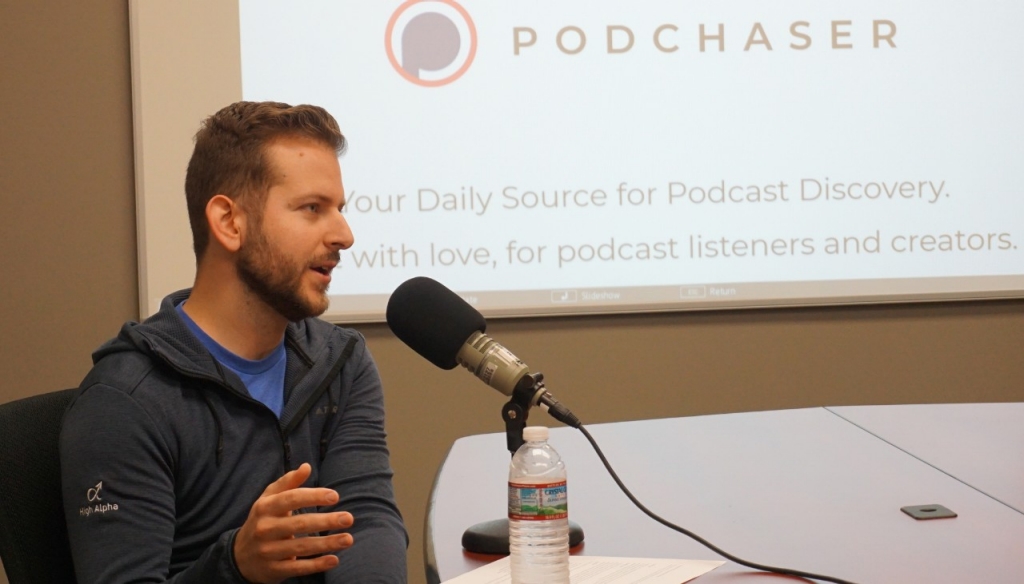
The first expensive obstacle was code. Slinger needed more time. The product needed front-end work and design. Davis concluded that his new job inside the side project was fundraising, although he had no investor network and, by his own account, had once needed to learn what “VC” meant. In Louisville, he asked business-development contacts where software money came from. A suggestion to try Kickstarter made the distance between his ambition and his surroundings rather plain.
So he mapped people instead. He sought introductions, persuaded local investors to have coffee and pitched again. Many early conversations required explaining podcasts before explaining Podchaser. The eventual shortcut was remarkably compact: “the IMDb of podcasts.” Five words made an unfamiliar market feel navigable.
Organizing the beautiful mess
A memorable pitch was helpful because the underlying product was sprawling. Podcasting is built on open feeds distributed among many apps, publishers and hosting companies. That openness makes the medium resilient and prolific. It also scatters its information. Credits live in descriptions. Audience figures sit behind separate companies. Reviews vary by platform. A guest can appear on dozens of shows without any single index joining the dots.
Podchaser began by asking its community to add ratings, lists and credits. The early influx showed Davis that the frustration was shared. Listeners wanted better discovery. Creators wanted their work properly attributed. Apps and publishers needed standardized metadata. Later, professional customers wanted audience estimates, contact data, transcript search, brand-safety information and evidence of where sponsors were spending.
The crucial strategic choice was to remain platform-agnostic. Davis argued that hoarding data would be myopic: Podchaser's dataset became more useful when partners could contribute to it and distribute it. Instead of building another listening enclosure, the company positioned itself as connective tissue. The public product helped people explore. Podchaser Pro and its API made the same organized layer valuable to agencies, advertisers and developers.
That sentence is a tidy rejection of founder mythology. Davis describes Podchaser's progress as hundreds of good and bad decisions, followed by learning. The Reddit post mattered. So did the clear analogy, the early community, the willingness to cold-email podcast apps and the choice to build a large data asset before forcing monetization. No single move could carry the company. Together, the moves formed a flywheel.
Fundraising without the costume
By 2018, Podchaser had raised roughly half a million dollars from about 20 angel investors. That capital paid for more development and helped establish the model. A $1.65 million seed round followed in 2020. In 2021, Davis raised another $4 million in a process he says took about 40 days, after years spent learning how investors talk, decide and introduce one another.
His advice after doing it is refreshingly inconvenient for the fundraising industry: do not raise money if you can avoid it. Venture capital makes a founder beholden to a particular definition of success, usually an exit. Davis recommends keeping a job while an idea is still proving itself and raising from strength rather than when cash is nearly gone. The counsel has the credibility of someone who both signed up for the roller coaster and reached the station.
It also reveals his operating temperament. In interviews, Davis is candid about naïveté, failed startup ideas, loneliness and the odd irrationality required to spend years on a database. He undercuts the polished founder performance without pretending the result was accidental. Persistence sounds less like a slogan in his version and more like bothering the right people, making payroll, keeping the day job and finding one more credible piece of evidence.
He also treats the founder's job as something that changes underfoot. The person useful when a product is a weekend prototype may need different habits when it has employees, institutional investors and a parent company. Davis's public reflections linger on becoming the CEO the company needs, not preserving an origin-story version of himself. The title stayed. The work moved from asking strangers to build a database toward helping teams decide what that database should make possible.
An exit that kept the door open
On July 18, 2022, Acast announced an agreement to acquire Podchaser. The initial consideration was $27.2 million, with up to $6.8 million more tied to an earnout. The industrial salesman who had once struggled to find people willing to hear a software pitch had led the company to the outcome its venture financing demanded.
The fit was philosophical as well as commercial. Acast worked across the open podcast ecosystem; Podchaser organized it. Davis said the companies shared an ethos of building tools for listeners, creators and advertisers without reducing the medium to one closed platform. Podchaser continued as a distinct brand, while its intelligence could inform a larger advertising marketplace.
After the acquisition, the database kept moving closer to decisions. Predictive demographics helped buyers understand audiences. Collections+ grouped shows for advertisers. Performance+ used modeling to recommend podcasts for direct-response campaigns. The humble directory had become a system for discovering not only what exists, but what might work.
Choosing a home base
A remote company also gave Davis an unusual freedom: he could choose where to live without choosing where the company could hire. Around 2020, he and his wife, Rose, moved from Louisville to Oklahoma City after visiting his sister Rachel. Davis expected a practical mid-sized city and found neighborhoods, public projects and a local founder community that surprised him. He began calling himself an “Okie transplant.”
The move fits the broader pattern. Davis tends to look beyond the default hub, whether for a co-founder, an investor or a hometown. Podchaser's CTO could be in Australia. Early capital could come from local angels. A global media-data company could have an Oklahoma City home base. His public bio adds two lighter coordinates: hot wings enthusiast and aspiring Survivor host. A founder who built a business around credits still has Jeff Probst's job in his sights.
Podchaser's story offers a practical set of moves worth borrowing. Keep the job while the evidence is thin. Describe an unfamiliar product with a familiar handle. Ask for collaborators where the problem's community already gathers. Build the neutral layer when everyone else wants to own the endpoint. And when a medium is gloriously open but maddeningly scattered, do not complain that the map is missing forever.
Ask who wants to draw it with you.