Brad Simms left a compulsory psychology class until his third year of university. He was studying commerce, and the subject had not appealed to him when he first arrived. By the time he finally took it, something had changed. The questions about people, motivation and organizations landed. He would later call the delay “one of the best accidental decisions I've ever made.” For someone who would spend years arranging people into teams, it was a useful subject to discover eventually.
His career would take him through technology, travel marketing and the advertising business. At SapientNitro, he became a senior vice president and North American managing director. He also served as chief marketing officer at TravelEdge and advised MDC Ventures. Those roles put business decisions, digital tools and customer relationships within the same professional orbit. When he co-founded GALE in 2014, he brought those interests into a company of his own.
Seven people, then a second birthday
GALE began in Canada with seven people and a focus on customer relationship management and data. That is a less theatrical entrance than advertising usually permits itself. A customer database has limited red-carpet potential. But it gave the founders a place to begin: understand the people buying a product, then work out what might make them buy again.
By May 2016, Simms was writing about the agency's second birthday. It had more than doubled in size over the preceding year and was moving into new offices in Bengaluru and New York, with Toronto next. His account included the less photogenic business of growth: structures, processes and the work of getting a larger group to function together. The birthday came with administrative homework.
He also described building a predictive marketing cloud and developing frameworks for winning customers, increasing what existing customers spent and reducing departures. These were practical questions with financial consequences. They gave GALE a foundation on which it could add other capabilities, rather than beginning with an advertising idea and looking for a business problem to attach to it.
The business problem gets the first chair
Simms called the resulting proposition a “Business Agency.” The ambition was to combine the business understanding of a management consultancy with the storytelling and execution of an agency. It sounds agreeable enough as a sentence. Making it a company meant deciding whose questions came first, what kinds of people to hire and which services belonged together.
He was candid about the limits of the experiment. GALE had explored a more product-based commercial offering early on, but clients had not always welcomed it. Even as he argued for changes to the industry's economics in 2023, he acknowledged that GALE still largely operated on a service model. The distance between a founder's idea and a customer's appetite remained part of the job.
The same impatience with vague promises appeared in his writing about digital transformation. In February 2022, he asked the industry to retire the phrase. Ask people what it meant, he argued, and the answers scattered across apps, ecommerce, email and customers. Agreement on the expression concealed disagreement about the assignment.
His alternative was to talk about the actual business: acquiring customers, increasing their value and strengthening their connection to a brand. Companies might need to change products, organizational structures or business models as well as technology. He illustrated the mismatch with the prospect of asking a barber to bake a cake. A familiar supplier, in other words, is not automatically equipped for every problem. It was an unusually domestic image for an argument about consulting.
A world tour for a company story
The agency grew by adding creative and media capabilities around that original data foundation. In 2023, GALE had nearly 800 employees across 11 offices. Media accounted for 40% of its business and creative for 25%; it handled almost $1 billion in media billings. Those billings describe advertising expenditure handled, rather than agency revenue. The distinction matters when the numbers get this large.
Simms saw an opening in clients wanting fewer agency relationships and broader assignments. Every additional specialist could mean another relationship for a marketing leader to coordinate. GALE's answer was to assemble more of the required skills inside one organization.
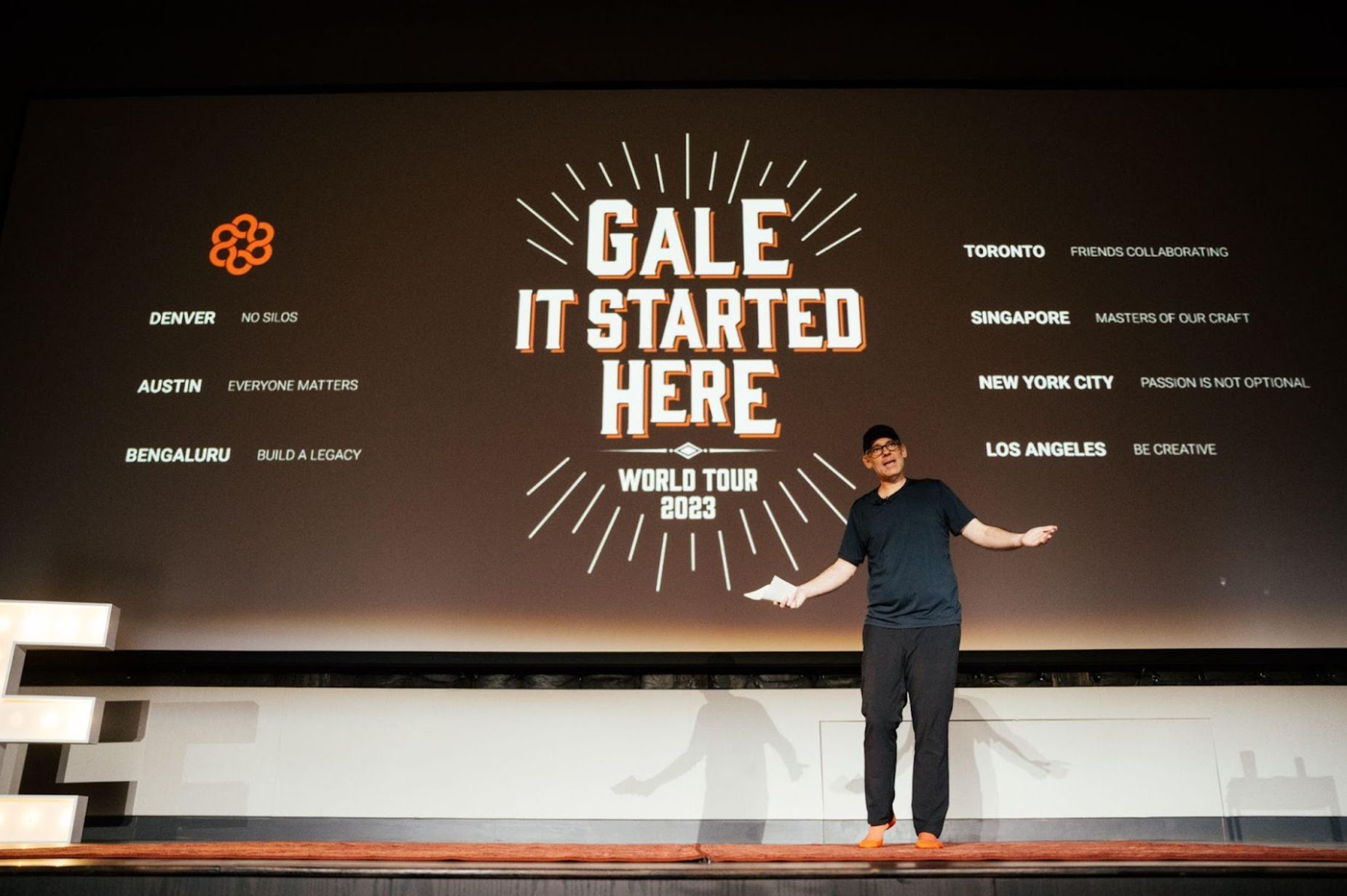
Size created its own coordination problem. In 2023, he visited GALE's offices to retell the founding story and explain its values, including to people who had joined during remote working. An origin story that seven colleagues know by heart does not automatically reach hundreds of new coworkers. Apparently, even company folklore needs distribution.
His responsibilities had also expanded outside GALE. In October 2022, he became global CEO of Crispin Porter + Bogusky, overseeing operations in North America, Britain and Brazil while retaining his GALE position and his chief product officer role at Stagwell Media Network. It was a substantial collection of organizational charts for one desk.
The appointment placed him inside another agency's reinvention while he continued building his own. His time leading Crispin ended in January 2024, when he returned his full attention to GALE. The sequence is worth keeping straight: the parallel jobs were a chapter in his career, rather than the role from which he eventually retired.
“one of the easiest decisions I’ve made for the business”
Brad Simms, on investing in employee development, 2024
Culture acquires a budget
Simms's interest in developing people produced some concrete spending decisions. In March 2024, he explained GALE's allocation of more than $1 million for employee training and development that year. The agency reported an 86% retention rate and 120 promotions during 2023. These were company-reported measures, and they gave his argument a more useful shape than a general assurance that people mattered.
The program included career coaches, an internal learning platform and four hours of training time per employee each month. An annual $300,000 education reimbursement allocation formed one component. Its Media Accelerator rotated participants through different specialties; GALE hired all 11 members of the 2023 cohort. Learning had a place in the calendar as well as the budget.
Allocated to employee training and development
His position on office attendance came from the same concern about how people learned. In 2022, he acknowledged that employees could be productive at home and still argued for returning. He emphasized access to managers, quick questions, presentations and the whiteboard conversations that help someone become more capable. Readers can disagree with the policy while recognizing the reasoning.
The interesting part was his willingness to distinguish today's output from tomorrow's development. A team could deliver work while its members had fewer opportunities to learn by watching one another. He treated the office as a place where senior people owed junior people their attention. That makes attendance a responsibility for the manager, too. Merely occupying a chair would be a fairly expensive interpretation of mentorship.
Let the campaign meet the public
For all his attention to data, Simms objected to marketing becoming trapped in its own measurements. In a 2024 essay, he borrowed Allen Iverson's famous frustration with questions about practice to explain his concern. Endless refinements before launch could prevent a team from learning what happened when an actual audience encountered the work.
He argued for releasing strong ideas and improving them while they ran. Separate departments pursuing separate performance indicators could fracture a campaign, especially when it needed to change quickly. His complaint extended to agencies as well as clients: a partner asking for speed needed to organize itself to deliver speed.
That argument gives his career a useful tension. He helped build an agency around customer information, yet resisted letting a dashboard become the final judge of every decision. Numbers were supposed to improve the work's relationship with the world. A campaign polished forever inside a meeting room had a rather small audience.
In another 2024 essay, he urged brands to consider building platforms of their own. A major television placement bought a moment inside someone else's property; an owned experience could give customers a reason to return. He discussed entertainment, hospitality and loyalty programs as different expressions of that idea.
Chipotle's loyalty work offered a practical example in his account: messages connecting customers with farmers could turn a transactional program into a vehicle for stories about the company. The larger point was that customer information could support something more interesting than another discount. His original CRM interests had acquired a much broader stage.
One more way to join the pieces
In March 2024, GALE introduced Alchemy.Ai, a private enterprise platform developed by a 50-person product team. It brought together data and tools for tasks across strategy, audience research, media planning, CRM and operations. Simms framed the benefit as giving employees more time to spend with clients.
One application used archived agency material to help draft responses to new-business information requests in his voice. After a decade spent explaining GALE, the founding CEO had become part of its software brief. The practical aim was to reduce coordination and repetitive work; the detail also supplies a small, unintended joke about the scale of a founder's inbox.
In February 2025, Simms announced his retirement. The following month, GALE named co-founder Andrew Noel global CEO and Sophia Zhang CEO of North America. Zhang had joined as an account director in 2016 and become a managing partner in 2020. The handover put the agency's next chapter in the hands of people who already knew it.
Long before that announcement, Simms had described the legacy he wanted in terms of the people who passed through GALE and what they became. Seen from that angle, the succession has a pleasing fit with the rest of the story. A founder can assemble the pieces. Eventually, other people get to decide what to make with them.
Read, watch & connect
- GALE’s website
- Brad Simms on LinkedIn
- The 2023 career and agency interview
- Listen: Fearless Creative Leadership
- Watch: The Brief with MilkPEP
- Watch: The Current’s Hot Seat
- Read: his argument about digital transformation
- Read: his 2024 training investment essay
- Read: his essay on campaign measurement
- The 2025 leadership handover