Before Brad Kifferstein tried to improve a cup of coffee, he sold carpet to college students. It was the late 1990s, he was an undergraduate at the University of Michigan, and incoming students needed something to cover the institutional floors waiting in their new rooms. Kifferstein noticed the moment, found the merchandise and made the sale. There is no app in this origin story. No grand theory arrives wearing a black turtleneck. There is simply a young operator standing near a recurring inconvenience with something useful to sell.
That early business is a tidy prologue because the same instinct appears later in VitaPerk, the company Kifferstein co-founded and still leads. Do not begin by asking people to rearrange their lives. Begin with the thing already happening. A student is moving into a room. A commuter is pouring coffee. The opportunity is beside the ritual, not in a PowerPoint insisting the ritual should disappear.
Kifferstein’s route from carpet to coffee wandered through several practical disciplines. After university, he worked in real estate and syndicated a multimillion-dollar housing complex. His career then moved through sales at Lynn Medical and business development at Crypton, the Michigan performance-fabric company. At Crypton he developed and launched products. The nouns kept changing. The verbs did not: sell, assemble, develop, launch.
It is tempting to arrange those jobs as a clean apprenticeship, as if the carpet rolls knew they were preparing him for property and the fabric samples were secretly training him for powder. Careers are rarely so courteous. What the record does show is repeated exposure to the hinge between an idea and a buyer. Real estate required coordination and capital. Medical sales required explanation. Business development required turning possibility into a product someone else could understand. When Kifferstein reached coffee, he had already spent years translating between what a thing could do and why another person might care.
01 / The useful obsession
A product that minds its manners
The VitaPerk idea began in 2010 with co-founder Jeb Belchinsky. Its premise sounded almost suspiciously neat: put a powdered blend into a single-serve packet that could be stirred into coffee without changing the coffee people had chosen. The packet would be an addition, not a replacement. Dark roast could remain dark roast. The office pot did not need an upgrade in machinery. A buyer’s loyalty to a particular café, pod or bag of beans could remain gloriously irrational and completely untouched.
That respect for preference is the sharpest part of Kifferstein’s product thinking. Founders are often tempted to choreograph the customer’s whole morning. New device, new drink, new vocabulary, perhaps a subscription with an onboarding quiz. VitaPerk asked for one extra movement. Tear. Pour. Stir. The company carried the difficult work so the user would not have to carry much at all.
The borrowed-habit design
Simple for the customer did not mean simple at the factory. The initial timetable pointed toward a launch within roughly a year. Commercial availability came in early 2015. On CNBC that summer, Kifferstein described four years of “trials and tribulations” involving taste, dissolvability and mixability with creamers. Flavorless, in other words, was not decorative language. It was a stack of constraints wearing an ordinary adjective.
“It took four years of trials and tribulations before we were able to perfect everything as it pertained to taste, dissolvability and mixability with every type of creamer on the market.”Brad Kifferstein, CNBC Power Pitch, 2015
The company’s patent trail makes that persistence visible. Kifferstein is named as an inventor on a nutritional-additive patent application published in 2013 and another published in 2018. Patents are not proof that a market will cooperate. They are evidence of an attempt to describe, in unforgiving detail, what a casual stir of the spoon conceals.
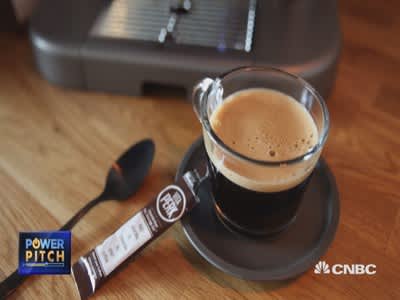
02 / National television, mixed arithmetic
The pitch did not tie a bow
By February 2015, VitaPerk was finally in the market. In July, Kifferstein carried it onto CNBC’s Power Pitch. His language was brisk and suited to television: “We have smartphones, smart cars, smart water and now, with VitaPerk, you can smart your coffee.” He also gave the hybrid a category name, “coffee-ceutical,” the sort of portmanteau that either lodges in a buyer’s memory or makes a copy editor reach for a red pen.
The panel returned one “in” and two “out” votes. That split matters because it denies the story an easy television ending. Kifferstein had earned attention, not consensus. One panelist saw the opening. Two saw reasons to hesitate, including the possibility that larger coffee companies could make their own versions. Kifferstein’s response was to welcome competition as validation of the basic idea.
The practical world continued after the cameras. VitaPerk worked with National Coffee on an office program and sold online, through specialty retailers and in several Detroit-area stores. In 2017 the company offered shares through StartEngine at $2.50 each and a stated $2.5 million pre-money valuation. Public campaign records put the raise at about $12,583. It was real money and a modest result. Startup stories rarely know how to discuss modest results, though most companies are made from them.
The earlier financing record was similarly concrete. A 2014 filing named Kifferstein as VitaPerk’s chief executive, director and promoter and reported $100,000 sold in a debt offering. Four investors participated. The document is dry, which is precisely its charm. Between the television adjectives and the founder slogans sits the paperwork: signatures, exemptions, dollars sold and dollars remaining. Kifferstein’s name appears where the person in charge has to sign. Entrepreneurship may be sold as vision, but much of it arrives formatted as a government form.
The concept begins
Kifferstein and Belchinsky start developing a coffee additive.
First patent publication
Kifferstein appears among the inventors on a nutritional-additive application.
Launch and Power Pitch
The product reaches customers and receives a split verdict on CNBC.
Crowd round, then another filing
VitaPerk completes a small equity campaign and a second patent application is published.
The storefront remains open
The company sells direct and publishes fresh material under the same core proposition.
03 / What survived the detours
The discipline of leaving the coffee alone
VitaPerk’s present storefront looks different from its 2015 debut. The flagship offer is now a flavorless stickpack rather than the four flavored varieties described in the early coverage. The packaging evolved. The price evolved. The website added workplace and partner programs. The central courtesy remained: use any coffee, hot or cold, and keep its familiar taste, color and aroma.
That continuity tells us something about Kifferstein as an operator. He has been willing to adjust the object without abandoning the observation beneath it. The observation is not that consumers crave another morning commandment. It is that established rituals are valuable infrastructure. A product can rent space inside one instead of building a lonely new road beside it.
There is a broader founder lesson here, but it should not be polished until it squeaks. Borrowing a habit does not guarantee distribution, margin or repeat purchases. It does not make skeptical investors vanish. VitaPerk’s extended development and small crowdfunding total make that clear. A crisp insight is an advantage, not an exemption from arithmetic.
What it can do is reduce one kind of risk: asking the customer to become a different person before the product becomes useful. Kifferstein’s packet does not require a new coffee allegiance. His first campus business did not require students to invent a reason for flooring. In both cases, the moment existed before the merchandise arrived.
The recurring move in Kifferstein’s career is not coffee. It is meeting demand where the customer already stands.
His public aspirations have followed the same logic. In 2015 he told CNBC that he wanted to add flavors and license the formula for other foods. VitaPerk later developed office and partnership programs that place the concept inside other companies’ channels. The ambition is expansive, but the mechanism stays neighborly: arrive beside an existing product, make a small request, avoid insulting the host.
Kifferstein’s story resists the neat labels founders are usually handed. It is neither a rocket ship nor a cautionary wreck. It is a long operating record with several industries, two public patent applications, one televised pitch, an unglamorous crowd round and a live store more than a decade after launch. The product is still asking customers to stir for a few seconds. The founder is still betting that convenience begins with respect.
The coffee mug is an almost comic place to locate a business philosophy. It is also perfect. A mug has a handle because human beings prefer not to negotiate with hot surfaces every morning. Good products remember that people have already negotiated enough. Kifferstein’s contribution is a small packet and a durable question: before you build a brand-new routine, have you looked carefully at the one already steaming on the table?