The ordinary version of market entry begins with a map. Find the customers. Price the product. Hire salespeople. The Bondi Partners version begins with a different question: who can stop this?
That question sounds defensive until the customer is the U.S. Navy, the product is a machine that prints large metal parts, and the seller is an Australian manufacturer named AML3D. Then it becomes the question. A technically impressive machine does not stroll into Newport News Shipbuilding on technical merit alone. It travels through procurement priorities, congressional interest, export rules, industrial policy, reputational checks and the quiet arithmetic of an alliance.
Bondi Partners exists in that maze. Founded in Washington in 2020 by Joe Hockey, the former Australian treasurer and ambassador to the United States, the firm advises companies whose commercial plans have become inseparable from government decisions. It has teams in Washington, Los Angeles, Sydney, Canberra, London and Tokyo. Its clients live in defence, cyber, critical minerals, clean energy, medical technology, consumer goods and space - industries where the public sector is not scenery. It is part of the plot.
The first thing that broke was the map
Hockey had watched capable Australian companies arrive in America and disappear into what the firm calls the market's “complexity and noise.” Their first failure was not necessarily the product. It was orientation. They could see a giant market but not the sequence of decisions inside it. American companies looking in the other direction had the mirror-image problem: Australia looked familiar enough to tempt them and different enough to punish lazy assumptions.
The diplomatic posting changed Hockey's view of the alliance. From outside, Australia and the United States looked like close friends. From inside the embassy, he saw a much denser operating system of defence, intelligence, capital and personal trust. Bondi Partners was his attempt to make that hidden system legible to business. The name came from Bondi Beach, where his parents met. The work is less romantic: identify the pressure points, find the credible messenger, and decide whether the meeting should happen now or six months from now.
This is the distinction the company wants buyers to notice. Plenty of firms can arrange an introduction. Bondi Partners packages the introduction inside an assessment, a strategy and an implementation plan. Its people work with boards and C-suites, but the assignment can wander far beyond a boardroom: competitive intelligence, regulatory navigation, stakeholder engagement, strategic communications, transaction support or the careful assembly of a coalition.
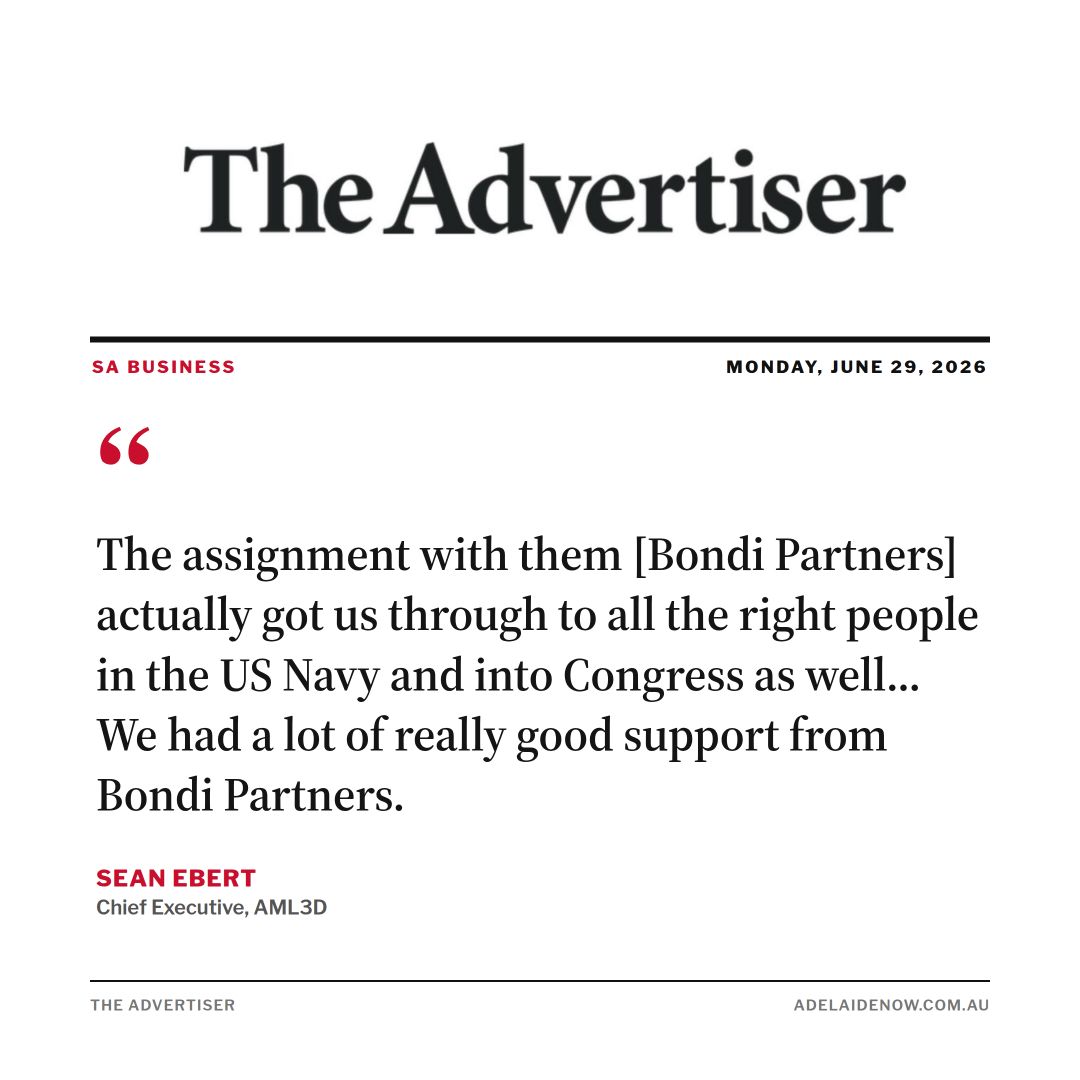
“The assignment with them actually got us through to all the right people in the US Navy and into Congress as well.”Sean Ebert, CEO of AML3D
A machine, a navy and twelve months
AML3D is the cleanest public demonstration of the model. The South Australian company makes Arcemy systems, which use wire-arc additive manufacturing to produce large metal components. During a 12-month Bondi Partners engagement, AML3D built relationships with the U.S. Navy and members of Congress. It later delivered an A$4.5 million system commissioned at Newport News Shipbuilding, the largest military shipbuilder in the United States, and secured a follow-on order of roughly A$9.9 million for four more systems due in early 2027.
The numbers do not prove that every introduction caused every order. They do reveal what the client valued: getting through to the people who shaped the market. Bondi Partners did not invent the printer. It worked on the path the printer had to travel.
The consultancy that bought a portfolio
In 2021, Bondi Partners added a revealing second act. With Ellerston Capital it created 1941, an investment initiative named for the year Australian prime minister John Curtin turned to the United States for defence support. The vehicle backs dual-use businesses: technologies with both commercial and national-security applications.
Its portfolio makes the thesis visible. SPEE3D prints metal parts in the field. LeoLabs tracks objects in low Earth orbit. Fleet Space uses satellites and ground sensors to help find critical minerals. WithYouWithMe trains and places digital talent, including military veterans. SwitchDin orchestrates distributed energy. Firmus is building AI computing infrastructure.
This is where Bondi Partners differs from a conventional government-affairs shop. Advice sits beside advocacy; both sit beside capital. A company may need to understand a policy, win support, raise money and execute a transaction. Bondi Partners has arranged itself to remain useful across that chain.
The arrangement also deserves scrutiny. Former officials selling insight into government will always raise questions about influence, conflicts and the revolving door. The firm's answer is performance and breadth: a cross-party roster of diplomats, military leaders, policy specialists and commercial operators. The reader should still keep the governance question in view. Access is valuable precisely because access is uneven.
What can be copied without the contacts
The useful lesson is not “hire famous former officials.” That is expensive, difficult to reproduce and incomplete. The copyable part is the sequence. Before entering a regulated market, write down the commercial buyer, the formal regulator, the budget owner, the political sponsor, the likely opponent and the person trusted by each. Then mark which decision must happen before the next one can occur. A stakeholder list becomes a dependency map.
Next, translate the product into the buyer's public problem. AML3D was not merely selling a printer; it was offering shipbuilding capacity, supply-chain resilience and advanced manufacturing within an allied industrial base. Fleet Space is not merely selling sensor data; it helps locate minerals that governments consider strategically necessary. The technology remains essential. The framing makes it governable.
Where the model earns its keep
Cross-border growth, regulated industries, public procurement, sensitive transactions and markets where geopolitics changes the buying logic.
Where it adds less
A straightforward domestic sale with a short buying cycle, little policy exposure and no need for government trust is unlikely to require this much choreography.
The firm's newer research products extend the same logic. Bondi Perspectives tracks weekly political and regulatory movement across four countries. The U.S. Pulse, produced with YouGov and first published through the Australian Financial Review, measures American opinion on the alliance, trade, defence, critical minerals, energy and technology. The premise is practical: elected officials answer to voters, so boardrooms should know what those voters think before policy hardens.
Bondi Partners occupies a peculiar place in the market. It competes with geopolitical advisers, lobbying firms, investment banks and the government-affairs teams inside large companies. Its advantage is the overlap. It can read a political shift, explain its commercial consequence, introduce the relevant actors and, through 1941, sometimes invest behind the thesis. The product is choreography.
There is no guarantee in choreography. Governments change, procurements stall, alliances argue and even the best-connected adviser cannot rescue a weak product. But the reverse is also true, and more interesting: a strong product can lose because its maker misunderstood the room. Bondi Partners built a company around the moment an executive finally notices that the room has more doors than walls.