Consider a hospital medication tray. It can be full and still be wrong: one expired vial, one missing drug, one item that belongs somewhere else. The tray presents a small problem of perception. Everything is right there. Seeing what matters takes work. Bluesight built its original business around making that work faster.
- RFID tags make whole trays readable in a single scan.
- Connected records help teams investigate missing drugs and purchasing mistakes.
- The payoff depends on dependable data and people who act on it.
Its KitCheck system pairs a scanning station with tagged medications and cloud software. Put a tray inside; the software checks its contents against what should be there. The appeal is wonderfully specific. A technician gets a list of exceptions instead of another counting exercise. The blue box has a job you can explain without a slide deck.
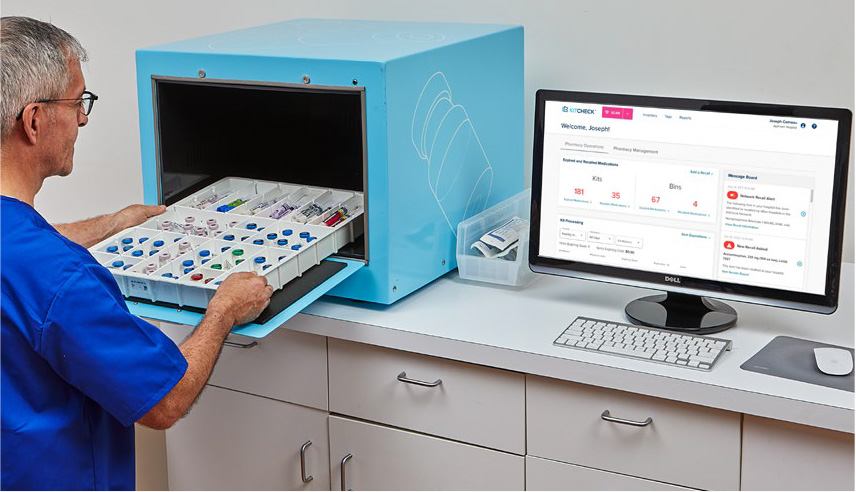
The hospital already knows. Somewhere.
Kevin MacDonald and Tim Kress-Spatz founded the company in 2011 as Kit Check. By June 2016, it reported serving more than 250 hospitals across the United States and Canada. That month, Baxter Ventures led a $15 million Series C, bringing disclosed funding to $37.4 million.
The larger opportunity lay beyond the tray. A hospital’s medication story is distributed across wholesaler invoices, dispensing cabinets, clinical records, and staff systems. Each tells a portion. Bluesight’s expanding proposition was to join those portions into something a pharmacy buyer or investigator could use.
In December 2022, Kit Check became Bluesight. The new name accommodated purchasing optimization and controlled-substance surveillance alongside RFID inventory. MacDonald described the company’s early reputation as a friend to hospital pharmacists
. The phrase explains the commercial strategy rather neatly: begin with a recognizable chore, earn a place in the workflow, then address the adjacent chores.
Thirty minutes, once a week
Sentara Health supplies a useful example because the change was procedural. According to Bluesight’s case material, Sentara replaced slower reviews dependent on wholesaler and purchasing-group reports with CostCheck. It reported $1 million in savings in five months. Bluesight’s later account puts savings above $3.45 million in under two years, with each hospital spending about 30 minutes weekly using the platform and pursuing recommendations.
What failed first was the old review process’s ability to keep up. CostCheck compares purchasing options and checks contracts and invoices, giving buyers specific changes to consider. The copyable habit is a recurring appointment with the exceptions, followed by action. A recommendation sitting untouched on a dashboard saves nothing.
These are vendor-published customer results, not a promise for another hospital. Purchasing volume, contract terms, available alternatives, and the buyer’s authority all matter. The important question is whether a team can turn a flagged opportunity into a completed purchasing change.
One contract, actual dollars
Hospital software pricing usually requires a conversation. A public October 2025 committee packet from University Medical Center of Southern Nevada offers a narrower, more useful view: a proposed Bluesight agreement with separate product lines. Its first-year schedule listed KitCheck at $21,000 and ControlCheck at $62,500.
The potential five-year aggregate, including optional years and miscellaneous fees, was capped at $937,945.10. Those are proposed customer-specific terms, not a public price list. They show the scale of the decision: subscriptions, hardware arrangements, escalation clauses, and implementation deserve attention alongside the savings presentation.
A discrepancy needs a detective
ControlCheck tackles a more sensitive mismatch: controlled medication removed from a cabinet without a corresponding account of administration, return, or waste. It combines transaction reconciliation with behavioral analysis and case workflows. An unexplained record deserves investigation. It does not, by itself, establish theft.
Bluesight operates in a market with established alternatives, including BD HealthSight Diversion Management and Wolters Kluwer’s Sentri7 Drug Diversion. Its distinction is the breadth of the surrounding portfolio. Thoma Bravo invested in 2023 as Bluesight acquired Medacist. Sectyr followed in 2024, adding 340B compliance capabilities; Protenus followed in January 2025, bringing patient privacy monitoring.
Today that portfolio includes 340BCheck, ShortageCheck, and PrivacyPro. Buyers are hospital pharmacy and compliance teams, rather than consumers filling prescriptions. Bluesight sells a recurring software relationship and promotes consolidation under one vendor and annual renewal. Its 2026 announcements put adoption above 3,000 hospitals in the US and Canada.
“a friend to hospital pharmacists”Kevin MacDonald, on the company’s early reputation
The scanner’s invisible dependency
The limits become clearest in a support notice. Bluesight’s Fresenius Kabi RFID partnership ended on November 6, 2025. Already registered products remained supported, but new, unregistered products would no longer automatically populate medication data. Bluesight advised customers that applying its own tags could preserve the workflow.
A chip alone cannot tell a pharmacy everything it needs to know. The associated record must remain usable. Location tracking requires similar discipline: Bluesight’s account of NYU Langone’s Remote Dispatch rollout describes training, configured carts, and custom QR codes. A hospital that skips those details will have a harder time finding the right item.
Faster answers still need judgment
Prism Assistant arrived inside ControlCheck in May 2026 and PrivacyPro in October. Investigators can ask questions in ordinary language. An AWS technical account describes an instructive engineering choice: putting existing application APIs between the assistant and underlying data reduced query latency from five minutes to ten seconds.
The same account describes a cross-product compliance prototype that used deterministic scoring while the language model gathered evidence and assembled reports. The practical lesson: assign each component a bounded job, and preserve a trail someone can check.
Bluesight’s October diversion report adds a final wrinkle. Patient and colleague reports represented a small share of investigations but were more likely than software-triggered cases to yield confirmed diversion. Better visibility still includes listening. The blue box can help a hospital count what is present. People must decide what the missing pieces mean. For a buyer evaluating the suite, that suggests a concrete starting point: choose one troublesome handoff, verify the underlying records, and establish who will review the exceptions. Better information needs an owner.