At the Prinses Máxima Centrum in Utrecht, two robots have spent years helping prepare medicines for children with cancer. By September 2026, the center and ARxIUM, the company behind its RIVA systems, reported more than a million patient-specific sterile doses. The preparation pharmacy opened in 2018. This is a story about what happens after the demonstration ends and the machine becomes part of Tuesday.
- What it makes: IV compounding robots, dispensing cabinets, medication packagers and pharmacy software.
- Who it serves: hospitals, health systems, centralized pharmacy operations, long-term care and retail pharmacies.
- The useful idea: automate a defined workflow, then keep the checks, records and replenishment connected.
A million doses, two robots
A child’s treatment schedule is a poor place for improvisation. Sterile medicines must be prepared to the intended specifications, with a record of what happened. The Dutch center’s two RIVA systems support both routine sterile preparations and high-risk oncology medications. Individualized treatments make this a more revealing example than an assembly line producing one identical item forever.
In the joint announcement, pharmacy director Dr. Lidwien Hanff credited the pharmacy team and the preparation process developed with ARxIUM. The distinction matters. A dose count describes sustained use; it does not, by itself, measure clinical outcomes or prove that every installation will perform equally well. The accomplishment belongs to a working arrangement of people, procedures and machines.
“This milestone reflects the dedication of our pharmacy team and our continued focus on providing high-quality care for every patient.”
Dr. Lidwien Hanff · Director of Pharmacy · September 2026
That arrangement is ARxIUM’s business. The company supplies the hardware that handles medicines, the software that tracks pharmacy operations, and the support and consumables that keep the equipment working. Its customers buy capacity and control in a setting where the consequences of a small mistake can be substantial.
The robot that needed a bigger company
ARxIUM took its present name in 2015, when Winnipeg-based Intelligent Hospital Systems acquired AmerisourceBergen Technology Group. The smaller business had RIVA. The acquired operation brought complementary pharmacy technologies. Niels Erik Hansen led the combined company; investor and owner Ed Van Humbeck explained the commercial problem with unusual directness.
The Winnipeg Free Press reported that RIVA carried a price above $1 million and a lengthy sales cycle. That historical price is a marker of the capital commitment involved, rather than a current quotation. A sophisticated machine can be valuable to a hospital while remaining difficult for its maker to sell quickly enough.
Van Humbeck’s explanation was that growing with RIVA alone would take too long. The purchase was reported as a cash transaction with debt financing, without additional equity partners. The broader portfolio gave ARxIUM more ways into a pharmacy’s budget and more of the pharmacy to work on. Selling the whole workflow became a strategy with a very practical origin.
The needle has to face the right way
RIVA prepares IV syringes and bags inside a closed ISO Class 5 aseptic environment. ARxIUM describes support for USP <797> sterile compounding processes when the system is used according to established procedures and instructions. The qualifications are part of the product’s meaning: buying machinery does not relieve a pharmacy of its operating responsibilities.
Its intelligence is pleasingly specific. In a May 2026 technical explanation, ARxIUM described a rule-based Action Description Language framework and a vision method that determines needle-bevel orientation from two images. A needle has a direction. Getting that direction right, repeatedly, is a more concrete task than the expansive promises usually attached to artificial intelligence.
Another example concerns a syringe that fails a gravimetric check. The documented response is to label and isolate it, route it to a reject bin, request inventory and resume the workflow. The exception has a route of its own. That is an important design principle for a machine whose work cannot be judged solely by how fast it moves.
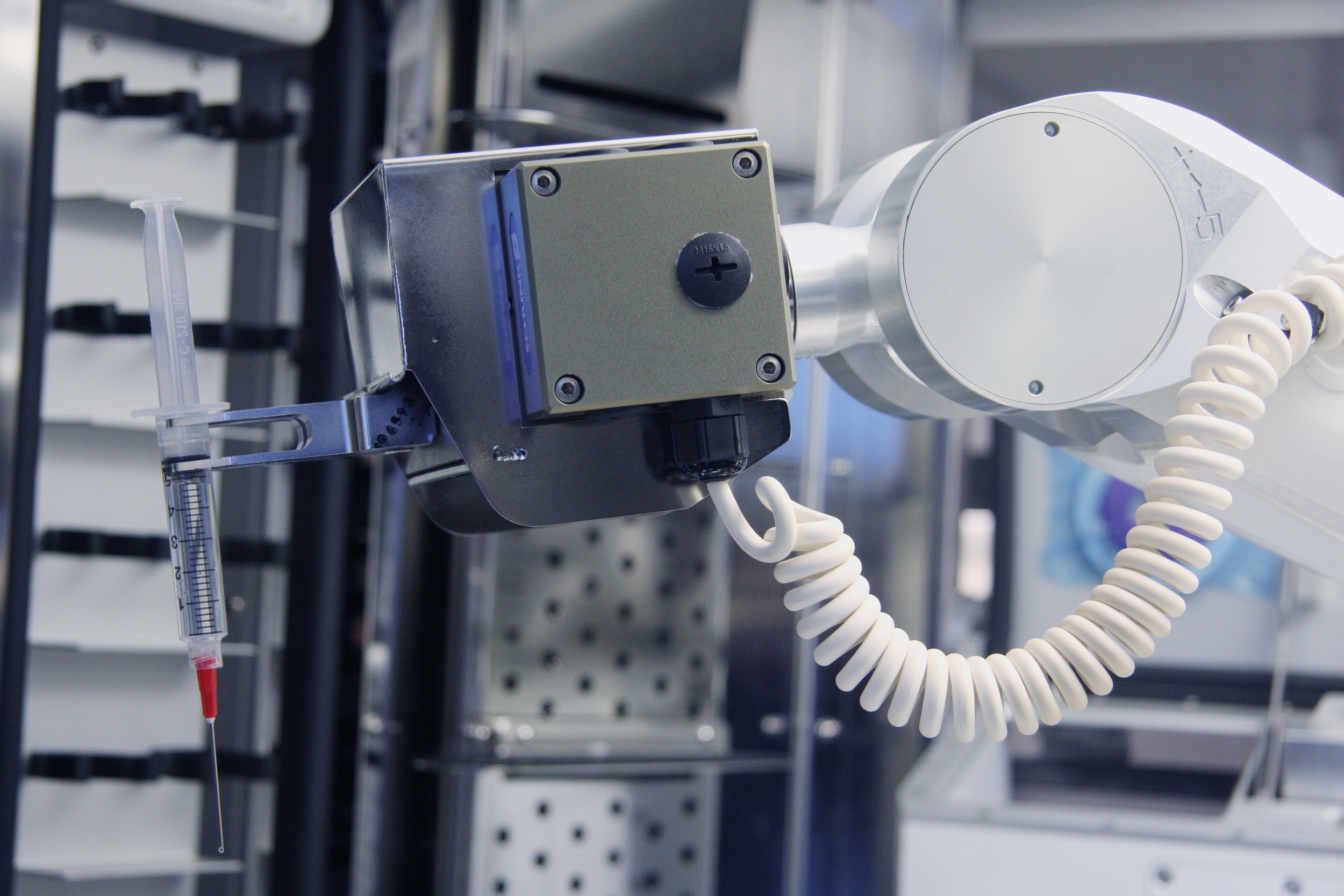
Even the robot’s surfaces enter the story. A Stäubli supplier case study describes the TX60L Stericlean arm used in RIVA as resistant to hydrogen peroxide, with an enclosed construction suited to the application. Material compatibility is part of sterile automation. So is labeling: ARxIUM integrates RIVA with Codonics’ barcode-based Safe Label System and resells it in the United States.
The pharmacy has more than one bottleneck
ARxIUM’s portfolio follows medicines through several different kinds of work. MedSelect cabinets provide controlled dispensing and storage. FastFill handles oral-solid vial filling, with the semi-automated FastFill 54 intended for lower-volume needs. FastFind uses vertical carousel storage to bring medication picking to waist height. It is hard to be theatrical about reduced bending, though the person doing the bending may appreciate it considerably.
FastPak handles pouch packaging. The August 2026 FastPak Elite 7.0 release added integrated MDM Core verification with double-sided imaging, checking medication pouches against expected models to support pharmacist review. It also expanded barcode capabilities, reporting and support for multiple Elite systems. The manufacturer specifies up to 65 pouches per minute and 15,000 doses per eight-hour shift. Pouches and doses are different units; neither figure is a promise about a particular pharmacy’s achieved output.
up to
up to
Published August 2026. Different measures of capacity; actual workflow performance depends on deployment.
The software addresses the work between devices. RxWorks Pro manages purchasing, receiving, invoicing and inventory across suppliers and stocking points. Its workflow tools can route orders to manual picking locations, show order status and track delivery. ARi adds reporting and analytics. The company also offers tools for 340B program oversight and purchasing. A fast packager is more useful when the rest of the pharmacy knows what it packed.
This puts ARxIUM in the pharmacy automation market alongside companies such as Omnicell, BD and Swisslog Healthcare, with the relevant alternative changing by task. Its pitch rests on portfolio breadth and configured integration. Those attributes deserve evaluation; they do not establish a universal advantage over every competitor.
The purchase order is only the beginning
The economic story continues after installation. In August 2026, DuPage County approved a contract for supplies for the DuPage Care Center pharmacy’s FastPak Elite machine, capped at $26,000 for September 2026 through August 2027. The record identifies compatible supplies for existing equipment as the reason for sole-source purchasing. It is a supplies ceiling for one customer, rather than the machine’s price or its total annual running cost.
For ARxIUM, equipment sits alongside software, parts, consumables and technical support in a business relationship that can last for years. For the customer, that means evaluating the continuing costs and dependence on support as carefully as the initial capacity. The company offers remote assistance and on-site technicians. The distinction between having a robot and having a dependable service can become expensive.
A historical warning appeared in KLAS’s 2019 IV compounding report. KLAS described an acquisition-related decline in ARxIUM customer satisfaction as relationships weakened. It also found that achieving expected throughput challenged IV robot users across vendors. This was a dated assessment, not a current league table, but it punctures the idea that hardware specifications settle the buying decision.
Security belongs in that continuing relationship too. In August 2026, ARxIUM announced that its Corporate Information Technology environment maintained HITRUST e1 certification. The scope matters: the announcement concerns the evaluated corporate IT environment. It should not be stretched into a claim that every product or every customer installation has been certified.
Draw the arrows before buying the robot
One of ARxIUM’s most useful teaching materials is a vancomycin workflow diagram. The manual version follows labels, clean-room transfers, preparation and review. Its automated counterpart retains pharmacist order review while simplifying the preparation sequence. Put the pictures beside each other and the buying question becomes clearer: which handoffs can disappear, and which decisions still require a professional?
- 01Review
the order - 02Prepare
the medicine - 03Verify
and document - 04Release
and deliver
Automation changes selected steps. Pharmacy oversight connects the sequence.
The lesson a reader can copy is to begin with that map. Define the drugs, batch patterns, checking process and exception handling before choosing machinery. KLAS found more successful robot use among customers with specific strategies: large batches of a limited set of drugs, selected hazardous preparations, or standardized patient-specific workflows. A poorly matched workload or unreliable support can defeat an otherwise capable machine.
By April 2026, ARxIUM reported more than 19 million doses prepared across RIVA’s global installed base. The figure gives the company a substantial operating history. Its more interesting promise remains smaller and harder to deliver: make the next preparation repeatable, make the exception visible, and make the people around the machine able to trust the process. In medicine, boring is a compliment worth earning.