A replacement heart valve is an awkward place to discover that your first decision was slightly wrong. The opening is irregular. The fit matters. Blood finds the gap you hoped it would overlook. Direct Flow Medical approached this problem with a proposition that sounds almost modest: let the physician see how the valve performs before making its position permanent.
- The idea: a nonmetallic support that allows a valve to be assessed, repositioned, or retrieved before final release.
- The interruption: Direct Flow Medical closed in 2016 after an expected financing changed.
- The next chapter: Silara appears in newer patent filings and a small 2026 clinical report.
That proposition is the thread running through Silara Medtech’s public history. Its LinkedIn address still says “direct-flow-medical.” Its description still reaches back to 2004. Yet the story contains a corporate break, a failed rescue, and a newer research program. Following the valve is more useful than pretending the name tells us everything.
The luxury of changing your mind
Aortic stenosis narrows the valve through which blood leaves the heart. Transcatheter replacement brings a prosthetic valve to that location through a catheter. The engineering challenge includes both opening a passage and securing a seal. A valve can sit in the right general neighborhood and still let blood leak around it.
The legacy Direct Flow device used bovine-pericardial leaflets inside a nonmetallic, inflatable double-ring support. Its conformable rings captured the native annulus, the tissue surrounding the opening. Operators could examine performance while the system remained adjustable. Once satisfied, they exchanged the inflation fluid for a hardening polymer to establish the permanent support.
Here was the distinction from established metal-frame approaches: a pressurized support structure gave the operator another opportunity to decide. Edwards Lifesciences and Medtronic were the large names in the market. Direct Flow’s proposition depended on a different mechanism, with its own deployment technique and evidence requirements. An elegant mechanism still had to earn its place in a hospital.
The question changed before the product did
Randy Lashinski and Gordon Bishop founded Direct Flow Medical in Santa Rosa in 2004. Their earlier work concerned mitral repair. According to a 2012 account of the company’s origins, conversations with physicians performing early catheter-based valve procedures drew their attention toward the aortic valve. The opportunity emerged from listening to people who had already encountered the awkward parts of the operation.
This matters because the founders were not simply pursuing a fashionable anatomical address. They had a technology they believed could serve more than one valve location, then chose a problem where practitioners saw room for improvement. The lesson a reader can borrow is fairly concrete: interview users about the decisions they struggle to correct, rather than merely the tasks they struggle to complete.
“Proceeds of the Series A round will be used to advance into human clinical trials our lead product”Randy Lashinski, 2005 investor announcement
The customers were specialist hospitals and their structural-heart teams. Patients received the implants; clinicians selected and deployed them. The original commercial plan combined distributors with the company’s own sales staff. It was a business of devices, clinical training, regulatory work, and hospital adoption, with development spending well ahead of the intended sales.
One hundred patients, carefully counted
The first version had already exposed a physical limit. A 2012 report described 31 high-risk patients treated with the earlier, larger system and a procedural success rate of 71%. Excessive native-valve calcification was the main reason implantation failed. The next version used a smaller delivery system and revised components. Reversibility helped; anatomy still had a vote.
The Direct Flow system received a European CE mark in January 2013. DISCOVER, its early European study, enrolled 100 patients with severe symptomatic aortic stenosis and substantial surgical risk. The published one-year results reported 90% survival and mild or less aortic regurgitation in the assessed echocardiographic results.
These were encouraging observations in a difficult population. They came from a small, nonrandomized study, however. They did not establish that Direct Flow outperformed another valve in a controlled comparison. There were complications, including major strokes and new pacemaker implantations. A device’s ability to be retrieved does not abolish the other risks of putting it into a human heart.
The distinction between an observation and a comparison can look pedantic until someone uses the wrong one to make a purchasing decision. Hospital teams need the mechanism, the population, the outcomes, and the limitations together. A percentage without its denominator is an advertisement waiting to happen.
The deadline the valve could not move
In December 2014, Direct Flow announced a $32 million financing package: $17 million in equity and a $15 million debt tranche. The money was intended to support its U.S. pivotal trial and growth outside the United States. Those figures describe financing, not the price of a procedure or the full cost of developing the technology.
The decisive reversal came in November 2016. PDL BioPharma, the lender, reported that the anticipated financing changed from equity into a smaller loan on less favorable terms. Direct Flow shut down in December. PDL subsequently obtained most of its assets through foreclosure.
In January 2017, Haisco bought China-exclusive clinical, regulatory, commercial, and intellectual-property rights for $7 million. Financing had failed before the development story was finished. The sequence illustrates a particular hazard for device companies: evidence accumulates on one timetable, while cash becomes payable on another.
A rehearsal for an unfamiliar opening
Silara Medtech Inc.’s California corporate filing dates to January 2017. Later public records place it within the Chengdu Silara group. Its newer patent trail includes implant delivery and annuloplasty-release systems, suggesting development work beyond a single historical product.
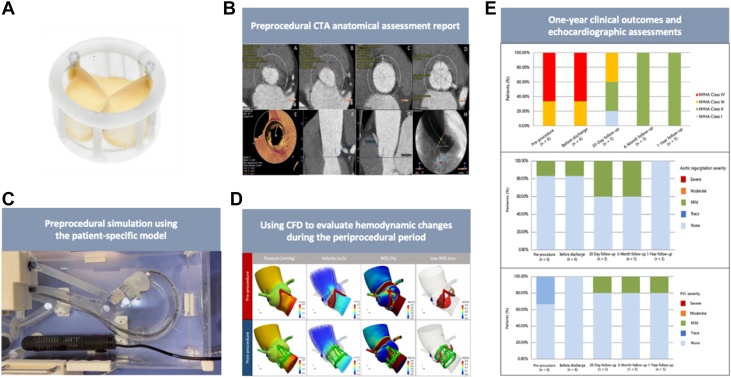
A March 2026 paper describes a Silara system used for pure aortic regurgitation, a different challenge from a narrowed valve. Six high-risk patients underwent treatment at Xijing Hospital. Planning combined patient-specific 3D printing with computational fluid dynamics to guide sizing and implantation depth.
Five patients completed at least a full year of follow-up. The report recorded no deaths, strokes, or new permanent pacemakers during follow-up. It was a single-center feasibility study without a simulation-free control group. The authors called for larger studies and longer observation.
The useful idea is the rehearsal: give a consequential choice a testable form before committing. Its usefulness depends on anatomy, operator expertise, reliable planning, and supporting evidence. In Silara’s story, the chance to reconsider remains compelling. The work of establishing when that chance improves outcomes continues.