There is a particular kind of business idea that begins not with a revelation but with an irritation. The coffee is cold. The suitcase wheel wobbles. The marketing agency keeps returning handsome work that somehow does not solve the marketing problem. Viviane Torres knew the third irritation well. For more than 15 years she led marketing inside large companies, hired outside agencies, and felt the distance between vendor and colleague. The deliverable might arrive. The partnership often did not.
In 2020 she made the complaint into a company. Blue Halo Agency, based in Miami, would behave like the marketing department Torres had wished she could hire: close enough to understand the business, broad enough to carry an idea through several formats, and accountable after the presentation ended. It sounds obvious. Many useful businesses do, after someone finally builds them.
The founding annoyanceShe knew what the buyer hated
Blue Halo’s origin matters because it explains the menu. Social media, websites, graphic design, copy, video, events, SEO, paid search, and integrated campaigns can look like the familiar buffet of a full-service agency. But the point is not simply that the firm does many things. The point is that a brand should not have to introduce itself eight times to eight specialists employed by five vendors.
Every handoff is a small opportunity for amnesia. A strategy becomes copy, the copy becomes a landing page, the landing page becomes an event booth, and by the time the social team posts it, the company sounds like its own distant cousin. Blue Halo’s product is continuity. Its public pitch - work with the whole team or buy only the piece you need - makes that continuity available as a retainer, a project, or a hybrid arrangement with an in-house department.
It took years to get my first steady clients.Viviane Torres, reflecting on Blue Halo’s early years
The first thing that failed was speed. Torres has written that she was pregnant, seriously ill with hyperemesis gravidarum, and flying to trade shows during COVID, trying to persuade someone to hire her. Trips felt wasted. Clients were not steady. The polished origin story had not yet acquired its polish.
That detail rescues Blue Halo’s story from the usual founder montage. The change of mind was not one lightning-bolt moment. Torres already believed agencies could work differently. What changed was the evidence: early partners trusted her, the work repeated, and a frustrating theory became an operating company. The lesson worth copying is less romantic than “follow your dream.” Start with a complaint you understand from the buyer’s chair, then survive long enough to learn whether other buyers share it.

The proof gets industrialBelts are not boring if they move the world
The clearest example is AMMEGA Group - Americas, an industrial belting company whose products often do their work backstage. Since 2023, Blue Halo says it has supported six AMMEGA brands across English, Spanish, French, and Portuguese. This is not the easiest material for a mood board. Conveyor belts lack the natural charisma of sneakers. They do, however, keep factories, food lines, airports, and logistics moving.
For one brand-simplification campaign, the agency helped bring Chemprene, uni, and Green Belting under the Ammeraal Beltech name. The obvious move would have been a hard switch: new logo, launch email, good luck. Blue Halo began with customer and stakeholder interviews. It built three messaging pillars, “Comprehensive Portfolio,” “Local Partner of Choice,” and “Proven Expertise,” then planned two phases. Legacy brands remained visible beside their new product categories before the unified identity took over.
A reusable brand-simplification sequence
That sequence is the most portable thing in the portfolio. A merger, product consolidation, or rebrand need not demand instant forgetting. Preserve the cue customers already trust, attach it to the new system, and remove the training wheels gradually. It works when the old names carry real recognition and the new parent genuinely offers a clearer portfolio. It is a poor fit when management is using a rebrand to conceal a broken product, a service failure, or an acquisition that customers actively reject. Design cannot arbitrate a dispute the business refuses to acknowledge.
What the client actually buysNot a post, a booth, or a website - fewer seams
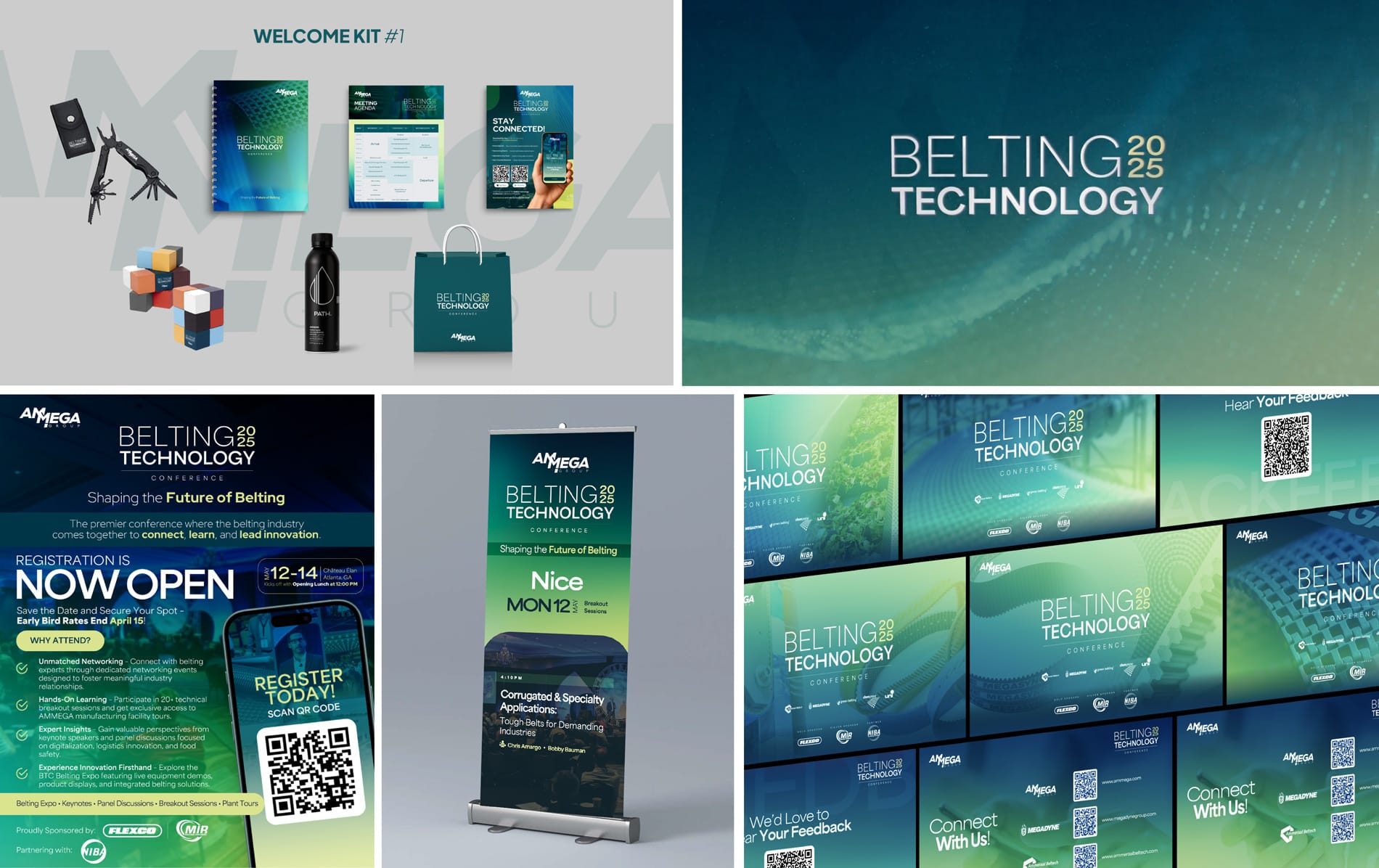
AMMEGA’s Belting Technology Conference shows how the model earns its keep. Blue Halo handled planning, vendor communication, event identity, signage, banners, a custom website, an attendee app, and on-site support. The same team could see where a registration promise collided with a physical sign. That is the advantage of breadth when breadth is coordinated: fewer seams for the client to inspect.
Other engagements are smaller. MIR uses Blue Halo as a creative partner for a modernized brand book, digital materials, and trade-show graphics. Food and beverage clients such as Sunsof and MBC Companies use social content, design, copy, and web work. The Cortada Foundation, a Miami nonprofit, engaged the agency for brand and social presence. The common problem is not industry. It is a marketing team with more channels than hands, or a complex product that needs to sound like one company everywhere it appears.
Blue Halo publishes no rate card. It says cost depends on scope, services, and whether the engagement is a one-off project, monthly retainer, or mixture. That flexibility helps companies buy only what they need, but it also means comparison requires a clear brief. Without one, “full service” can become an unhelpfully elastic phrase.
The alternative is usually one of three things: build an internal department, assemble specialist vendors, or hire another integrated agency. Blue Halo fits between the first two. It can sit beside a small in-house group that owns product knowledge and brand direction while the agency supplies technical production and capacity. This works best when the client appoints a decision-maker, shares access to subject experts, and accepts a common strategy across channels. It works badly when every department can rewrite the brief, approvals arrive by committee, or “partnership” means unlimited work for a fixed fee.
Purpose, with a test attachedThe green chapter must survive contact with the work
After five years, the company says it paused to realign around environmental responsibility and people-focused businesses. Its mission now welcomes both committed eco-conscious brands and companies taking early steps. The agency offers special consideration to purpose-driven organizations and describes sustainability as a filter for strategy and communication.
This is promising and incomplete by nature. A mission statement is a direction, not an audited outcome. The useful standard is whether the agency helps clients say exactly what has changed, avoids turning aspiration into achievement, and chooses evidence over green decoration. Blue Halo’s most convincing work already follows that discipline: interview people, identify what is true, and phase the story at the speed trust can bear.
Its stance on artificial intelligence follows a similar line. The team says it uses AI for research, processes, and automation, while keeping creative strategy, brand voice, and judgment with people. That boundary will move as tools change. The principle is sturdier: automation should return time to the human part of the work, not impersonate it.
The copyable partTurn the old complaint into operating rules
A founder cannot copy Torres’s history, and a company cannot borrow Blue Halo’s client relationships. It can copy the conversion method. Write down what disappointed you as a buyer. Translate each complaint into a behavior a customer can observe. “Agencies did not listen” becomes customer interviews before a rebrand. “Too many vendors” becomes one campaign roadmap. “The work felt generic” becomes direct access to subject experts. “Reporting arrived without meaning” becomes performance review tied to decisions.
Blue Halo remains a small private company. It discloses no funding, valuation, or revenue, and its public numbers are output counts rather than independently measured business results. That modest scale is part of the story. Twenty-six brands, 73 articles, 14 video productions, and one industry conference do not describe a marketing empire. They describe a shop that endured its awkward opening years and found a job it could explain.
The name once referred to the blue halo some flowers use to attract bees. The metaphor is charming, if a little neat. The better image is the founder on another difficult trade-show flight, carrying an agency in theory before steady clients made it real. Attraction mattered. Staying in the air mattered first.