A construction project begins with a surprisingly clerical problem. Someone needs a list. Who installs the glass? Who supplies the doors? Who can price the electrical work in this particular county? Before crews arrive, an estimator must assemble a plausible cast of companies, each capable of doing one piece of a complicated job. The building exists on paper. The team often does, too.
- Find commercial construction firms by trade and territory.
- Show qualifications through ProView; find opportunities through BidScope.
- Use bid tools to share plans and keep subcontractors in the conversation.
Blue Book Construction Network has occupied that moment since 1913. Its roots are in a New York City subcontractor registry published by Joseph O’Malley. Organizing firms by trade sounds modest until you consider the alternative: knowing the right person already. A directory made that knowledge portable. A contractor entering unfamiliar territory could begin with a classification instead of a lucky introduction.
Three doors into the same job
Today, Blue Book operates inside Dodge Construction Network. Its customers include general contractors building a bidder list, specialty subcontractors seeking invitations, and suppliers trying to reach people who buy materials. Architects, engineers, owners, and facility managers also use the network. Its focus is US commercial construction, where a useful connection might be several layers removed from the eventual building owner.
The products address different questions. ProView answers: what can this company do? It is a digital profile containing capabilities, project experience, photographs, references, and qualification information. Premier membership buys priority placement in selected classifications and regions. For a subcontractor, the attraction is being visible when someone is actively looking for the trade it performs.
BidScope answers: where is the work? It searches public and private project opportunities and supplies plans, specifications, and decision-maker information. Geography matters. So does the stage of a project. An opportunity outside a company’s service area, or discovered after the useful conversations have happened, can be an impressively detailed distraction.
Qualifications
Project discovery
Invites + plans
ONETEAM answers: how do we get everyone the information? Its documented tools include customized bid invitations, private plan rooms, vendor organization, and threaded conversations. A general contractor can invite familiar subcontractors and search for additional firms. Those are distinct tasks: keeping the existing team informed and filling the gaps in it.
The unglamorous details are revealing. ONETEAM can report which invited firms entered a plan room and which files they viewed or downloaded. Its support documentation describes follow-up on failed invitation emails. Blue Book also offers concierge assistance with sourcing bidders and organizing documents. The network’s expertise includes the administrative work that determines whether a connection becomes a usable response.
Consider the difference between a search result and a bid invitation. The first introduces a firm; the second gives it a deadline, documents, and a reason to respond. Blue Book connects those stages. A buyer can examine a profile before making contact, while a seller can assess the project before committing estimating time. That sequence is useful because neither side benefits from a long list of unsuitable names. The opportunity has to survive several small decisions before anyone submits a number.
The price of being found
Blue Book’s economics join two interests. Buyers want a workable pool of bidders. Sellers want attention from those buyers. The company sells advertising and membership benefits around that attention, while ONETEAM’s published support page describes free accounts, unlimited users and projects, and included support. Invited subcontractors can access documents and submit bids without paying.
Paid visibility is a separate proposition. A Premier profile’s placement is an advertising benefit, so buyers should still assess qualifications and fit. For sellers, the useful calculation is the cost of reaching relevant opportunities, including the staff time spent estimating them. More invitations can create more work at a desk before they create any work on site.
“There were a lot of people we weren’t reaching.”Brian Funicelli, Blue Book social media manager, 2016
Even the matchmaker needed an introduction
Blue Book faced its own version of the discovery problem. In a 2016 LinkedIn case study, social media manager Brian Funicelli described expanding beyond email and search advertising. The constraint he identified was audience reach. His team tested Sponsored Content, InMail, and display advertising, targeting professional roles such as architects and subcontractors with relevant material.
The reported comparison was striking: LinkedIn Sponsored Content delivered an 86% lower cost per lead than Facebook campaigns. For the 2016 showcases, it also produced 218% more registrations than Twitter campaigns. These were results from that campaign context, published by the advertising platform. They make a useful historical example rather than a forecast for someone else’s budget.
The same lead metric. A different cost.
Cost-per-lead index. Facebook = 100; LinkedIn = 14, calculated from the reported 86% reduction. No dollar spend disclosed.
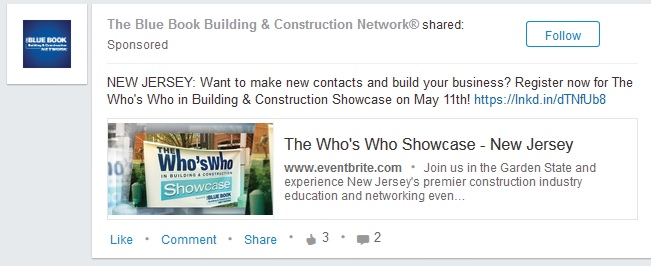
The practical lesson is narrow enough to copy: define the professional you need to reach, then give that person something useful. One promoted article concerned improving bid responses. The destination was sometimes a physical networking event. Digital distribution supported the face-to-face business rather than replacing it.
A bigger address book meets a project map
Ownership changed along the way. Blue Book announced an employee stock ownership plan in 2013, its centennial year. In April 2021, it combined with Dodge Data & Analytics in a transaction facilitated by Dodge’s owner, Symphony Technology Group. The stated logic joined firm discovery and networking with project information and market intelligence.
That combination helps explain Blue Book’s position among alternatives such as ConstructConnect’s bid-management products. Buyers can compare networks, document tools, and local coverage. Blue Book’s particular proposition combines a construction directory and advertising presence with project discovery and bid communication. Its announced 2017 Procore integration also illustrated the handoff from bidding into project management.
The fit has boundaries. Blue Book’s marketing specifies commercial construction, excluding residential services and job seeking. Within its market, a firm still needs the qualifications, territory, and estimating capacity for the opportunities it pursues. A sensible trial starts with one trade and region: inspect relevant projects, make the profile accurate, and track invitations through bids and awards. The list gets the conversation started. The contractor must earn the job.