Frederick W. Dodge's first information system had two wheels. In the 1890s, he rode around Boston, observed building activity and committed the useful details to carefully cataloged index cards. The customers were construction professionals who needed to know where labor, materials and opportunity would be required next. The charming part of the story is the bicycle. The consequential part is the timing: Dodge was packaging evidence of a project before that evidence became easy for everyone to see.
A century and several corporate identities later, the same wager sits underneath Dodge Construction Network. The company is not a contractor and does not pour concrete. It gathers, verifies and connects the information surrounding commercial construction - projects, owners, architects, contractors, plans, specifications, products and market direction - then sells access to the resulting intelligence. Its software helps a general contractor spot a hospital in planning, a subcontractor find the firms attached to it and a building-products maker notice when a rival brand appears in the specification.
The useful moment before the obvious moment
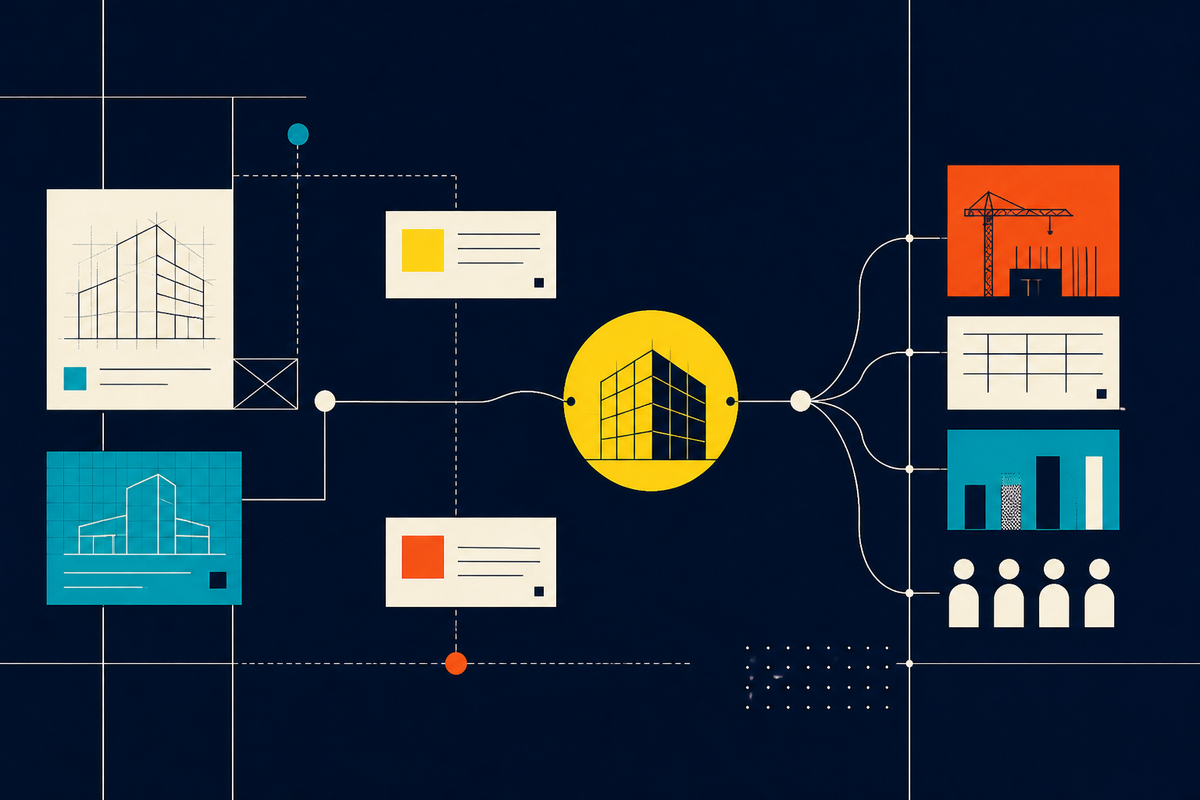
Construction software is a wide market, but its products often begin at different moments. Project-management platforms organize work after a team has a job. Bid-management tools distribute invitations and collect responses once bidding is active. Dodge aims further upstream. Its flagship platform, Dodge One, follows commercial projects from pre-planning and design through bidding, award and construction. That position matters because many commercial choices harden early. A manufacturer that learns about a project after the specification is closed is not merely late to the notification; it may be late to the sale.
Dodge's answer to this narrowing window is a mix of software and reporting labor. Its current product pages describe a record of more than 10 million historical projects, hundreds of thousands tracked each year and thousands of new or updated reports each day. Hundreds of field or content specialists verify records around project stage, value, contacts and specifications. Automated collection can find a permit page. Human research is more useful when the permit has a stale contact, the architect has changed or a project described as active quietly stopped moving.
The product looks like data. The value is time to act.
Five old institutions inside one new interface
Dodge Construction Network is easiest to understand as a portfolio rather than a single app. Dodge One is the primary project and relationship intelligence platform. The Blue Book Network, founded as a New York trade registry in 1913, supplies a large directory and bid network for contractors and subcontractors. Sweets began in 1906 as an indexed building-product catalog; today it gives designers and builders access to specifications, BIM objects, CAD details and manufacturer literature. IMS watches public agencies for early RFP, RFQ and qualification opportunities. Principia, acquired in 2022, adds custom market research and strategy for building-material manufacturers, distributors and investors.
The combination creates three kinds of search under one roof: find a project, find a firm and find a product. It also gives the company a market-intelligence layer. Dodge economists publish construction-starts reports and the Dodge Momentum Index, a leading indicator based on nonresidential projects in planning. The U.S. Census Bureau has used Dodge data for more than 55 years in work connected to nonresidential spending estimates and quarterly gross domestic product. That is a different credential from a large user count. It means the same underlying reporting apparatus can serve a salesperson looking for Tuesday's call list and an economist reading the national cycle.
Who pays, and what headache disappears
For general contractors, the headache is pipeline opacity: which plausible jobs are forming in a territory, and which owners or designers should the business-development team know now? For subcontractors, it is dependence on invitations and familiar relationships. Dodge lets them search outside the inbox and build a profile that general contractors can discover. Architects and engineers can follow planned work and prospective clients. Distributors can anticipate local demand. Building-product manufacturers can watch specifications, map the firms that influence them and focus reps on projects where substitution is still possible.
The practical output is rarely a grand strategic revelation. It is a better morning. Instead of searching municipal sites, stitching together questionable lead lists and asking whether a project is real, a territory rep can open filtered opportunities, inspect changes and decide whom to contact. Dodge cites Central States Building Works as saving roughly 250 research hours per representative annually. Komatsu East is presented as saving thousands of hours across a larger sales group through automated project reporting. These are vendor case studies, not universal outcomes, but they reveal the job customers hire the software to do: remove low-confidence hunting from expensive selling time.
A moat made of memory and phone calls
ConstructConnect is Dodge's clearest broad competitor in commercial leads and bidding data. Autodesk's BuildingConnected is strong in managing invitations and subcontractor bidding once a general contractor puts a project into motion. PlanHub and SmartBid occupy similar bid-workflow territory. Procore and Autodesk Construction Cloud dominate adjacent project execution. Each comparison depends on the job: a contractor managing sub bids has different needs from a manufacturer trying to influence a specification six months earlier.
Dodge's distinction is breadth across time. It can place an early project signal against historical starts, attach the firms and contacts, expose documents and specifications, then feed the record into customer systems. The archive is difficult to recreate quickly. So is the operating routine behind it. A new entrant can scrape public pages and apply a language model, but it still needs to resolve duplicate projects, call participants, date changes and decide which apparent opportunities are alive. Dodge's human layer is expensive. It is also part of why the database is defensible.
How the machine earns
Dodge is a private B2B information company. Its core model is subscription access and enterprise licensing, with pricing customized by products, geography, data coverage and seat count. It also licenses data through APIs and CRM connections, sells manufacturer visibility and specification-oriented programs, and charges for custom research and consulting. The network produces a useful flywheel: more firms and projects make the data more valuable; more users and integrations create more reasons to keep profiles, documents and relationships current.
Private-equity ownership has shaped the modern portfolio. Symphony Technology Group acquired McGraw Hill Construction in 2014. The Blue Book combination followed in 2021. Clearlake Capital joined STG as an investor in 2022, the same year Dodge bought Principia. In November 2024, the company announced $100 million in new capital, extended debt maturities and appointed Andrew Somosi chief executive. The sequence reads like a familiar information-services strategy: combine durable datasets, modernize delivery, integrate sales workflows and expand the higher-value analytical layer.
Dodge can reveal and organize an opportunity. It cannot make the project viable, create a relationship or write the winning bid. The software improves the odds that the right human begins sooner.
The rebuild after the roll-up
The risk for any venerable data business is that customers respect the records and resent the interface. Dodge effectively acknowledges that tension in the story of Dodge One: customers valued the data but wanted a faster, simpler product. The rebuilt platform adds cleaner search, more precise filters, exports of up to 10,000 records, mobile access and an AI Search Assist that accepts plain-language descriptions of an opportunity. Personalized dashboards are listed for later in 2026.
AI is useful here when it makes an enormous taxonomy easier to query. A salesperson should be able to describe the sort of school, warehouse or health facility worth pursuing without mastering every database field. Yet Dodge's advantage does not come from attaching an AI label to search. It comes from giving that search something reliable to search. The frontier is a polished loop between verified field intelligence, recommendations and the systems where customers already manage relationships.
The company now sits in an unusual market position: part SaaS platform, part marketplace, part research bureau and part economic observatory. That mixture can look untidy beside a focused construction app. It can also be useful because commercial building is untidy. A project is simultaneously a design, a financing event, a set of firms, a basket of products, a local labor demand and a future data point. Dodge's long experiment is to keep those views connected.
The bicycle story endures because it is not really about nostalgia. Frederick W. Dodge noticed that a scattered physical market leaves informational tracks before it leaves a finished building. His company has spent 135 years changing the container for those tracks - cards, reports, databases, networks and now an AI-assisted application. The business proposition remains refreshingly plain: if you can see the work earlier, you have more choices about what to do next.