In 1997, Bjorn Manuel Hegelich went to a lecture and acquired a problem that would occupy him for decades. A visiting professor described using short, powerful laser pulses to accelerate particles. The idea offered an enticing trade: some of the work done by a large accelerator might happen in a much smaller space. Hegelich was an undergraduate. There are less expensive ways to develop a lifelong interest.
“It completely captured my passion,” he recalled. The attraction was practical as well as intellectual. If the machines could become accessible, more people could use them. That question followed him through research laboratories and university appointments, eventually becoming TAU Systems, the company he founded in 2021. The lecture had furnished an idea. Making a business of it would require rather more equipment.
A long education in short pulses
His education crossed several borders before the company existed. He completed undergraduate qualifications at the University of Siegen and Napier University Edinburgh, then a physics Diplom at Göttingen in 1998. His doctorate followed in Munich in 2002, through Ludwig Maximilian University and the Max Planck Institute for Quantum Optics. A short pulse of light, it turns out, can require a fairly long apprenticeship.
Those institutions matter because his work sits between theory, equipment and the habits of an experimentalist. The question is how intense electromagnetic fields interact with matter. Answering it means arranging conditions in which the prediction can actually be tested. Lasers, targets, detectors and calculations have to agree on what happened. A beautiful explanation has a more demanding audience when the audience includes a piece of laboratory hardware.
At Los Alamos National Laboratory, Hegelich became a scientist and team leader working on ultrahigh-intensity laser experiments at the Trident facility. He joined the University of Texas at Austin in 2012. The route from Munich to New Mexico to Texas kept the same broad question in view while changing the laboratory around it. His career developed through institutions equipped to investigate difficult physics, with collaborators who could attack different pieces of the problem.
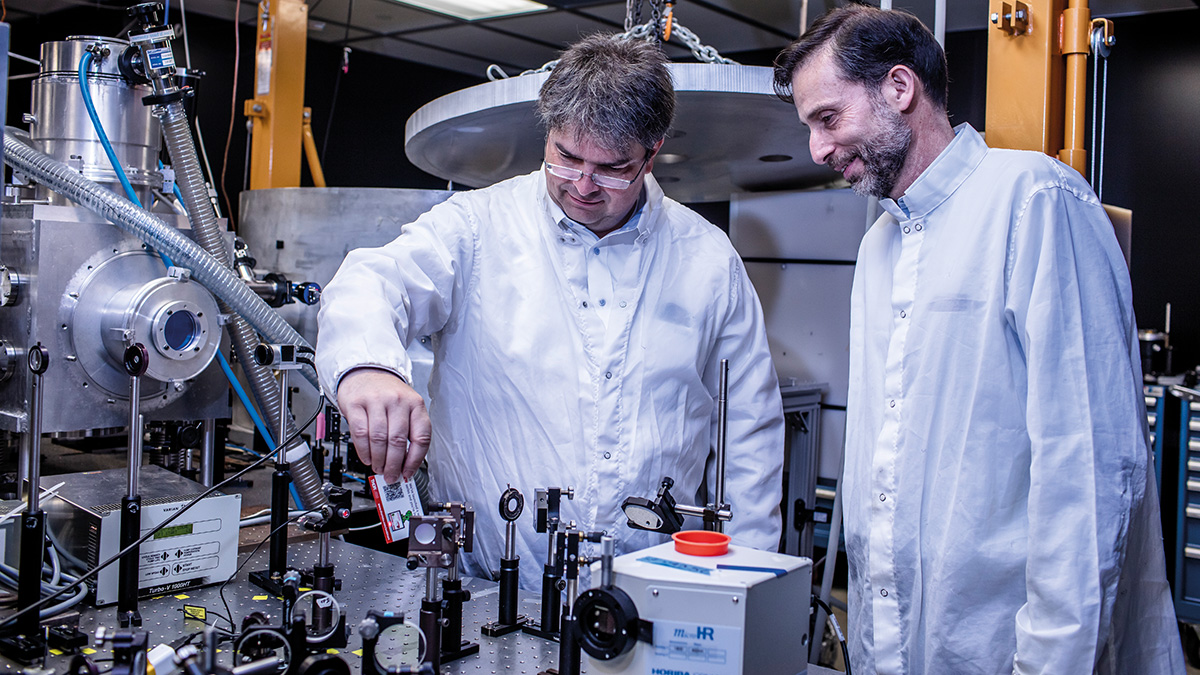
His collaborations also took him back to Munich. During a 2010 visiting fellowship, he worked with physicist Dietrich Habs on the foundations of an electron mirror, a proposed route toward coherent X-ray and gamma-ray sources. Later, in 2018 and 2019, he served as associate director of South Korea’s Center for Relativistic Laser Science and as a professor at the Gwangju Institute of Science and Technology. The geography of his work is a useful corrective to the image of the solitary inventor.
Ten centimeters, with a room attached
The physics begins with a powerful laser pulse entering a gas. The pulse creates a plasma and a disturbance in it. Electrons can gain energy by riding the resulting wave, rather like surfers following a boat’s wake. In the version Hegelich’s team developed, metal nanoparticles help introduce electrons into that wave at a useful moment. Timing is part of the machinery.
The distinction from a conventional accelerator is the material carrying the accelerating field. Metal structures have limits: push the field too far and the structure suffers electrical breakdown. Plasma permits much stronger accelerating fields. That opens the possibility of giving particles substantial energy over a short distance. It also leaves a long list of things to control. A surfer still needs to catch the wave.
The short acceleration region sits inside a larger system of lasers, optics and beam-handling equipment.
In November 2023, a collaboration involving UT Austin, TAU and other laboratories and universities described electrons reaching approximately 10 billion electron volts. The acceleration took place in a chamber about 10 centimeters long. The full experimental system occupied less than 20 meters. Both measurements belong in the story; a gas cell is a component, and the surrounding equipment has its own perfectly legitimate need for floor space.
“We can now reach those energies in 10 centimeters,” Hegelich said. He was the senior author of the research. Constantin Aniculaesei and Thanh Ha were the co-first authors; UT physicists Todd Ditmire and Michael Downer also contributed. Hegelich and Aniculaesei submitted a patent application for generating nanoparticles in the gas cell. TAU obtained an exclusive university license, with UT receiving shares in the company.
Approximate acceleration chamber length
Length of the complete experimental system
The equipment has to turn up for work
Alongside the high-energy experiment came less theatrical engineering. In August 2023, TAU and UT announced an upgrade of the university’s Tabletop Terawatt Laser to 40 terawatts of peak power. Personnel from both organizations worked on it, using components from Thales. A new TAU-designed beamline accelerated electrons. The partnership gave the company a place to develop the machinery and the university new experimental capabilities.
Hegelich has written about a difficulty familiar to anyone who has tried to make a new instrument inside an established department. A physics department trains physicists. Building a usable instrument also calls for software, mechanical design and controls. Hiring a software engineer to develop an interface can be awkward inside an academic structure, even when the interface is essential to getting useful work done.
That observation helps explain his move into business. The machine needs the people who understand the beam, and the people who can make its controls dependable. It needs an organization able to assemble both. Hegelich’s argument for commercializing the research has included the freedom to build that sort of team. In this account of invention, the employment contract deserves a small place beside the laser.
He has also argued for borrowing strength. Writing about partnerships in 2024, he credited collaborations in Texas and at Berkeley with giving TAU access to expertise and specialized facilities it would otherwise have had to assemble. He described benefits flowing back toward the universities, including industrial applications and routes into employment for students. The company grew out of a laboratory and continued to depend on relationships with laboratories.
A customer with a satellite to test
In April 2025, TAU announced $20 million in extended seed funding, bringing the total raised to $35 million. Quantonation led the round, with participation from Team Global and other investors, including the UT Seed Fund. The money supported TAU Labs in Carlsbad, California, and the company said it had secured a first commercial customer, a satellite manufacturer.
The customer gives the physics a deadline and a specific task. Electronics intended for space need radiation testing. TAU’s proposal is to sell access to a configurable testing environment, letting customers book beam time. For an engineering team, the relevant questions include availability, repeatability and whether the experiment answers the question about its component. The fascination of the underlying physics does not remove any of those requirements.
A July 2025 collaboration with Thales joined TAU’s accelerator work to the French company’s high-power laser expertise. By November, TAU announced electron-beam production on its commercial system in Carlsbad, using a Thales laser system rated at 100 hertz. The company described a further ramp-up toward full operating capabilities. That distinction matters: producing a beam is an engineering milestone; delivering a mature service requires additional work.
Hegelich’s own public response to the commercial-beam announcement was affectionate toward the people doing that work. He thanked investors and gave the team the applause. He also noted a familiar experimental inconvenience: the breakthrough had arrived on the last day of the run. A laboratory schedule can apparently recognize dramatic timing, even when nobody has budgeted for it.
The experiment he tried to miss
For Hegelich, running a company introduced another scarce resource: his own time. During a five-week experiment at a 10-petawatt laser in Romania, he initially stayed away and trusted the team to do the work. Then he went for the final week. His explanation included preparing future collaborations and being with the group. Delegation had made progress; the experimentalist retained visiting rights.
He described a color-coded calendar separating research, customers and team responsibilities. In conversation, he also made a point of admitting gaps in his understanding. “I don’t understand this. Explain it to me again.” It is a useful sentence for someone employing specialists. The admission gives a technical discussion permission to become clearer, which is rather more productive than allowing everyone to nod at different meanings.
“I don’t understand this. Explain it to me again.”
Bjorn Manuel Hegelich, on leading specialists
Eight hours is a different kind of result
The broader program has continued to develop after the early energy demonstrations. In 2025, Hegelich was among the co-authors of research reporting more than 1,000-fold gain in a free-electron laser driven by a laser-plasma accelerator. Work at Berkeley’s BELLA Center brought together the accelerator and the equipment needed to turn an electron beam into coherent light.
In April 2026, TAU and Berkeley Lab announced a related result: more than eight hours of free-electron laser operation without manual adjustment. The experiment delivered 100 MeV electrons at one pulse per second, with light at 420 nanometers. Those are different conditions from the 10 GeV experiment. Here, the achievement concerned sustained operation and stability, a practical measure for anyone hoping to use such a light source.
Hegelich’s own next chapter extends beyond TAU. Its current team page lists him as founder and Jerome Paye as chief executive. Hegelich is also co-founder and chief scientist of Tachyon Industrial, which is building particle-accelerator technology with operations in Austin and Redwood City. Its team includes Ian Blumenfeld and Niv Levy; its stated interests span electronics testing and longer-term work involving antimatter.
At a September 2026 seminar in Darmstadt, Hegelich presented a program reaching from laser-driven electrons to ion accelerators. His abstract reported electrons above 20 GeV in joint experiments at Romania’s ELI-NP facility and described plans to recommission the Texas Petawatt Laser. Nearly three decades after that undergraduate lecture, he is still working on what intense light can make possible. The ambitions have expanded. The machinery is supposed to shrink.
Keep exploring