Bill Meury had barely finished one corporate chapter before another began. Bristol Myers Squibb completed its acquisition of Karuna Therapeutics in March 2024. The following month, he was named chief executive of Anthos Therapeutics. Novartis acquired Anthos in April 2025. By June, he had taken the top job at Incyte, in Wilmington, Delaware. For a stretch, his business cards must have had a shorter useful life than his suits.
The transactions make a convenient introduction. They also leave out much of the person. Meury's working life includes an economics degree, public accounting, financial reporting and a long climb through an organization he joined in 1993. His route to the chief executive's chair ran through marketing, sales and business development. Before he became responsible for the whole enterprise, he had spent years working on the pieces.
That distinction matters when looking at his arrival at Incyte. A succession announcement can compress decades into a few titles. The more revealing story is how those jobs fit together: understanding the accounts, understanding the customer, assembling a team, and deciding where the next dollar should go. The glamour arrives with the transaction announcement. The calendar fills up with everything that follows. A change of ownership has a closing date. The work of making responsibilities clear, choosing priorities and keeping teams connected has to continue afterward. Reading Meury’s career through those responsibilities gives the quieter years their place alongside the announcements, and gives his current assignment a more useful frame than a running total of deals.
Twenty-one years before the quick exits
Meury earned a Bachelor of Arts in economics at the University of Maryland. Before entering the business in which he would build his career, he worked in public accounting at Reznick, Fedder & Silverman and in financial reporting at MCI Communications. These were early jobs in a career that would eventually place both operating budgets and investment decisions on his desk.
He joined Forest Laboratories in 1993, holding positions in marketing, new products, business development and sales before becoming executive vice president of sales and marketing. Forest's acquisition by Actavis in July 2014 closed a roughly twenty-one-year stretch. In a biography now punctuated by rapid transitions, that long tenure deserves some room. He had been building experience inside one business for decades before the recent sequence of chief executive appointments.
The next steps widened his remit. At Actavis, he became executive vice president for North American brands. He subsequently served as president of branded pharma at the business that became Allergan. In May 2016, Allergan appointed him chief commercial officer, bringing its commercial responsibilities together under one global leader reporting to Brent Saunders. An expanding title was accompanied by an expanding map.
- 1993Forest Laboratories
A long commercial apprenticeship - 2016Allergan
Global commercial responsibility - 2020Hildred
The investor’s perspective - 2023-24Karuna → Anthos
Two chief executive assignments - 2025Incyte
A new chapter in Wilmington
The customer behind the organization chart
At Allergan, Meury's responsibilities encompassed a global business with about fifty products, $16 billion in revenue and approximately 8,000 employees. The numbers describe the scale of the job he held, rather than a business he created alone. They also suggest why a commercial leader needs more than a talent for presentation. Across that many products and people, coordination becomes a daily operating question.
In a 2016 conversation alongside Saunders and research leader David Nicholson, Meury discussed customer focus through the practical details of staffing, turnover and vacancies. He argued that a large company could remain attentive to its customers. The test, in his account, involved the people who represented the company every day. A claim about culture had to survive contact with the customer-facing organization.
Asked about the pace of dealmaking, he joked that his colleagues thought they should be moving faster. There was humor in the remark, but also impatience with standing still. His comments about combining businesses emphasized keeping an open mind toward the talent in other companies. The acquired organization might contain capabilities worth learning from, as well as assets worth buying.
That is a useful complication in a career often described through deal values. The people arriving through an acquisition bring experience the buyer may lack. Treating them merely as boxes to be moved around an organization chart would miss part of what has been purchased. Meury's public remarks give that human side of integration a place beside speed and commercial ambition.
“Internally, we think we should be moving faster!”
Bill Meury · 2016 interview
A seat on each side of the table
After Allergan's acquisition by AbbVie in 2020, Meury became a partner at Hildred Capital Management. He remained in that role through December 2022. Hildred now lists him as a senior operating adviser, an ongoing connection to the investment side of the business. His career has included both managing an operating company and working at a firm that invests in companies.
Karuna appointed him president and chief executive effective January 3, 2023. The succession made an explicit division of responsibilities: Steve Paul moved into the research leadership role, while Christopher Coughlin became chairman. Meury arrived with commercial and operational experience as the company prepared for its next stage. There was already a business and a team in place; his appointment added a different set of responsibilities to that arrangement.
In December 2023, Bristol Myers Squibb agreed to buy Karuna for approximately $14 billion in equity value, or $330 a share in cash. The acquisition closed on March 18, 2024. Those dates distinguish the announcement from the completed transaction, and the valuation belongs to Karuna as a company. Meury led it during this period; the work behind the business extended well beyond his tenure.
Anthos followed in April 2024. Its board recruited him after Karuna, pointing to his experience leading a large organization and managing a company through expansion. By February 2025, Novartis had announced an agreement to acquire Anthos for $925 million upfront, with up to $2.15 billion in additional milestone payments. The transaction closed on April 3. The distinction between money payable at closing and contingent payments matters; a possible future payment is still a possibility.
Approximate total equity value
Acquisition completed March 2024
Announced upfront payment, plus up to $2.15bn contingent on milestones
Acquisition completed April 2025
Wilmington, with a Swiss connection
Incyte's board unanimously appointed Meury on June 26, 2025. He succeeded Hervé Hoppenot, who was retiring after eleven years leading the company. Hoppenot agreed to advise the incoming chief executive and remain on the board through the end of the year. Julian Baker became chairman. The handover gave Meury a new leadership assignment within an established company, alongside a defined transition from his predecessor.
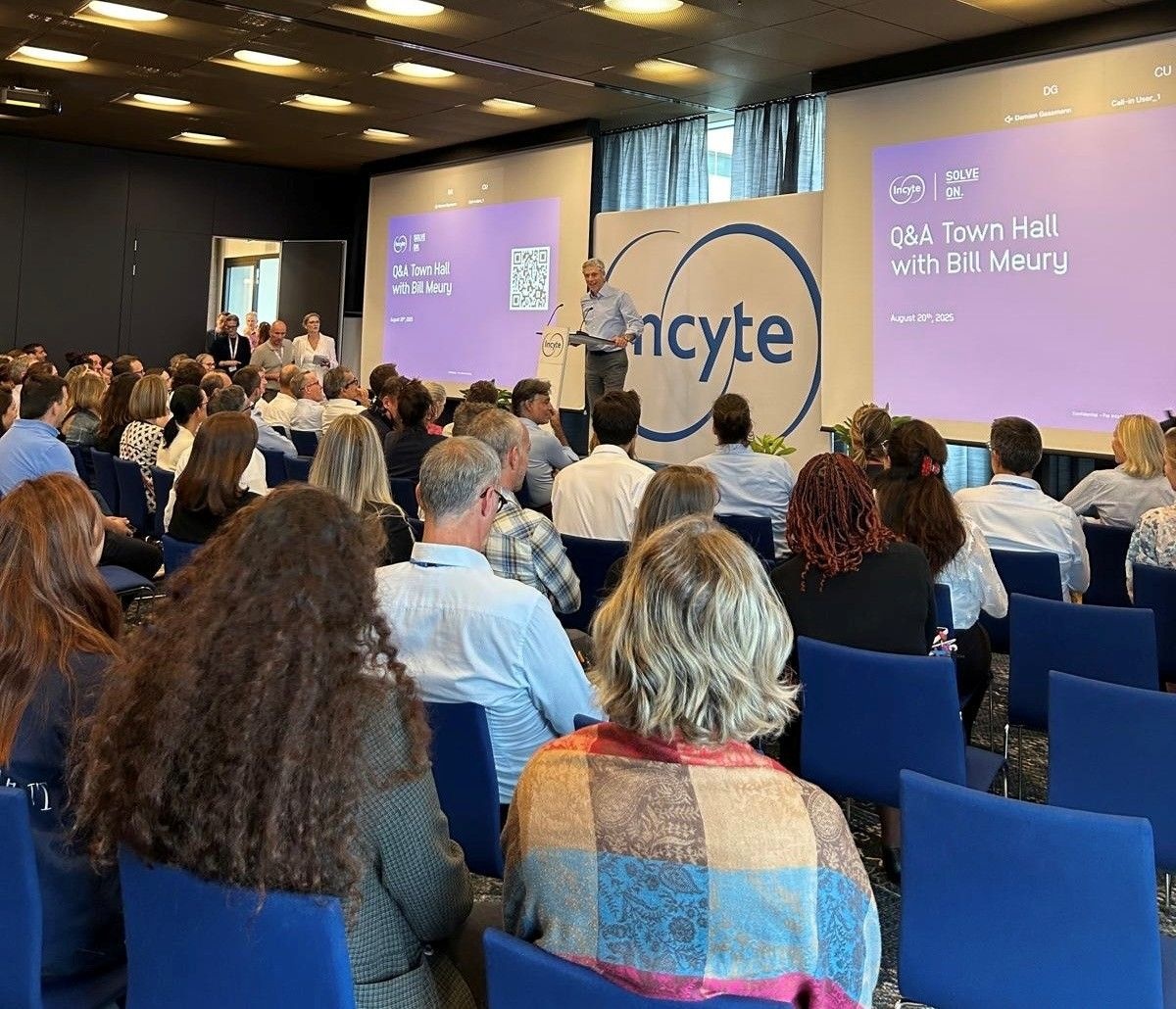
One early glimpse of his working life there came from Switzerland. In August 2025, Meury thanked employees in Morges and Yverdon after a visit. A photograph showed him standing at a lectern before rows of colleagues, with a screen announcing a question-and-answer town hall. The scene is ordinary in the useful sense: a room, a microphone, employees facing their new chief executive.
A later account of a visit to Morges described business reviews, a town hall and an employee barbecue with the international team led by Lee Heeson. Meury identified the international business as important to long-term growth and thanked colleagues for candid discussions. The barbecue is a small detail, but a welcome one in a career otherwise measured in executive titles and acquisition dates. An organization also has to make time for people to meet.
Putting names next to the plan
During his first year, the leadership appointments began to give the Incyte chapter its own shape. Soni Basi joined as chief human resources officer in August 2025, with responsibility for areas including organizational design and professional development. Dave Gardner joined as chief strategy officer, bringing an investment background to strategy and business development. Meury was assembling colleagues around responsibilities that connect people, operations and investment.
In March 2026, Incyte announced expanded leadership roles for Pablo Cagnoni, Steven Stein and Mohamed Issa. Cagnoni became president of Incyte, with responsibilities that included enterprise planning and operational execution. Issa took charge of a combined U.S. commercial organization. The stated purpose included aligning teams, improving execution and standardizing practices. These were changes to how the business would work, as well as to what appeared beneath people's names.
The finance appointment added another piece. Suketu “Suky” Upadhyay became chief financial officer in May 2026, overseeing a remit that included capital allocation, planning, investor relations and accounting. Meury emphasized the incoming executive's investment discipline and objective decision-making. For someone whose own early career included accounting and financial reporting, those responsibilities form a recognizable connection between his first jobs and his current one.
The next dollar, the next conversation
Meury's 2026 shareholder letter set out a framework for judging investments: strategic fit, financial return, risk and opportunity cost. It applied to spending inside the company as well as opportunities outside it. The reasoning asks each proposed use of money to compete with the alternatives. A history of transactions does not, by itself, make another transaction the correct next step.
The same letter described a culture of respect and teamwork, with humility and hard work among its requirements. That language sits comfortably beside his earlier advice about recognizing talent in other organizations. Across different employers and different scales of business, the recurring concern is how to bring people's abilities together without assuming that a senior title supplies every answer.
There is an appealing tension in Meury's career. He has spent long years building experience within a company, and short, consequential periods leading companies into new ownership. At Incyte, those experiences meet in decisions about colleagues, commercial organization and investment. His next chapter will take its shape through those choices. The handshake may earn the photograph. Afterward, someone still has to chair the meeting.