In 1989, Bill McKibben published a book with the sort of title that does not expect to be invited to the beach. The End of Nature explained global warming to ordinary readers before climate change became a daily headline, a corporate promise or a political identity. He was 28. The book traveled into 24 languages. The planet, less obligingly, kept warming.
The awkward fact at the center of McKibben's career is that he had done the writer's job early. He had learned the science, found the human scale and written it plainly. His warning reached people. Yet emissions continued to rise because a lucid paragraph has no vote, no pension fund and no way to sit down in front of a pipeline.
So the quiet magazine writer became a public organizer. It was an ill-fitting promotion by his own account. McKibben still says he is a writer at heart. Given his preference, he would be home typing. History had other ideas, and his life became an experiment in what happens when reporting accepts responsibility for its conclusions.
The warning arrived before the movement
McKibben learned brevity at The New Yorker. After graduating from Harvard in 1982, where he had been president of The Harvard Crimson, he joined the magazine and spent five years writing much of Talk of the Town. Those compact pieces depended on noticing the telling detail. On an assignment about homelessness, he lived for a time on New York's streets. There he met Sue Halpern, then working as a homeless advocate, who would become his wife and a writer in her own right.
When longtime editor William Shawn was pushed out in 1987, McKibben resigned. He and Halpern moved north, first to the Adirondacks and later to Vermont. The distance from Manhattan suited his subject. Climate change was planetary, but he approached it through felt places: snow, seasons, forests and the uneasy recognition that even the idea of untouched nature had been altered by human activity.
Parts per million of atmospheric carbon dioxide: a scientific target turned into a name the whole world could carry.One number / almost no translation required
For years he assumed the accumulation of evidence would trigger political action. More books, more articles, more seminars: surely clarity would eventually win. Then he reached the conclusion that remade his working life. The argument had largely been won; the fight was being lost. One side possessed evidence. The other possessed concentrated money and power.
“I'm a writer at heart, not an activist.”Bill McKibben, describing the career he did not plan
Seven students divided up the planet
The first experiment was local and wonderfully implausible. In 2006, McKibben and students helped lead a five-day walk across Vermont demanding steep carbon cuts. A few thousand people joined by the finish in Burlington. The lesson was less about distance than company: climate had plenty of information and too few bodies in motion.
The following winter, a small crew sat in a Middlebury College cafeteria and devised Step It Up 2007. Their ambition was shameless: actions in all 50 states. More than 1,400 events took place. Skiers descended a shrinking glacier in Montana. Divers carried a banner near a Florida coral reef. Presidential candidates adopted the campaign's emissions target. A cafeteria idea had become a national stage.
The next name was even tighter. Climate scientist James Hansen and colleagues had argued that atmospheric carbon dioxide should be returned below 350 parts per million. McKibben and seven recent Middlebury graduates built 350.org around the number. Seven students, seven continents. Each took one, although the organizer assigned Antarctica also had to handle the internet.
The number traveled well. Organizers could arrange it in people on a beach, paint it on a banner or hold it above a crowd. It required little translation and left room for local leadership. 350.org actions reached every continent, including Antarctica. The architecture was distributed because the problem was global and the original office was small.
The introvert learns the uses of leverage
McKibben's organizing has rarely depended on personal grandeur. His preferred unit is the campaign: a pressure point, a portable phrase and enough people to make refusal visible. The Keystone XL fight turned a proposed pipeline into a test of political will. The fossil-fuel divestment movement asked universities, churches, pension funds and other institutions why their investments contradicted their stated futures.
The language did important work. “Do the Math” compressed a sprawling industry into a carbon budget and the reserves companies intended to burn. Divestment made an atmospheric problem appear on a committee agenda. In McKibben's telling, movements spend a different currency from corporations: numbers, spirit, creativity and the willingness of people to place their bodies in the way.
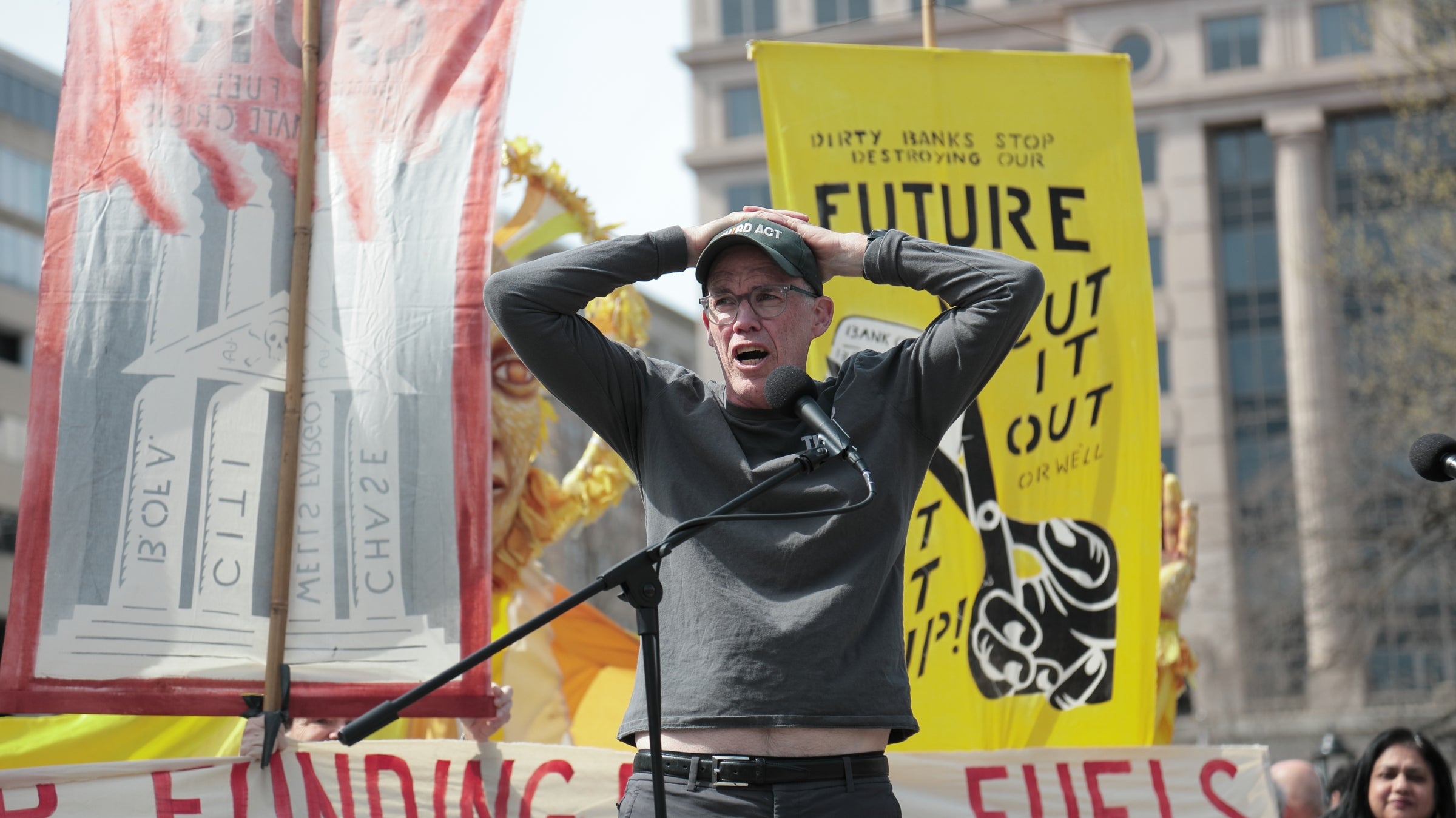
His humor prevents the moral stakes from turning into marble. At a 2023 bank protest, Third Act organizers gathered rocking chairs for a sit-in. McKibben, no longer eager to sprawl on concrete for hours, called it the most comfortable sit-in of all time. Elsewhere, older activists cut oversized wooden credit cards with solar-powered chainsaws. The symbolism was exact; the method had a grin.
Third Act is a beginning disguised as an age
McKibben turned 60 in 2020 and noticed another neglected source of power. Americans over 60 vote reliably, hold a large share of the country's assets and remember movements that changed civil rights, women's rights, war and the environment. Younger climate activists had supplied urgency and leadership. Asking them to solve a crisis they did not cause, largely by themselves, struck him as both unfair and impractical.
He founded Third Act in 2021 to organize older Americans around climate and democracy. The name is theatrical and sly. A third act is where consequences arrive, but also where earlier details acquire purpose. The group now says it has more than 70,000 members. Their leverage is deliberately age-specific: votes, bank accounts, institutional memory, practiced skills and time.
Third Act also makes the intergenerational bargain visible. At one march, teenagers moved quickly at the front while older protesters followed with a banner reading “Fossils Against Fossil Fuels.” The joke worked because the solidarity underneath it was serious. Youth brought the moral claim. Their elders brought forms of structural power that arrive only with time.
Then the price curve bent toward the light
For most of McKibben's public life, the technical answer to climate change was available but expensive enough to be treated as an ethical upgrade. That changed. From 2010 to 2024, the global average cost of electricity from new utility-scale solar photovoltaics fell by 90 percent. In 2024, 91 percent of newly commissioned utility-scale renewable capacity produced electricity more cheaply than the least expensive new fossil-fuel alternative.
This is the turn behind his 2025 book Here Comes the Sun. McKibben's favorite comparison is retail: people once treated wind and solar as the Whole Foods of energy, virtuous but pricey. Now, he says, they are Costco - available in bulk and sitting on the shelf. The joke has numbers underneath it. Solar was the largest contributor to growth in global energy supply in 2025, the first time a modern renewable source led that increase.
“Energy from heaven, not from hell.”A moral phrase for a material shift
The new optimism is constrained, which is why it sounds like McKibben. He calls himself a hard realist. Global warming will not be erased; the task is to stop it from becoming far more destructive. Cheap panels do not dissolve permitting fights, grid bottlenecks, financing gaps or fossil-fuel political power. They do change what is possible within the narrow window he has spent decades describing.
At his Vermont home in January 2026, he demonstrated his fourth iteration of solar panels, including plug-in panels of the kind that can hang from a balcony. It was a fitting domestic scene. After years of talking in planetary units, here was the proposition reduced to an appliance: point a sheet of glass at the sky and make electricity.
A newsletter with an expiration date
McKibben began The Crucial Years in 2021 with a defined horizon: the decade through 2030. In August 2026, at its fifth anniversary, he counted more than 300 editions. The newsletter is part briefing, part correspondence and part running argument about what a flood of climate and energy news actually means. The clock in its title is intentional.
The form returns him to his first craft. Each installment gathers telling developments, introduces the analysts and organizers doing useful work, and supplies a frame. His campaigns have always depended on this kind of compression. 350 was a scientific finding made portable. Third Act turned an age group into a source of agency. Sun Day gave a technology a public holiday.
There is a woodland gnat named Megophthalmidia mckibbeni, a biological footnote bestowed in 2014. It is the sort of honor that suits a writer with a comic novel about Vermont secession among his books. The more consequential legacy is less tidy: readers who became organizers, students who became movement leaders, institutions that reconsidered their money, and older people who discovered that the closing act still contains entrances.
McKibben's career has not traveled from pessimism to optimism. It has traveled from information to power, and lately from scarcity to possibility. The alarm is still ringing. He has simply noticed that a door stands beside it, getting cheaper by the year, and sunlight is pouring through.