The list begins with hair salons. Then come home builders, YMCAs, places of worship, auto dealers, hotels and universities. When Bill Foster explained community banking in the unsettled months of 2023, he reached for the businesses and institutions people pass on the way to somewhere else. His description of a bank began outside the bank.
There was a reason for the explanation. Foster had become TowneBank’s president and chief executive officer on January 1. That March, several prominent American banks failed, leaving other bankers answering questions they had not expected to spend the year answering. A new chief executive’s calendar rarely arrives empty. His had acquired a national banking scare.
Writing that September, he put his case plainly: the institution he ran belonged to the same everyday economy as its depositors. “The best part about our business is that our members are our friends.” It was an unusually social way to describe a balance sheet. It also set a standard against which the next chapter of his career could be judged.
The Norfolk assignment
Foster’s formal name is William I. Foster III; TowneBank calls him Billy, while his LinkedIn profile uses Bill. Before the CEO title came a series of jobs attached to specific places. He joined TowneBank in 2004 as a regional president charged with leading its expansion into Norfolk. The institution had opened in 1999. He arrived while its own history was still relatively short.
His education was rooted in Virginia: a business administration degree with an accounting major from Old Dominion University, followed by an MBA from William & Mary. Before joining TowneBank, he had served as Eastern Region President of Central Fidelity Bank. The Norfolk assignment brought an experienced regional banker into a younger institution trying to establish itself in another community.
He served as Norfolk president from 2005 to 2011, then Virginia Beach president from 2011 to 2018. Commercial and real estate banking followed, from 2018 to 2020. From 2020 through 2022, he was president for Central Virginia and the Carolinas. Read the sequence aloud and it sounds like a set of driving directions. It was also a gradual enlargement of responsibility.
- 2004Joins for Norfolk expansion
- 2011Virginia Beach president
- 2018Commercial & real estate banking
- 2020Central Virginia & the Carolinas
- 2023President & CEO
The commercial banking appointment had a practical brief: develop the lending teams, pursue quality loan growth across Virginia and North Carolina, and direct market presidents’ attention to lending and relationships. Growth came with an adjective, quality. The distinction matters in a business where writing a loan and being repaid are separated by time, circumstance and the borrower’s fortunes.
His selection as CEO followed a months-long board process led by a special committee. He succeeded J. Morgan Davis as chief executive and Brad Schwartz as president, bringing two responsibilities together. In 2023 he became TowneBank’s third CEO, after founder Bob Aston and Davis. This was succession inside an existing culture, with its founder continuing as executive chairman.
In 2023, Foster and his wife, Beth, were living in Virginia Beach and had three grown children. The family detail places him in the same region as two of his longest TowneBank assignments. His route to the top job had involved responsibilities across a widening territory while retaining a documented home base in Hampton Roads.
A first year of answering questions
The failures of 2023 gave Foster an early occasion to explain that culture in public. In his guest column, he described the differences between banks with concentrated, unusual customer bases and institutions serving a broad collection of local businesses. His examples were deliberately recognizable. Readers did not need an industry glossary to picture a hair salon or a local builder.
He acknowledged that trouble at one institution reverberates through the industry. The argument was therefore partly about communication: people needed an explanation of what kind of bank held their money. Familiarity became a way to make the business legible. A depositor might never meet a bank’s securities portfolio. They could recognize the businesses in Foster’s account of its community.
“The best part about our business is that our members are our friends.”
Billy Foster · September 2023
That same year, TowneBank appointed Ernest Piccioli as chief risk officer. Foster emphasized the value of his experience managing risk at a large institution. The pairing is instructive: the personable explanation of banking sat alongside a formal investment in oversight. A friendly conversation across a desk still requires people elsewhere in the organization asking difficult questions.
There is a useful tension here. Local knowledge can tell a banker things that a distant office may miss. An institution also needs rules that apply when confidence in a familiar borrower proves misplaced. Foster’s background runs through retail, commercial and industrial, and commercial real estate banking. Those responsibilities place relationships and financial judgment in the same room.
Four people and a golf tournament
Another view of Foster’s working world comes from a photograph taken around the 2024 TowneBank Foundation golf tournament. He stands with tournament co-chairs Andy Rivenbark and John Fruit, and executive chairman Bob Aston. The occasion produced $212,000 for the foundation. Golf has an agreeable talent for turning a day away from the desk into an item on the business calendar.
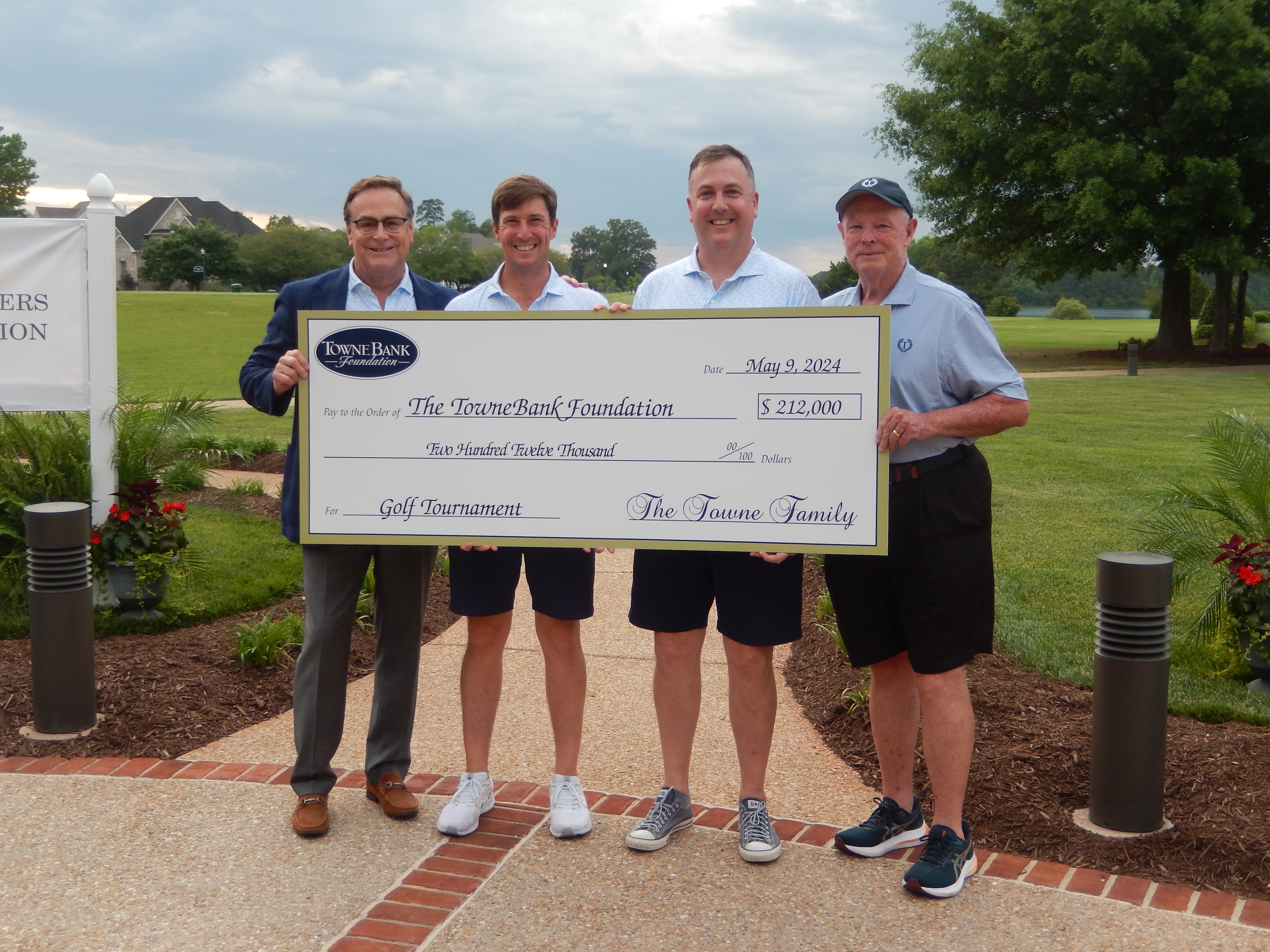
The fundraising total since the first outing in 2001 had passed $2 million. The foundation described grants and donations reaching more than 200 organizations annually. These are collective efforts involving organizers, sponsors and participants; the photograph places Foster among them. It shows one of the recurring settings in which a community bank meets the community it talks about.
His public commitments also extend to the people working inside the bank. On TowneBank’s careers page, he says: “We are committed to creating a workplace that people want to join and where our employees enjoy a rewarding career.” It is a concrete ambition for an employer whose service depends heavily on whether experienced employees stay, learn and build relationships over time.
In September 2024, Foster appeared with Will Morrison on the business podcast Chatter with BNC. Both are Old Dominion graduates. Morrison leads Towne Financial Services Group; Foster leads the bank. Their joint appearance reflected the breadth of the organization, with mortgage, insurance, real estate and wealth services alongside banking. A conversation about the company could quickly require more than one executive.
The meeting before the merger
By June 2025, another conversation was taking place at TowneBank headquarters. Steve Jones, then CEO of Raleigh-based Dogwood State Bank, met Aston, Foster and chief financial officer Bill Littreal on June 12. They discussed the banking climate, their respective businesses and whether a combination deserved serious consideration. Before a transaction became a headline, four executives had to decide whether to keep talking.
They did. Jones returned on July 1. The discussion moved into financial considerations, the future management team, branch locations and opportunities to combine operations. The parties agreed to proceed toward due diligence and a written offer. That progression supplies a less theatrical picture of an acquisition: a first meeting, another meeting, advisers, documents and a great deal of checking.
The merger closed on January 12, 2026, after its August 2025 announcement. It strengthened TowneBank’s position across North Carolina and extended its reach into additional South Carolina markets, with a Tennessee location also joining through Dogwood. Foster singled out the acquired bank’s experienced SBA lending team as a way to expand small-business lending capabilities.
Jones became TowneBank’s president of the Carolinas and joined its corporate management group. This detail matters to the story of Foster’s expansion: the transaction brought another senior banker into the leadership team. Customers and lending expertise travelled with the acquired institution. A map of new offices describes only part of what changed hands.
The legal combination preceded the change of systems and the TowneBank name at Dogwood locations.
A larger map, a familiar banker
At the 2025 annual meeting, Foster had already drawn shareholders’ attention toward Richmond, Central Virginia and North Carolina cities including Greenville, Greensboro, Raleigh-Cary and Charlotte. He pointed to university traditions and local talent in these markets. The future he described involved taking the bank’s existing approach into communities with their own institutions and business networks.
Village Bank joined in April 2025, followed by Old Point in September. When discussing Village, Foster emphasized shared attitudes toward customers and the prospect of a familiar feeling for its employees and clients. Across these combinations, the recurring promise was continuity of service within a larger company. The acquisitions put that promise into repeated practice.
Recruitment was another part of the expansion. In July 2026, Foster said TowneBank had added 24 experienced bankers across the Carolinas since the beginning of the year. The additions included market executives, private and commercial bankers, and treasury sales officers. The specific jobs explain how a regional strategy becomes something a customer can use: people handling businesses, accounts and day-to-day financial needs.
By late October, Dogwood customers were approaching a different kind of milestone. Their locations were scheduled to open as TowneBank on November 2, with systems and services transitioning. The customer guide put a short assurance near the top: “Your banker remains your banker.” Behind the merger’s geographic reach was a question that could be answered with a name and a familiar face.
That is where Foster’s career returns to its starting assignment. In 2004, he was helping TowneBank enter Norfolk. As CEO, he oversees an institution entering and enlarging its presence in many more communities. The work now includes acquisitions, integration and recruitment across a wider territory. The human test remains close to the counter: whether the person seeking help still knows whom to ask.